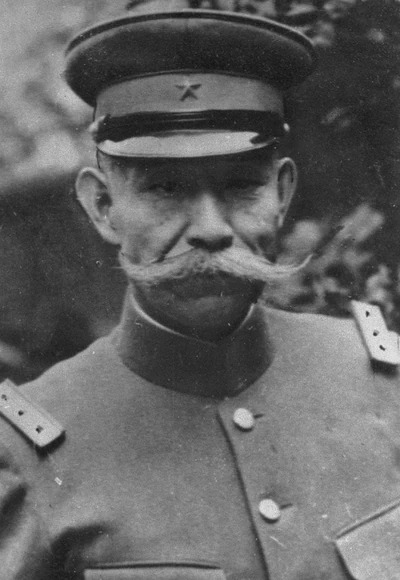
Senjūrō Hayashi
| Name | Senjūrō Hayashi |
| Title | Japanese politician and general (1876–1943) |
| Gender | Male |
| Birthday | 1876-02-23 |
| nationality | Japan |
| Source | https://www.wikidata.org/wiki/Q351665 |
| pptrace | View Family Tree |
| LastUpdate | 2025-11-17T10:08:49.148Z |
Family Tree
Tap  to expand more relatives
Introduction
Senjūrō Hayashi (林 銑十郎, Hayashi Senjūrō) was born on 23 February 1876 in Kodatsuno, Kanazawa, Ishikawa Prefecture, Japan. He was the eldest son of Hayashi Shishirō, who served as secretary of the Tonami District Office, and his wife Bessho Saha. The Hayashi family belonged to the samurai class, formerly serving the Kaga Domain. Hayashi had at least two brothers: Hayashi Ryōzō, who became an Imperial Army Colonel, and Shirakawa Yūkichi, who served as Vice Mayor of Tokyo.
He dropped out of school in July 1894 to enlist in the Imperial Japanese Army during the First Sino-Japanese War. After the war, he attended the Imperial Japanese Army Academy, graduating in June 1897. Upon graduation, he was assigned to the IJA 7th Infantry Regiment. In 1903, he graduated from the Army Staff College and participated in the Russo-Japanese War, notably during the Siege of Port Arthur.
Hayashi's military career included command positions such as commanding officer of the IJA 57th Infantry Regiment from 1918 to 1920. He served in various roles, including a position at the Technical Research Headquarters and as an acting Military Investigator in 1921. Between 1921 and 1923, he was the head of the Preparatory Course at the Imperial Japanese Army Academy. He also worked with the Inspectorate General of Military Training and was the Japanese Army Representative to the League of Nations from 1923 to 1924.
In subsequent years, Hayashi held several significant positions: commanding officer of the IJA 2nd Infantry Brigade in 1925, Commandant of the Tokyo Bay Fortress in 1926, and Commandant of the Army War College in 1927. He was Deputy Inspector-General of Military Training in 1928 and became General Officer Commanding of the Imperial Guards Division in 1929.
In 1930, Hayashi was appointed Commander in Chief of the Japanese Korean Army. Following the Mukden Incident on 19 September 1931, he ordered the IJA 20th Division to split its forces to form the 39th Mixed Brigade and, acting without prior authorization from the Emperor or Central Government, ordered this brigade across the Yalu River into Manchuria. The national government later authorized the movement on 22 September 1931. After his service in Korea, Hayashi served as Inspector General of Military Training and was a member of the Supreme War Council from 1932 to 1934. He received the Order of the Sacred Treasure (1st class) in 1932 and the Order of the Rising Sun (1st class) in 1934.
Transitioning to political roles, Hayashi served as Army Minister from 1934 to 1935 and again was a member of the Supreme War Council until his retirement in 1936. During his time as Army Minister, he supported Major General Tetsuzan Nagata, leader of the Tōseiha faction within the Imperial Japanese Army. Although the Tōseiha faction achieved some victories, including the removal of a Kōdōha faction leader, Nagata was assassinated in 1935.
Hayashi also promoted Fumimaro Konoe's political doctrines, aligning himself as a "right-winger" among militarists, and opposed radical militarists led by Kingoro Hashimoto who aimed to establish a military-led dictatorial regime.
In 1937, Hayashi briefly served as Prime Minister of Japan for approximately four months. During his premiership, he sought to establish a cabinet that transcended factional divisions and demanded cabinet members renounce party allegiances.
From 1940 to 1941, he served as a Privy Councillor. Additionally, Hayashi was president of the Greater Japan Muslim League (大日本回教協会, Dai Nihon Kaikyō Kyōkai). He suffered an intracranial hemorrhage in January 1943 and died at his residence on 4 February 1943, without regaining consciousness.
Posthumously, he was awarded the Order of the Golden Kite (4th class) and the Order of the Paulownia Flowers. His honors include the Grand Cordon of the Order of the Sacred Treasure (1932), the Grand Cordon of the Order of the Rising Sun (1934), and the Grand Cordon of the Order of the Rising Sun with Paulownia Flowers (1943, posthumously).