Joseph Emory Davis
| Name | Joseph Emory Davis |
| Title | American lawyer |
| Gender | Male |
| Birthday | 1784-12-10 |
| nationality | — |
| Source | https://www.wikidata.org/wiki/Q16065635 |
| pptrace | View Family Tree |
| LastUpdate | 2025-11-16T10:09:57.422Z |
Family Tree
Tap  to expand more relatives
Introduction
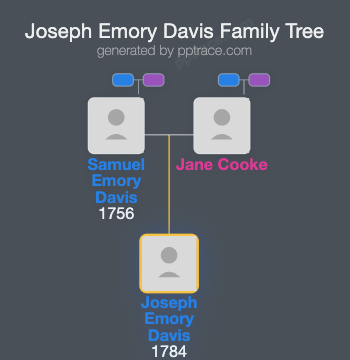
Joseph Emory Davis was born on December 10, 1784, near Augusta, Georgia. He was the eldest of ten children born to Samuel Emory Davis and Jane (Cook) Davis. His paternal grandfather was Evan Davis of Cardiff, Glamorgan, Wales, and his maternal grandparents were William Cook and Sarah (Simpson) Cook. The Davis family was engaged in farming in Georgia until 1793, when they moved to Kentucky in pursuit of more promising land opportunities. In Kentucky, four additional daughters were born to the family, and Jefferson Davis, the youngest son, was born in 1808. Joseph Davis was 23 years older than Jefferson Davis.
At a young age, Joseph Davis began working in a mercantile house and studied law in Russellville and Wilkinson County, Mississippi. In 1811, he accompanied his father to explore the Mississippi territory. He was admitted to the bar in 1812, beginning his legal practice in Pinckneyville, Mississippi, and later in Greenville. In 1817, Davis served as a delegate from Jefferson County to Mississippi’s constitutional convention. By 1820, he moved to Natchez, Mississippi, where he established a law partnership with Thomas B. Reed, a leading figure in the Mississippi legal community.
Davis fathered three illegitimate daughters between 1811 and 1823; he acknowledged these daughters publicly, supported their education, and brought them into his household temporarily. Their names were Florida Ann Davis (b. 1811), Mary Lucinda Davis (b. 1816), and Caroline Davis (b. circa 1823). In 1827, at age 43, Davis married Eliza Van Benthuysen, who was 16 years old at the time. This marriage marked his transition from law to plantation management. Davis also adopted two children: Joseph D. Nicholson, the infant son of Mrs. Jane Nicholson, and Martha Quarles, daughter of John Quarles and granddaughter of Martha Brooks Wallace.
In the late 1820s, Davis began acquiring land for plantation development. He purchased a significant tract on a peninsula south of Vicksburg, which later became known as Davis Bend. By 1860, his Hurricane Plantation encompassed 5,000 acres along the Mississippi River, with a mansion built starting in 1835—an elaborate three-story brick structure. He owned a substantial library and maintained an estate regarded as one of the finest along the Mississippi. Davis’s plantation produced cotton along with other crops and livestock, including cattle and sheep, creating a largely self-sufficient estate.
Davis owned 365 slaves in 1860, making him one of nine planters in Mississippi holding more than 300 slaves. His plantation operated on a paternalistic model, emphasizing improved living conditions and greater autonomy for enslaved people, including the establishment of a plantation court with a slave jury system and the appointment of Ben Montgomery, a slave, as overseer and store manager.
During the American Civil War, Davis evacuated his family and many slaves from Davis Bend in 1863 to Tuscaloosa, Alabama. His wife Eliza died in 1864; they had no children together. Later, Union General Ulysses S. Grant authorized the lease of land to freedmen and allowed black refugees to settle in the area. In 1865, Montgomery managed the sale of cotton produced at Davis Bend, generating around $160,000. The freedmen community at Davis Bend faced internal conflicts, as did societal relations during the post-emancipation period.
Following the war, Davis returned to Vicksburg and secured a presidential pardon from Andrew Johnson after his lands had been confiscated. He subsequently regained possession of his property from the Freedmen’s Bureau, which managed refugee settlements and confiscated land. A flooding event in 1867 altered the geography of Davis Bend, transforming it into Davis Island. Davis arranged a mortgage with Montgomery, selling him the plantation with a long-term note, and supported a community of freedmen until it declined in the 1880s when Isaiah Montgomery moved the residents to establish Mound Bayou, Mississippi.
Joseph Emory Davis resided in Vicksburg in his final years. He lived at a residence known as Anchuca from 1868 until his death. He passed away on September 18, 1870.