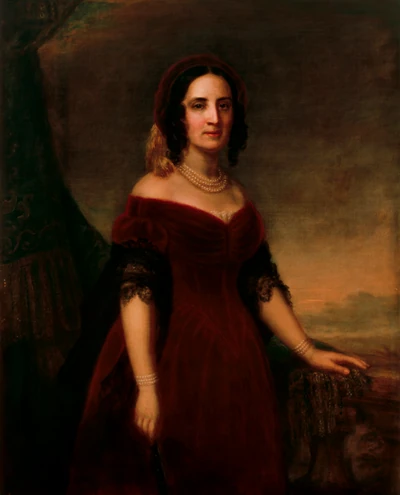
Sarah Childress Polk
| Name | Sarah Childress Polk |
| Title | First Lady of the United States from 1845 to 1849 |
| Gender | Female |
| Birthday | 1803-09-04 |
| nationality | United States of America |
| Source | https://www.wikidata.org/wiki/Q234285 |
| pptrace | View Family Tree |
| LastUpdate | 2025-11-17T06:39:13.081Z |
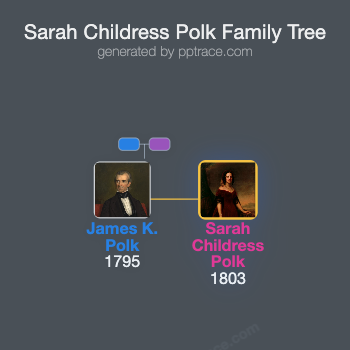
Family Tree
Tap  to expand more relatives
Introduction
Sarah Childress Polk was born on September 4, 1803, in Raleigh, North Carolina, to Elizabeth Whitsitt and Joel Childress. Her father was a prominent planter, merchant, and land speculator, and she was the third of six children in her family. She received a comprehensive education for a woman of her time, attending Salem Academy in Winston-Salem, North Carolina, in 1817, an institution known for its selectivity and higher education for women in the early 19th century.
Sarah Childress met James K. Polk, who would become the 11th President of the United States, during her early years of education at Samuel P. Black's residence in Murfreesboro, Tennessee. Polk was 19 years old, and she was 12. Their relationship developed over time, and they became engaged in 1823. The engagement was reportedly supported by Andrew Jackson, who characterized Sarah as "wealthy, pretty, ambitious, and intelligent," and encouraged Polk to marry her.
Sarah Childress married James K. Polk on January 1, 1824, at her parents' plantation home near Murfreesboro, Tennessee. James Polk was 28 years old at the time, while Sarah was 20. Their marriage lasted for 25 years and did not produce biological children, a circumstance often attributed to Polk's history of bladder stone surgery, which is believed to have rendered him sterile. The couple did, however, raise Polk's nephew, Marshall Tate Polk (1831–1884), for several years before sending him to school in Washington, D.C., and Georgetown University. After James Polk’s death in 1849, Sarah fostered her grand-niece, Sarah Polk Fall (1847–1924).
During James K. Polk’s political career, Sarah actively supported and advised her husband. She assisted with speechwriting, guided policy discussions, and managed social and political engagements. She often accompanied him to Washington during his congressional terms, engaged in correspondence with national leaders, and wrote support for his presidential campaign. Her writings included advocacy for expansionism and the manifest destiny ideology, supporting U.S. territorial growth.
Sarah Polk was known for her social skills and maintained a reputation for being well-informed and discreet. She was a religious woman who declined to participate in dancing, horse racing, or theater, and she styled her public persona around modesty and integrity. During her husband's presidency from 1845 to 1849, she served as First Lady. She upheld a conservative and sober atmosphere at the White House, eschewing alcohol, dancing, and card games at official events. Her approach earned her the nickname "Sahara Sarah." She also engaged in political correspondence, including writings for a local newspaper.
Following her husband's presidency, the Polk family moved to Polk Place in Nashville, Tennessee. James Polk died of cholera three months after leaving office, at age 53. Sarah remained a widow for 42 years, the longest widowhood of any U.S. First Lady until that time. She lived at Polk Place, which she inherited from her husband, until its demolition in 1901. During her widowhood, she experienced financial difficulty, which she alleviated through inheritance from her plantation and ongoing support from her brother, John Childress. From 1884 until her death, she received a pension of $5,000 annually from the U.S. government.
Throughout the Civil War, Sarah remained officially neutral but expressed sentiments supportive of the Union, while also acknowledging Southern sympathies during visits from Confederate generals to Nashville. She was a lifelong resident of Nashville, often visiting her brother at the Childress-Ray House in Murfreesboro and maintaining close relationships with friends such as Adelicia Acklen.
Sarah Polk died on August 14, 1891, at the age of 87. She was initially buried beside her husband at their home in Nashville, but following the demolition of Polk Place in 1901, her remains were reinterred with James Polk at the Tennessee State Capitol. Her estate, including Polk Place, was bequeathed to her grand-niece, Sarah Polk Fall.