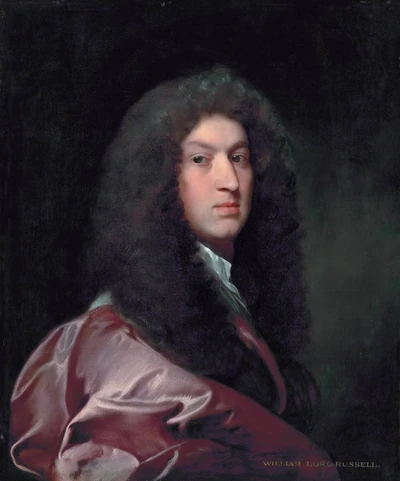
William Russell, Lord Russell
| Name | William Russell, Lord Russell |
| Title | English politician executed for treason (1639-1683) |
| Gender | Male |
| Birthday | 1639-09-29 |
| nationality | Kingdom of England |
| Source | https://www.wikidata.org/wiki/Q332923 |
| pptrace | View Family Tree |
| LastUpdate | 2025-11-26T23:21:32.387Z |
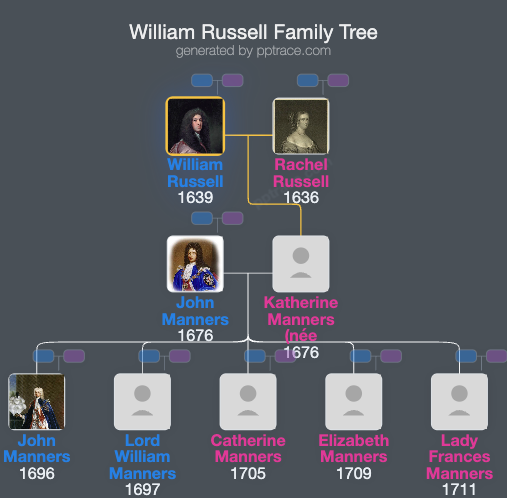
Family Tree
Tap  to expand more relatives
Introduction
William Russell, Lord Russell (29 September 1639 – 21 July 1683), was an English politician associated with the Country Party, which was a precursor to the Whig Party. His political activity occurred during the reign of Charles II of England, focusing on opposition to Catholic influence and the policies of the king's advisors.
Born as Honorable William Russell, he was the third son of William Russell, 5th Earl of Bedford, who was later created Duke of Bedford, and Lady Anne Carr. Following the death of his elder brother Francis, William gained the courtesy title of Baron Russell, commonly referred to as Lord Russell. In 1654, William and Francis were students at Cambridge University. Subsequently, they traveled abroad, visiting Lyon and Geneva, and resided for a time at Augsburg. During their travels, William provided a vivid account of his experiences. By 1658, he and his brother had reached Paris and returned to Woburn Abbey near Woburn by December 1659. At the restoration of the monarchy in 1660, Charles II ascended to the throne, and Russell was elected Member of Parliament for Tavistock, a seat traditionally held by his family.
In his early years, Russell appears to have maintained a low profile in public affairs, engaging in court intrigue but not speaking in Parliament until 1674. He was involved in two duels in 1663 and 1664, with wounds sustained in the second. At age 30, in 1669, he married Lady Vaughn, a widow, establishing connections with the Earl of Shaftesbury, who had married her cousin. Their marriage was described as close and affectionate.
Russell became more active in political matters with the formation of the Country Party, which opposed the policies of the Cabal Ministry and the perceived Franco-Catholic influence. He was known for his strong opposition to Roman Catholicism and his advocacy for Protestant Dissenters. His parliamentary debut was on 22 January 1674, where he criticized the government’s financial and military policies, and supported proceedings against the Duke of Buckingham. Over subsequent years, Russell took a leading role in debates concerning royal policies. He moved for the removal and impeachment of the Earl of Danby in 1675, and in 1677, called for the dissolution of Parliament and supported a declaration of war against France in 1678.
During this period, Russell engaged in close communication with the Marquis de Ruvigny, a relative of Lady Russell, who brought funds to England, though Russell reportedly refused to accept French payments, according to Barillon’s testimony. The political climate was influenced by anti-Catholic fears, notably the "Popish Plot" of 1678, which alleged a conspiracy to assassinate King Charles II and facilitate the Catholic Duke of York's succession. Russell aligned with factions supporting James Scott, the Duke of Monmouth, as a Protestant alternative for the throne, a move recognized as a political mistake.
In November 1678, Russell proposed an address to the king to exclude James from the line of succession. Despite parliamentary dissolution and subsequent elections, Russell was re-elected as MP for Bedfordshire in 1679. He became a member of the new Privy Council ministry in April 1679, supporting measures to prevent a Catholic succession and advocating for religious and political securities. Throughout 1680 and 1681, Russell actively opposed perceived popish influences, introducing legislation aimed at excluding James from the throne. He also participated in efforts to resist royal indulgences for Roman Catholics.
Following the dissolution of Parliament, Russell retired to his estate in Hampshire. He was involved in discussions related to the Rye House Plot of 1683, a conspiracy aimed at assassinating Charles II and his brother James. This plot was uncovered; Russell was accused of conspiring to raise an insurrection and was arrested at the Tower of London on 26 June 1683. Despite some of his associates offering to return to England to face trial, Russell refused to escape to the Netherlands. He was found guilty of treason and sentenced to death; his sentence was later commuted by the king to execution. William Russell was executed on 21 July 1683.