Shinzō Abe
| Name | Shinzō Abe |
| Title | Prime Minister of Japan from 2006–2007 and 2012–2020 (1954-2022) |
| Gender | Male |
| Birthday | 1954-09-21 |
| nationality | Japan |
| Source | https://www.wikidata.org/wiki/Q132345 |
| pptrace | View Family Tree |
| LastUpdate | 2025-11-17T06:46:30.444Z |
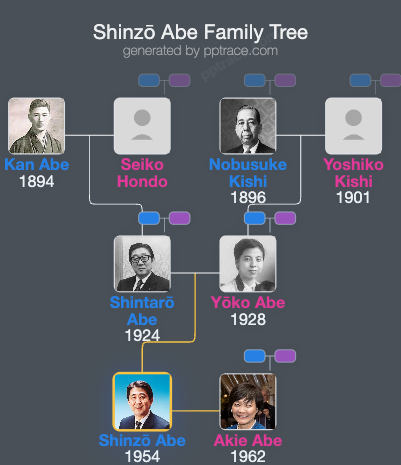
Family Tree
Tap  to expand more relatives
Introduction
Shinzo Abe was a Japanese politician born on September 21, 1954, in Tokyo, Japan. He died on July 8, 2022. Abe was a member of a prominent political family; his father was Shintaro Abe, who served in the House of Representatives from 1958 to 1991 and held roles including Chief Cabinet Secretary, Minister for International Trade and Industry, and Minister for Foreign Affairs. His maternal grandfather was Nobusuke Kishi, who served as Prime Minister of Japan from 1957 to 1960 and previously held various government positions during the wartime period, including Vice Minister of Munitions in the cabinet of Prime Minister Hideki Tojo.
Abe's early education took place at Seikei Elementary School, followed by Seikei Junior and Senior High School. He graduated from Seikei University in 1977 with a bachelor's degree in political science, majoring in public administration. Between 1978 and 1979, Abe studied abroad at the University of Southern California, where he took courses in history, international relations, and political science. After his studies, he worked briefly for Kobe Steel from 1979 to 1982 before entering government service.
He worked as an executive assistant to the Minister for Foreign Affairs, a private secretary to the chairperson of the Liberal Democratic Party (LDP) General Council, and a private secretary to the LDP secretary-general. Abe also served as a secretary for his father during his diplomatic visits to 81 countries in the 1980s. Following the death of his father in 1991, Abe was elected to the House of Representatives in 1993 representing the first district of Yamaguchi Prefecture. He was affiliated with the Seiwa Seisaku Kenkyūkai faction within the LDP.
In the early 2000s, Abe held roles such as Director of the LDP Social Affairs Division and Deputy Chief Cabinet Secretary under Prime Ministers Yoshirō Mori and Junichiro Koizumi. Notably, he was involved in negotiations concerning Japanese abductees in North Korea, including accompanying Koizumi in 2002 to meet North Korean leader Kim Jong Il.
Abe became the President of the LDP on September 20, 2006, and was elected Prime Minister of Japan the following day. At age 52, he was the youngest post-war Japanese prime minister and the first born after World War II. His initial term lasted until September 2007. During this period, his cabinet emphasized foreign policy and national security issues, with significant focus on revising Japan's pacifist constitution. He reshuffled his cabinet in August 2007, aiming to organize the Prime Minister's Office more like the White House.
Abe returned to power after a political comeback in 2012, winning the LDP leadership and leading the party to a landslide victory in the general election. He served as Prime Minister until 2020, becoming Japan's longest-serving prime minister, with his tenure marked by economic, security, and constitutional policies. His economic initiatives, termed "Abenomics," aimed to revive Japan's economy, with mixed results. He also reinstated the Trans-Pacific Partnership in 2018 and implemented military reforms in 2015 that enabled the deployment of Japan Self-Defense Forces overseas, which drew domestic controversy.
Abe was re-elected during the 2014 and 2017 elections. His resignation in 2020 was attributed to health issues, and he was succeeded by Yoshihide Suga. On July 8, 2022, Abe was assassinated in Nara while giving a campaign speech related to the upper house elections. The assassin, identified as Tetsuya Yamagami, stated his motive was connected to Abe’s ties with the Unification Church.
Throughout his career, Abe was a controversial figure, known for his nationalist viewpoints and efforts to revise historical narratives. Supporters argued that he strengthened Japan's security and international standing, while critics accused his policies of threatening pacifism and damaging relations with neighboring countries such as China and South Korea.