Nathan Mayer Rothschild
| Name | Nathan Mayer Rothschild |
| Title | German-born British financier (1777–1836) |
| Gender | Male |
| Birthday | 1777-09-16 |
| nationality | United Kingdom of Great Britain and Ireland |
| Source | https://www.wikidata.org/wiki/Q547291 |
| pptrace | View Family Tree |
| LastUpdate | 2025-11-26T23:30:58.584Z |
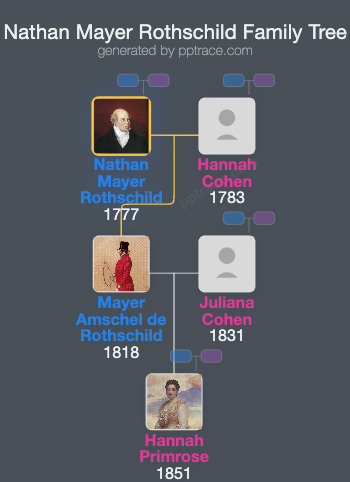
Family Tree
Tap  to expand more relatives
Introduction
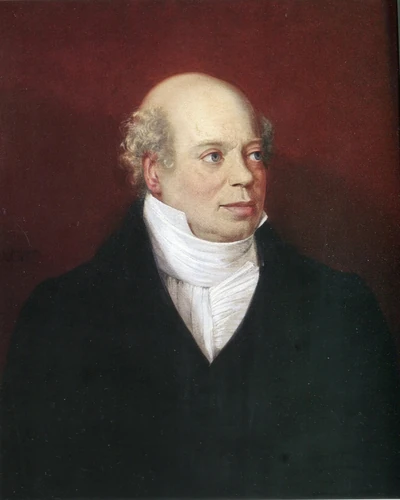
Nathan Mayer Rothschild (16 September 1777 – 28 July 1836), also known as Baron Nathan Mayer Rothschild, was a banker, businessman, and financier of German and British nationality. He was born in Frankfurt am Main, within the Holy Roman Empire (present-day Germany), and was a member of the prominent Rothschild family of Ashkenazi Jewish descent. His parents were Mayer Amschel Rothschild and Guttle (née Schnapper). He was the third of five brothers who later expanded the family’s banking interests across Europe; his siblings were Amschel Mayer Rothschild, Salomon Mayer Rothschild, Carl Mayer Rothschild, and James Mayer Rothschild. The family also included five sisters, notably Henriette Rothschild, who married Abraham Montefiore.
In 1798, at the age of 21, Nathan Rothschild moved to Manchester, England, where he established a business involved in textile trade and finance. Subsequently, he relocated to London and began dealing on the London Stock Exchange from 1804. His banking enterprise, initiated in 1805, traded in financial instruments such as foreign bills and government securities. Rothschild became a member of the Emulation Lodge, No. 21, of the Premier Grand Lodge of England, joining on 24 October 1802.
From 1809, Rothschild expanded his business into gold bullion trading, which became a foundational aspect of N. M. Rothschild & Sons. In 1811, he began negotiating with Commissary-General John Charles Herries to transfer funds for the payment of Wellington’s troops deployed in Portugal and Spain during the Napoleonic Wars. These operations included disbursing subsidies to British allies following Napoleon’s Russian campaign.
Throughout the 1840s, Rothschild and other financiers faced accusations from French socialists regarding their profitability from the Napoleonic Wars, including claims—later disputed—about Rothschild’s alleged early knowledge of the Battle of Waterloo. A 19th-century work by Georges Marie Mathieu-Dairnvaell, published under the pseudonym "Satan," claimed that Rothschild had used advance intelligence to speculate profitably on the London Stock Exchange during Waterloo, though modern historians such as Niall Ferguson suggest that while Rothschild's couriers may have obtained news first, the financial gains were realized over a more extended period and were based on a broader set of strategies.
In 1816, Rothschild’s brothers were ennobled by the Emperor of Austria, acquiring the title of Freiherr (Baron), and receiving the style "von Rothschild." Nathan Meyer Rothschild was granted the same title in 1822, along with his brothers, making him a Baron in the Austrian nobility. He generally did not adopt the title for official use in England; however, Queen Victoria authorized the use of the Austrian title in the United Kingdom in 1838, two years after his death.
Rothschild played a significant role in government securities, arranging a £5 million loan to Prussia in 1818 and providing substantial funds to support the Bank of England during liquidity crises in the 1820s. In addition, he co-founded the Alliance Assurance Company in 1824 with his brother-in-law Sir Moses Montefiore, which later merged to form Sun Alliance.
During the period following the Slavery Abolition Act 1833 and the Slave Compensation Act 1837, Rothschild, along with Montefiore, loaned the British government £15 million to compensate slave owners for enslaved individuals; this loan was ultimately paid off by British taxpayers. Rothschild was identified as a beneficiary under the slave compensation scheme, having received a payment of £2,571 (approximately £308,196 in 2023) for a plantation in Antigua that included 158 enslaved persons.
In 1835, Rothschild acquired the rights to the Almadén mercury mines in southern Spain through a contract with the Spanish government, securing a significant European mercury monopoly. In June 1836, he traveled to Frankfurt for his son Lionel’s wedding but fell ill and died there at the age of 58 on 28 July 1836. His body was transported back to London for burial; his funeral procession on 8 August proceeded from his residence on New Court in the City of London to the Brady Street Ashkenazi Cemetery in Whitechapel.