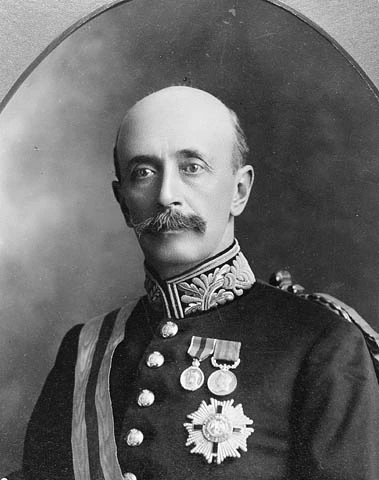
Albert Grey, 4th Earl Grey
| Name | Albert Grey, 4th Earl Grey |
| Title | British politician and Governor General of Canada (1851-1917) |
| Gender | Male |
| Birthday | 1851-11-28 |
| nationality | United Kingdom of Great Britain and Ireland |
| Source | https://www.wikidata.org/wiki/Q333336 |
| pptrace | View Family Tree |
| LastUpdate | 2025-11-26T23:27:52.683Z |
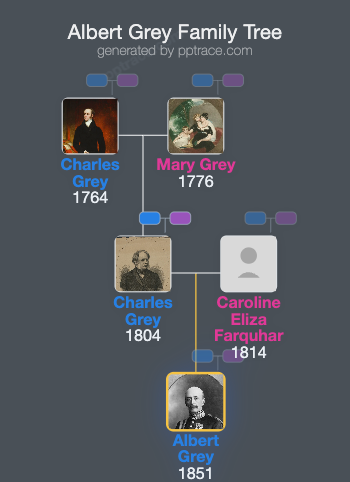
Family Tree
Tap  to expand more relatives
Introduction
Albert Henry George Grey, 4th Earl Grey (28 November 1851 – 29 August 1917), was a British peer and politician who served as the Governor General of Canada from 1904 to 1911. He was the ninth person to hold this position since Canadian Confederation.
Born at Cadogan House, Middlesex, Grey was the son of General Sir Charles Grey and Caroline Eliza Farquhar. His grandfather was the 2nd Earl Grey, who served as Prime Minister of the United Kingdom from 1830 to 1834. The Grey family had a history of political involvement; his grandfather was a champion of the Reform Act 1832, and his uncle, the third Earl Grey, was Secretary of State for War and the Colonies during the first ministry of Lord John Russell, known for advocating colonies' self-governance.
Grey received his education at Harrow School and Trinity College, Cambridge, where he graduated with an MA and LL.M. degree. After completing his studies in 1873, he became private secretary to Sir Henry Bartle Frere and accompanied Prince Albert Edward, Prince of Wales, on his tour of India in 1877. Grey married Alice Holford in 1877; they had five children, with one dying in early childhood.
His early political career began when he stood for parliament at South Northumberland in 1878. Though initially unsuccessful, he was elected as a Liberal Member of Parliament (MP) for South Northumberland in 1880. In 1884, he expressed support for women's suffrage and electoral reform, advocating proportional representation and supporting the Single Transferable Vote (STV). Grey was an active supporter of imperialism and was a founder of the Imperial Federation League, which aimed to unify the British Empire.
In 1894, Grey inherited the earldom from his uncle, the 3rd Earl Grey, and took a seat in the House of Lords. He was a close associate of Cecil Rhodes, serving as a trustee for the Rhodes Scholarship and as a director of the British South Africa Company. He was involved in colonial administration during the period leading to and following the Jameson Raid on the Transvaal. Between 1894 and 1897, Grey was the administrator of Southern Rhodesia, reporting directly to Cecil Rhodes.
Grey's public service extended to being appointed Lord Lieutenant of Northumberland in 1899. In 1904, he was appointed Governor General of Canada by King Edward VII, based on the recommendation of British Prime Minister Arthur Balfour. His tenure lasted until 1911, succeeding the Earl of Minto and succeeded by Prince Arthur, Duke of Connaught and Strathearn.
During his time in Canada, Grey promoted national unity and oversaw significant developments, including the creation of the provinces of Alberta and Saskatchewan. He supported social reforms, prison reforms, and electoral reform initiatives. Grey traveled extensively across Canada and engaged with Canadian political leaders, including Prime Minister Sir Wilfrid Laurier, and maintained diplomatic relations with U.S. President Theodore Roosevelt.
Throughout his career, Grey was noted for his active engagement in political and imperial affairs, advocating for social and electoral reforms, and fostering closer ties within the British Empire.