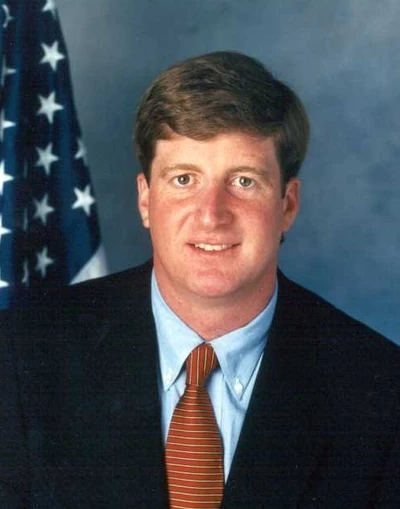
Patrick J. Kennedy
| Name | Patrick J. Kennedy |
| Title | American politician, Rhode Island |
| Gender | Male |
| Birthday | 1967-07-14 |
| nationality | United States of America |
| Source | https://www.wikidata.org/wiki/Q948920 |
| pptrace | View Family Tree |
| LastUpdate | 2025-11-17T06:45:01.974Z |
Family Tree
Tap  to expand more relatives
Introduction
Patrick Joseph Kennedy II, born on July 14, 1967, is an American retired politician and mental health advocate. He served as a Democratic member of the United States House of Representatives representing Rhode Island's 1st congressional district from January 3, 1995, to January 3, 2011. Kennedy was among the first two Generation X members of Congress when he took office in 1995, alongside Randy Tate.
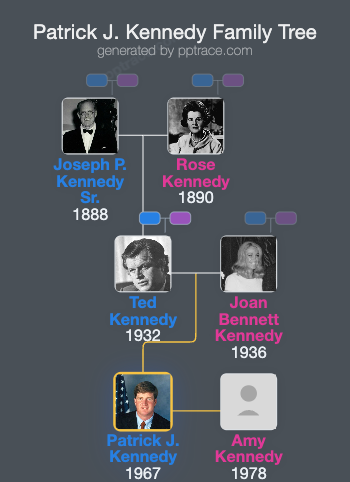
Kennedy was born and raised in Boston, Massachusetts, in the Brighton neighborhood. He is the youngest child of Senator Edward Moore "Ted" Kennedy, a prominent Massachusetts senator who served for many years in Congress, and Virginia Joan Kennedy. His siblings include Kara Kennedy, a television and film producer, and Ted Kennedy Jr., a lawyer and former Connecticut State Senator. Kennedy's paternal great-grandfather was businessman and politician Patrick Joseph Kennedy (1858–1929).
He completed his secondary education at Phillips Academy in Andover, Massachusetts, graduating in 1986. He then attended Providence College, earning a Bachelor of Science degree in 1991. During his time at Providence College, Kennedy defeated five-term incumbent John F. Skeffington Jr. to win election to the Rhode Island House of Representatives in 1988, making him the youngest member of the Kennedy family to hold elected office at that time. He served two terms representing District 9 in Providence, Rhode Island, and chose not to seek a third term.
In 1994, Kennedy was elected to the U.S. House of Representatives, representing Rhode Island's 1st congressional district. He was re-elected seven times, serving in the 104th through 111th Congresses. His committee assignments included the Armed Services, Natural Resources, and Appropriations Committees, where he was appointed to the Subcommittee on Commerce, Justice, Science, and Related Agencies; the Subcommittee on Labor, Health and Human Services, Education, and Related Agencies; and the Subcommittee on Military Construction, Veterans Affairs, and Related Agencies.
Kennedy co-sponsored and was the lead sponsor of multiple pieces of legislation, including the Mental Health Parity and Addiction Equity Act passed in 2008. He also authored and supported federal legislation aimed at improving mental health and addiction treatment, such as the Positive Aging Act, the Foundations for Learning Act, the National Neurotechnology Initiative Act, the Genomics and Personalized Medicine Act, and the Alzheimer's Treatment and Caregiver Support Act. Kennedy was instrumental in founding the Congressional Down Syndrome Caucus and the 21st Century Healthcare Caucus and served as vice chairman of the Native American Caucus.
He was actively involved in various caucuses, including the Congressional Boating Caucus, the Caucus on Armenian Issues, the Caucus on Hellenic Issues, the Fire Services Caucus, the Human Rights Caucus, the Travel and Tourism Caucus, the National Guard and Reserve Components Caucus, the Portuguese American Caucus (which he co-chaired), and the Older American Caucus. He also founded the Rhode Island Chapter of the National Committee for the Prevention of Child Abuse and briefly chaired the Democratic Congressional Campaign Committee from 1999 to 2001, during which time he became prominent in Democratic political fundraising.
Kennedy considered running for U.S. Senate in Rhode Island in 2000 and again in 2006 but opted to seek re-election for his House seat instead. He decided not to run for re-election in 2010 and left office at the conclusion of his eighth term in January 2011. His departure marked the first time since 1947 that no member of the Kennedy family held elected office in Washington.
Following his congressional career, Kennedy has been active as an advocate for mental health and addiction issues. He publicly disclosed his struggles with bipolar disorder and drug addiction, and he co-founded One Mind, a mental health nonprofit, in 2011. In 2013, he founded The Kennedy Forum, a behavioral health organization where he serves as CEO, aimed at transforming mental health and addiction care in the United States.
In 2017, President Donald Trump appointed Kennedy to the Opioid and Drug Abuse Commission. He serves on the boards of eight corporations involved in the government’s response to the opioid crisis, holding equity stakes and receiving director fees from these organizations. Kennedy co-authored a book titled "A Common Struggle" in 2015, recounting his personal experience with mental illness and addiction and his advocacy efforts.
Kennedy holds positions on various advisory and advocacy groups related to mental health and substance abuse and has been involved in efforts to oppose marijuana legalization initiatives, expressing concerns about their impact on public health.
He is the son of Ted Kennedy and Virginia Joan Kennedy and has three siblings. Kennedy's early life was characterized by his education in Massachusetts and Rhode Island and his early engagement in politics at the state level before his service at the federal level.