Charles Rinaldo Floyd
| Name | Charles Rinaldo Floyd |
| Title | American military leader |
| Gender | Male |
| Birthday | 1797-01-01 |
| nationality | — |
| Source | https://www.wikidata.org/wiki/Q17014221 |
| pptrace | View Family Tree |
| LastUpdate | 2025-11-16T10:23:07.477Z |
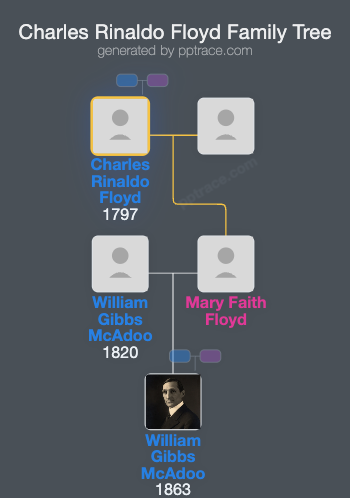
Family Tree
Tap  to expand more relatives
Introduction
Charles Rinaldo Floyd was born on October 14, 1797, near Darien in McIntosh County, Georgia, at a location known as "The Thickets." He was the son of General John Floyd and Isabella Maria Hazzard. His paternal grandfather, Captain Charles Floyd, served in the American Revolutionary War. The Floyd family later moved to Camden County, where they acquired substantial land holdings south of the Satilla River, encompassing areas such as Floyd’s Neck and Floyd’s Basin. General John Floyd constructed Bellevue Plantation and Fairfield Plantation in this region, with the former featuring an anchor-shaped layout symbolizing maritime fortunes.
Floyd was educated through private tutoring and attended Sunbury Academy in Georgia, as well as a boarding school in Beaufort, South Carolina. At age sixteen, he served as a military aide to his father during the Creek Indian War, participating in battles including Tallassee, Chalibee, and Autossee. During the campaign at Autossee, a confrontation with Creek forces resulted in the destruction of the town and the death of over 200 Creek individuals. Floyd sustained a grazing head wound during battle.
He subsequently enrolled at the United States Military Academy at West Point but was dismissed in 1817 due to insubordination, which he regarded as a matter of personal honor. Despite his dismissal, Floyd received a commission as a marine lieutenant. His military career included service in the U.S. Marine Corps, with notable duties such as commanding the Marine Honor Guard protecting the Marquis de Lafayette in 1824. In 1820, he was court-martialed for caning a naval storekeeper who insulted a sentinel and was suspended for twelve months with pay.
Floyd married Catharine Sophia Powell on May 22, 1823, in Boston. They had two daughters, both born in Camden County. In 1828, tragedy struck when Floyd’s wife and infant daughter drowned after a servant and her toddler fell into Boston Harbor during disembarkation. Floyd later married Julia Ross Boog on September 9, 1831, at Bellevue Plantation. Julia was born on April 16, 1815, in King's Bay Plantation near St. Marys, Georgia. Together, Floyd and Julia had seven children. They resided at Fairfield Plantation, which Floyd's father had provided, and Floyd maintained a private armory with an extensive collection of weapons and a personal art studio.
Floyd's early military service extended to combat in the Creek Indian War. He was involved in direct action and sustained minor wounds. After his West Point dismissal, he returned to Georgia to pursue plantation life and politics. In 1825, Floyd served as a member of the Georgia House of Representatives representing Baldwin County. He was also appointed brigadier general of the Georgia Militia, commanding the 1st Brigade of the 1st Division.
Throughout his career, Floyd engaged in duels, notably challenging neighbor Edward Stevens Hopkins over cattle grazing disputes and political disagreements in 1837; Floyd shot Hopkins in the upper leg during their duel on Amelia Island Beach.
In 1838, Floyd was involved in the removal of Cherokee Indians from northern Georgia, overseeing internment and forced marches as part of the Trail of Tears. He instructed troops at New Echota to execute their duties with discipline and compassion. Later that year, as brigadier general of the Georgia militia, he led operations to remove Seminoles from the Okefenokee Swamp during the Second Seminole War, undertaking a campaign that he documented in letters published in regional newspapers.
Floyd's disappointment arose in 1839 when he was bypassed for a promotion to Major General by the Georgia legislature. In his later years, beginning in 1843, he sold substantial land to fund hobbies such as hunting, boating, and collecting antique weapons. He founded the Camden County Hunting Club, participated in competitive racing with boats, and challenged New York clubs to regattas. Floyd was also known for his interest in medieval weaponry and his collection of artifacts.
Charles Rinaldo Floyd died on March 22, 1845, at Fairfield Plantation.