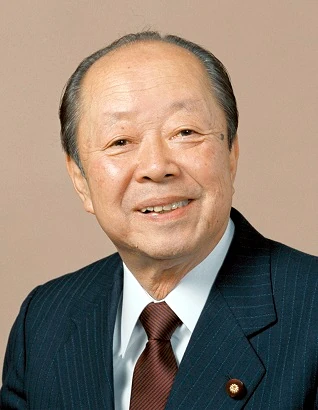
Kiichi Miyazawa
| Name | Kiichi Miyazawa |
| Title | 78th Prime Minister of Japan (1919-2007) |
| Gender | Male |
| Birthday | 1919-10-08 |
| nationality | Japan |
| Source | https://www.wikidata.org/wiki/Q315565 |
| pptrace | View Family Tree |
| LastUpdate | 2025-11-17T06:47:28.497Z |
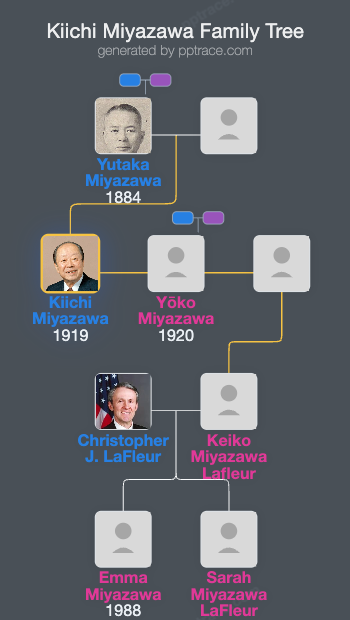
Family Tree
Tap  to expand more relatives
Introduction
Kiichi Miyazawa (宮澤 喜一, Miyazawa Kiichi) was a Japanese politician born on 8 October 1919 in Tokyo, Japan. He died on 28 June 2007 in Tokyo. Miyazawa's parents were Yutaka Miyazawa, a member of the National Diet, and Koto, his wife. His maternal grandfather was Ogawa Heikichi, who served as Minister of Justice and Minister of Railways. Miyazawa's family was affluent and politically active; following the 1923 Great Kantō earthquake, he resided at his grandfather’s villa in Hiratsuka.
He attended Musashi Higher School and subsequently graduated from Tokyo Imperial University with a degree in law. During his university years, Miyazawa participated in the Japan-America Student Conference in Washington D.C. in 1939. Throughout his early life, he developed fluency in English, which persisted during World War II. Miyazawa was passionate about Noh theater, films, and music.
In 1942, Miyazawa joined the Ministry of Finance, a decision influenced by avoiding military service during World War II. He was mentored by Hayato Ikeda, who later became Prime Minister. Miyazawa’s political career began when he was elected to Japan’s National Diet in 1953, initially representing the Upper House. He served in this capacity until 1967, after which he moved to the Lower House.
Miyazawa was associated with Ikeda's Kōchikai faction and was regarded as part of Ikeda's “brain trust.” His diplomatic experience includes accompanying Ikeda to a summit with U.S. President John F. Kennedy in 1961, where Miyazawa served as Ikeda's translator for discussions on the yacht Honey Fitz. Miyazawa held various government positions, including Director of the Economic Planning Agency (1962–64, 1966–68, 1977–78), Minister of International Trade and Industry (1970–1971), Minister of Foreign Affairs (1974–1976), and Chief Cabinet Secretary (1984–1986). He became Japan’s Minister of Finance in 1987 under Prime Minister Noboru Takeshita but resigned in 1988 following the Recruit scandal.
Miyazawa served as Prime Minister of Japan from 5 November 1991 to 28 August 1993. His tenure included a brief incident where President George H. W. Bush fainted during a state dinner in 1992. That same year, Miyazawa issued a formal apology for Japan's military use of comfort women during World War II, marking a first by a Japanese leader. His administration enacted legislation permitting Japan to participate in overseas peacekeeping operations and negotiated a trade agreement with the United States. It also pursued financial reforms amidst Japan’s economic downturn. Miyazawa resigned as Prime Minister following a no-confidence vote linked to a political scandal involving Fumio Abe.
After his premiership, Miyazawa returned to government service as Finance Minister from 1999 to 2001, serving in the cabinets of Keizō Obuchi and Yoshirō Mori. His speaking engagement at the United Nations took place in November 2001, despite not holding a government office at that time. He was elected to serve a total of 14 terms in both chambers of the Diet before retiring from politics in 2003, when Prime Minister Junichiro Koizumi set an age limit of 73 for LDP candidates.
In his personal life, Miyazawa married Yoko while studying in the United States. They had two children: Hiro, an architect, and Keiko, who married diplomat Christopher J. LaFleur. He authored a book titled *Secret Talks Between Tokyo and Washington* (2007), which discusses Japan-U.S. political, economic, and security negotiations during 1949–1954.
Miyazawa was awarded the Grand Cross of the Order of the Sun of Peru in 1992.