Sanjō Sanetomi
| Name | Sanjō Sanetomi |
| Title | Japanese politician (1837-1891) |
| Gender | Male |
| Birthday | 1837-03-13 |
| nationality | Japan |
| Source | https://www.wikidata.org/wiki/Q516646 |
| pptrace | View Family Tree |
| LastUpdate | 2025-11-17T10:07:56.455Z |
Family Tree
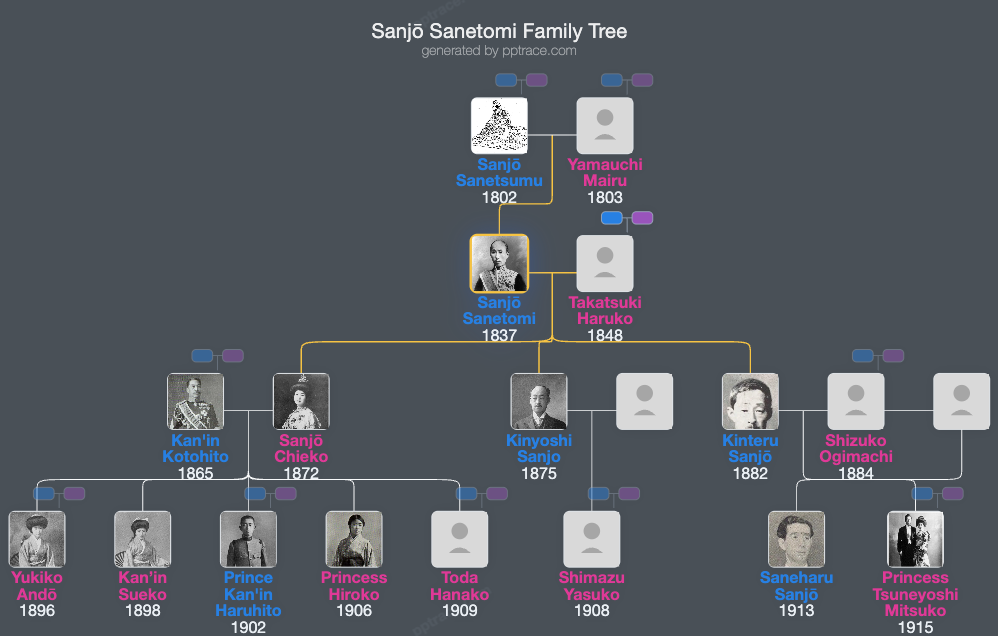
Tap  to expand more relatives
Introduction
Prince Sanjō Sanetomi (三条 実美; born March 13, 1837, in Kyoto – died February 18, 1891) was a Japanese noble and statesman during the Meiji Restoration period. His career included holding several high-ranking government offices in the early years of the Meiji government.
Early Life
Sanjō was born in Kyoto as the son of Sanjō Sanetsumu, who held the position of Naidaijin. During his early years, he was involved in court affairs and was a prominent figure in the sonnō jōi movement, which advocated for reverence of the emperor and the expulsion of foreigners. This movement opposed the Tokugawa shogunate's policies and was instrumental in the political upheavals preceding the Meiji Restoration. Following the coup d'état on September 30, 1863, which resulted in the rise of more moderate factions from Aizu and Satsuma, Sanjō fled to Chōshū. He later returned to Kyoto after the resignation of shōgun Tokugawa Yoshinobu in 1867.
Political Career
With the establishment of the Meiji government, Sanjō held various administrative offices. The initial Sanshoku system, comprising the offices of Sōsai (President), Gijō (Administration), and San'yo (Councilors), was inaugurated on January 3, 1868. However, these offices were abolished on June 11, 1868, and replaced by the Dajō-kan (Grand Council of State).
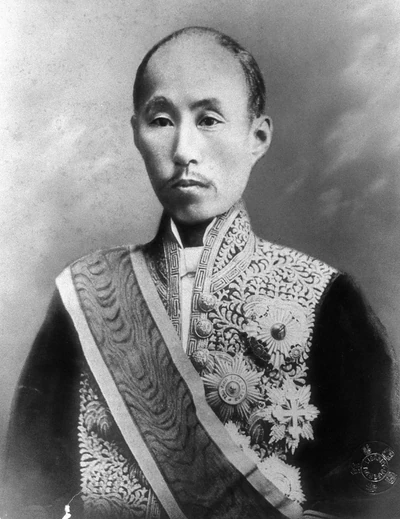
Within the government, Sanjō served as head of the Gijo and as Minister of the Right (Udaijin) from June 11, 1868, to August 15, 1871. Subsequently, he was appointed Chancellor of the Realm (Dajō-daijin) and served from August 15, 1871, until December 22, 1885. In 1882, he was awarded the Grand Cordon of the Supreme Order of the Chrysanthemum.
On July 7, 1884, Sanjō’s aristocratic title was elevated to that of prince (koshaku) under the kazoku peerage system. He held the position of Dajō-daijin until the abolition of the Dajō-kan system in 1885, after which he became Lord Keeper of the Privy Seal of Japan. During the political crisis in 1889, when Prime Minister Kuroda Kiyotaka and his cabinet resigned, Emperor Meiji accepted Kuroda’s resignation but did not appoint a new prime minister immediately. Instead, Sanjō was invited to head the government, acting as an interim prime minister. Notably, he was the only person to serve concurrently as Prime Minister of Japan and as Lord Keeper of the Privy Seal.
In 1890, Sanjō took a seat in the newly established House of Peers, part of the Diet of Japan created by the Meiji Constitution. He died in 1891 and was given a state funeral. His final resting place is at Gokoku-ji Temple in Bunkyō, Tokyo.
Honors
Sanjō received numerous honors during his lifetime. He was awarded the Grand Cordon of the Order of the Rising Sun on December 29, 1876. On April 11, 1882, he received the Grand Cordon of the Order of the Chrysanthemum. His peerage title was elevated to prince (koshaku) on July 7, 1884.
Order of precedence
Throughout his life, Sanjō's official ranks included Junior Fifth Rank (1850), Fifth Rank (1854), Fourth Rank (1855), Senior Fourth Rank (1856), Third Rank (1862, later degraded and restored), First Rank (1868), and Senior First Rank (1891).
Family and Ancestry
Details regarding Sanjō's family background and ancestry are documented but are not elaborated upon in the provided text.
References and Further Reading
Sources include works by William G. Beasley, Marius B. Jansen, Donald Keene, and Ozaki Yukio. External links include the National Diet Library biography, photo archives, and portraits from the period, including a 1877 portrait of Sanjō among other dignitaries.