Rosslyn Wemyss, 1st Baron Wester Wemyss
| Name | Rosslyn Wemyss, 1st Baron Wester Wemyss |
| Title | Royal Navy admiral of the fleet (1864-1933) |
| Gender | Male |
| Birthday | 1864-04-12 |
| nationality | United Kingdom |
| Source | https://www.wikidata.org/wiki/Q1225006 |
| pptrace | View Family Tree |
| LastUpdate | 2025-11-12T01:17:37.624Z |
Family Tree
Tap  to expand more relatives
Introduction
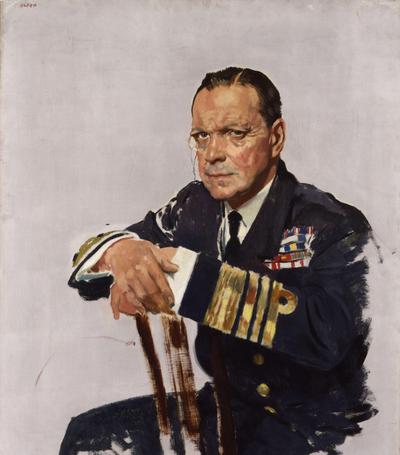
Rosslyn Erskine Wemyss, 1st Baron Wester Wemyss (12 April 1864 – 24 May 1933), was a senior officer in the Royal Navy. He was known as Sir Rosslyn Wemyss from 1916 to 1919 and held the rank of Admiral of the Fleet.
Early Life and Naval Career:
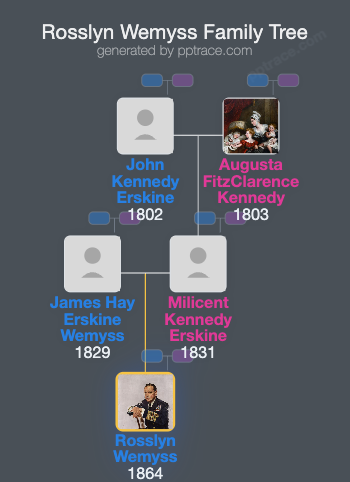
Wemyss was born as the youngest son of James Hay Erskine Wemyss and Millicent Ann Mary Kennedy Wemyss (née Erskine). His familial home was Wemyss Castle located on the Fife coast in Scotland. He entered the Royal Navy as a cadet on HMS Britannia in 1877. His early sea service included postings on HMS Bacchante (July 1879), HMS Northumberland (1883), HMS Canada, HMS Hecla, HMS Osborne, HMS Anson, HMS Undaunted, HMS Empress of India, HMS Astraea, and HMY Victoria and Albert, among others.
His promotions included midshipman (23 September 1879), sub-lieutenant (24 September 1883), lieutenant (31 March 1887), commander (31 August 1898), and captain (5 November 1901). Wemyss served on various ships and stations, including the Mediterranean Fleet, Channel Squadron, and the Cape of Good Hope Station. He was involved in a royal cruise as second-in-command of the SS Ophir in 1901 and held the position of second-in-command of the Royal Yacht HMY Osborne.
He was appointed an extra equerry to the Prince of Wales (later King Edward VII) in November 1901 and became a Member of the Royal Victorian Order in December 1901. His appointment as captain of HMS Superb followed in 1902. He later commanded the cruisers HMS Suffolk (1905) and HMS Implacable (1909), and served as Captain of the Royal Naval College, Osborne (from August 1903).
Promotions further included Rear Admiral (19 April 1911) and Commander of the 2nd Battle Squadron of the Home Fleet (October 1912).
World War I Service:
During the First World War, Wemyss initially commanded the 12th Cruiser Squadron in the Channel Fleet. In February 1915, he was dispatched to Lemnos to prepare the harbor of Moudros for operations against the Dardanelles, subsequently serving as Governor of Moudros. He commanded British landings at Cape Helles on 25 April 1915 and supported the landings at Suvla Bay on 9 August 1915.
Following the campaign's failure, he oversaw the re-embarkation of troops from Suvla Bay and Ari Burnu on 20 December 1915. In the 1916 New Year Honours, he was appointed a Knight Commander of the Order of the Bath.
Later in 1916, Wemyss commanded the East Indies & Egyptian Squadron, supporting operations on the Palestine Front and encouraging the Arab Revolt under Emir Faisal and T. E. Lawrence. He was promoted to vice-admiral on 6 December 1916 and received several international honours, including the Legion of Honour (France), the Order of the Crown (Italy), and the Romanian Order of the Crown.
Admiral of the Fleet and Admiralty Positions:
Returning to Britain, Wemyss was appointed Second Sea Lord in September 1917, then Deputy First Sea Lord in October 1917. In December 1917, following the dismissal of Admiral Sir John Jellicoe, Wemyss was appointed First Sea Lord.
As First Sea Lord, Wemyss promoted more aggressive naval operations, notably encouraging Admiral Roger Keyes to undertake the Zeebrugge Raid (April 1918). His honours increased with his appointment as Knight Grand Cross of the Order of the Bath in 1918 and receiving the Grand Cross of the Legion of Honour, the Croix de Guerre, and other international awards after the war.
He represented Britain at the armistice negotiations in November 1918. He was responsible for the timing of the ceasefire, which took effect at 11:00 a.m. on 11 November 1918, a decision that was approved over the suggestions of Prime Minister David Lloyd George.
Post-War and Retirement:
Wemyss attended the Paris Peace Conference as Britain's naval representative. He resigned from his position as First Sea Lord in November 1919 amidst debates about leadership succession. He was promoted to Admiral of the Fleet on 1 November 1919.
Later Life:
In retirement, Wemyss authored the memoir titled "The Navy in the Dardanelles Campaign." He served as a Non-Executive Director of Cable & Wireless and resided in Cannes, France. He died in his garden at Cannes on 24 May 1933 and was buried at Wemyss Castle.
Family:
Wemyss married Victoria Morier, daughter of Sir Robert Morier, on 21 December 1903. They had one daughter, Alice Elizabeth Millicent Erskine-Wemyss.