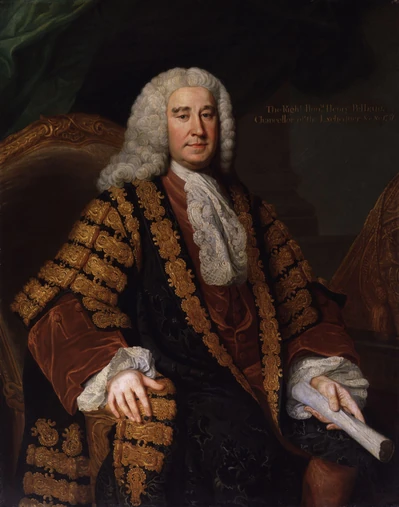
Henry Pelham
| Name | Henry Pelham |
| Title | Prime Minister of Great Britain; (1695-1754) |
| Gender | Male |
| Birthday | 1694-09-25 |
| nationality | Great Britain |
| Source | https://www.wikidata.org/wiki/Q244766 |
| pptrace | View Family Tree |
| LastUpdate | 2025-11-26T23:21:13.462Z |
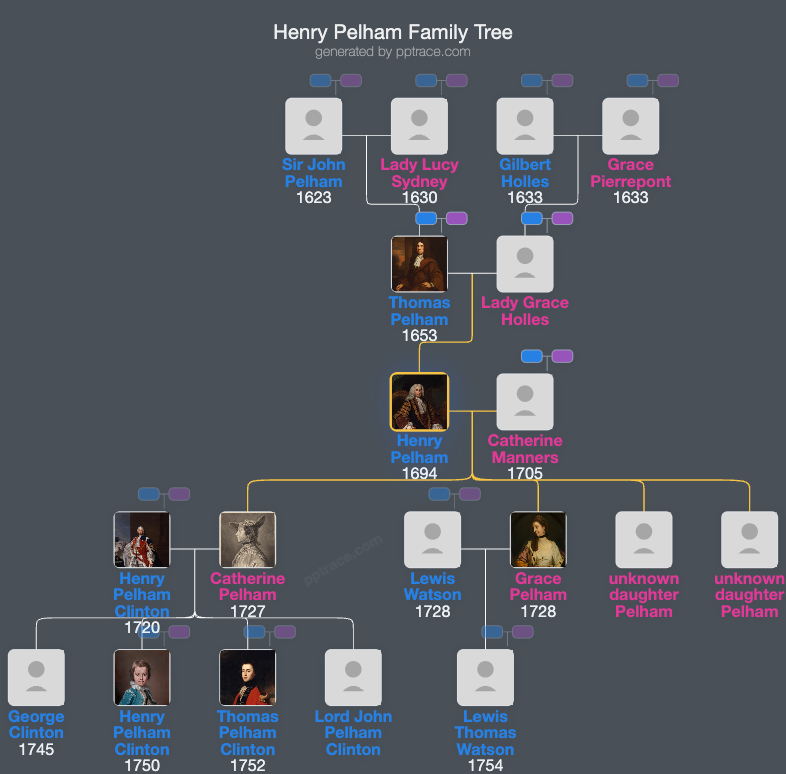
Family Tree
Tap  to expand more relatives
Introduction
Henry Pelham was born on 25 September 1694 and died on 6 March 1754. He was a British Whig politician who held the office of Prime Minister of Great Britain from 1743 until his death in 1754. Pelham was the younger brother of Thomas Pelham-Holles, who held the title of 1st Duke of Newcastle and served in Pelham’s government before succeeding him as Prime Minister.
Pelham's family background includes his parents, Thomas Pelham, 1st Baron Pelham, and Grace Pelham, Baroness Pelham of Laughton. His maternal grandparents were Gilbert Holles, 3rd Earl of Clare, and Grace Pierrepont. Pelham was educated at Westminster School and matriculated at King's College, Cambridge, in Easter 1709. He later transferred to Hart Hall, Oxford (the present-day Hertford College), matriculating on 6 September 1710.
At age 12, Pelham's father died. As a result, he inherited £5,000 and small annuities for life, with a larger portion of the estate allocated to his elder brother, the Duke of Newcastle. Pelham served as a volunteer during the Battle of Preston in 1715 and also traveled on the Continent. He was elected as Member of Parliament for Seaford, Sussex, in a by-election on 28 February 1717, a position secured through his brother's influence. He represented Seaford until 1722.
Pelham delivered his first speech in the House of Commons on 20 May 1720. During this period, the Whigs were engaged in efforts toward political union, notably supporting measures to discharge civil list debt. On 15 March 1721, Pelham assisted Walpole in securing the acquittal of the Earl of Sunderland on bribery charges.
Pelham’s initial government role was as Treasurer of the Chamber in 1720, followed by his appointment as Lord of the Treasury in 1721, largely due to his brother's influence and Robert Walpole's recommendation. He was returned as MP for Sussex in the 1722 general election. In 1724, he became Secretary at War, a position he held for six years, overseeing issues related to Army enlistments, courts-martial, mutiny, desertion, and jurisdictional matters.
Pelham was involved in significant fiscal debates, notably supporting measures to continue paying Hessian troops and defending government policies on taxation and military funding. Despite facing criticism from Jacobite opposition figures such as William Shippen, Pelham remained a prominent supporter of Walpole’s policies, including the introduction of excise taxes on salt.
In 1730, Pelham became Paymaster of the Forces. He collaborated closely with Walpole and his brother, often meeting at Houghton Hall to formulate policy, and was a founding governor of the Foundling Hospital in 1739. Pelham was also an active Freemason of the Premier Grand Lodge of England.
In 1742, a political union led to Pelham becoming Prime Minister and First Lord of the Treasury in 1743 after the death of the Earl of Wilmington. His initial premiership continued the policies of the Carteret ministry, with Lord Carteret remaining as Secretary of State for the Northern Department and responsible for foreign affairs. By November 1744, Pelham and his brother the Duke of Newcastle removed Carteret from the ministry, consolidating power within their faction.
Pelham’s government was characterized by a policy of peace and cautious engagement in the War of the Austrian Succession. Despite limited military success, the nation was generally content with his foreign policy. In 1746, after an initial resignation, Pelham and his brother returned to office at the king’s request, emphasizing the importance of confidence in the government by the monarchy.
Throughout his tenure, Pelham implemented several economic reforms, including reducing military expenditures, reorganizing the Royal Navy through the Navy Act 1748, reforming the calendar in 1752, and reducing the land tax from 4 shillings to 2 shillings in the pound. Social issues such as alcohol consumption led to the enactment of the Gin Act 1751.
Pelham’s final session in office saw the passage of the Jewish Naturalization Act 1753, which allowed Jews to become naturalized through application to Parliament, and the Marriage Act 1753, which established the minimum age for marriage. During this period, Pelham expressed a dismissive attitude toward opposition criticism, viewing it as insignificant.
Following Pelham’s death, his brother, the Duke of Newcastle, assumed full control of the government.