Richard Neville Aldworth Neville
| Name | Richard Neville Aldworth Neville |
| Title | politician, died 1793 |
| Gender | Male |
| Birthday | 1717-09-03 |
| nationality | — |
| Source | https://www.wikidata.org/wiki/Q17424033 |
| pptrace | View Family Tree |
| LastUpdate | 2025-11-26T23:23:32.389Z |
Family Tree
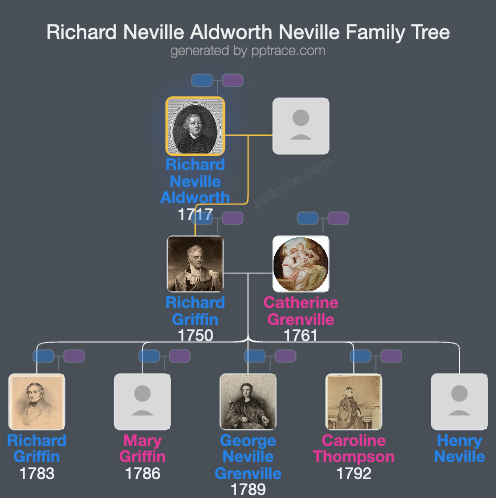
Tap  to expand more relatives
Introduction
Richard Neville Aldworth Neville was born on September 3, 1717, and died on July 17, 1793. He was an English politician and diplomat. Neville was the only son of Richard Aldworth of Stanlake and Catherine Neville, daughter of Richard Neville of Billingbear House. Through his maternal line, he was descended from Sir Henry Neville.
Neville received his education at Eton College, where he maintained relationships with individuals including Lord Sandwich, Lord Rochford, Lord Orford, Owen Cambridge, and Jacob Bryant. On July 12, 1736, he matriculated at Merton College, Oxford. However, he did not complete his degree there, instead choosing to travel abroad. In 1739, he visited Geneva and spent each winter there until 1744, associating with other English visitors such as John Hervey, 2nd Baron Hervey; William Windham Sr.; and Benjamin Stillingfleet. Neville later contributed to William Coxe's "Literary life and Select works of Benjamin Stillingfleet" (1811).
In the political arena, Neville became a Member of Parliament for Reading in the general election of 1747. He subsequently represented Wallingford from 1754 to 1761, Tavistock from 1761 to 1768, and again from 1768 to 1774. He aligned with the Whig party and received support from the Duke of Bedford. On February 13, 1748, he was appointed under-secretary of state for the Southern Department under Bedford, serving until Bedford's resignation on July 12, 1751. During this period, he also served as joint secretary to the council of regency in 1748 and 1750.
In August 1762, Neville assumed the surname and arms of Neville upon inheriting the estate of Billingbear following the death of the Countess of Portsmouth, the widow of his maternal uncle Henry Neville Grey. On September 4, 1762, he was appointed secretary to the embassy at Paris. During the negotiations to conclude the Seven Years' War, Neville served as a diplomat under Bedford, who was the British plenipotentiary at the conference. According to Walpole, Neville was responsible for delaying the signing of preliminary treaties until news of the capture of Havana had been received. As a reward, Neville was made paymaster of the band of pensioners. He arrived in England on February 15 with the definitive treaty signed on February 10, 1763, at Paris. Neville then returned to Paris to act as plenipotentiary until the Earl of Hertford arrived in May 1763 to succeed Bedford. While in Compiègne in August, Neville was visited by John Wilkes; Louis XV presented him with a portrait set with diamonds.
Following his return to England, Neville declined further political involvement. He suffered from gout and died at Billingbear House after a prolonged illness. He was buried at Ruscombe, where a monument sculpted by John Flaxman commemorates him.
Neville married Magdalen Calandrini in 1748, the daughter of Francis Calandrini, the first syndic of Geneva. Magdalen died in 1750. They had two children: a daughter named Frances, who married Francis Jalabert, and a son named Richard.