John Hanks
| Name | John Hanks |
| Title | Abraham Lincoln's cousin |
| Gender | Male |
| Birthday | 1802-02-09 |
| nationality | — |
| Source | https://www.wikidata.org/wiki/Q6237605 |
| pptrace | View Family Tree |
| LastUpdate | 2025-11-17T06:40:18.557Z |
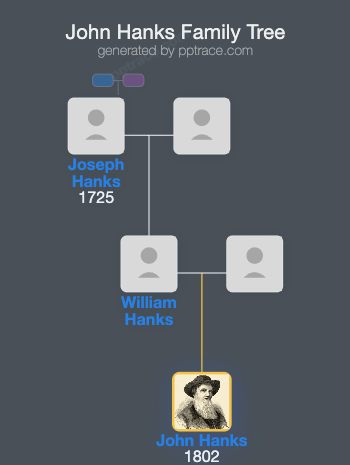
Family Tree
Tap  to expand more relatives
Introduction
John Hanks (February 9, 1802 – July 1, 1889) was an American individual known for familial connections to Abraham Lincoln and involvement in his early campaigns. Born near Beardstown in Nelson County, Kentucky, Hanks resided in the vicinity of the Falls at Rough Creek during his early years. In 1806, his family relocated to Hardin County, Kentucky. Hanks married Susan Malinda Wilson in Kentucky in 1826; she was born on February 14, 1804, and died on March 11, 1863. Their children included William, Louis, Jane, Phelix, Emily, Mary Ellen, and Levi.
From approximately 1822 or 1823, Hanks lived in Indiana with Thomas Lincoln, father of Abraham Lincoln. During this period, Hanks and Abraham Lincoln farmed together, primarily cultivating corn and splitting rails. Subsequently, Hanks traveled back to Kentucky for a period of one or two years. In 1828, he settled in Macon County, Illinois, where he built the first house in Decatur. He is credited with persuading Thomas Lincoln to relocate to Illinois in 1830.
Hanks and Abraham Lincoln worked together at Lincoln’s first job after leaving his family home. In 1831, they traveled to New Orleans as hired laborers on a flatboat owned by Denton Offutt. Hanks is reported to have recommended Lincoln and his stepbrother, John D. Johnston, for employment on the boat. Hanks also claimed to have initiated Lincoln's first speech, believing that Lincoln could deliver a more effective address than the competing political candidate.
During the Black Hawk War of 1832, Hanks served for four to six months, during which he participated in constructing a fort at Ottawa.
In relation to the 1860 Republican presidential campaign, Hanks became part of a campaign stunt symbolizing Lincoln as a "rail splitter." When Richard J. Oglesby sought a populist emblem for Lincoln, Hanks recounted that he had helped Lincoln split rails in Illinois. On May 9, 1860, at the Republican National Convention in Decatur, Illinois, Hanks and Isaac Jennings brought into the hall two fence rails, identified as being made by Lincoln and Hanks in 1830. This event contributed to Hanks’ recognition as a national figure. Certificates authenticating the "genuine Lincoln rails" were issued for distribution.
During the campaign, rumors circulated suggesting Hanks might not support Lincoln, partly because he had voted for Stephen A. Douglas in 1858. A letter purportedly written by Hanks, affirming his support for Lincoln, was drafted with assistance from Oglesby; however, Hanks’s brother Charles expressed suspicion regarding its authenticity, believing Hanks did not understand its content. Consequently, Hanks limited himself to personal appearances rather than public letters.
Following Lincoln’s election, Hanks sought a political appointment through Oglesby, favoring a position as an Indian agent. Although Lincoln considered the request, he did not appoint Hanks. Hanks visited the White House multiple times and attended Lincoln’s inauguration.
During the Civil War, Hanks enlisted as a teamster in the Illinois regiment under Ulysses S. Grant, despite being considered too old for service. He did not have personal contact with Abraham Lincoln after their earlier meeting but was present at Lincoln’s funeral.
Hanks died in 1889, having been known primarily for his familial ties and participation in early Lincoln campaigns.