Charles Ernest Pellew
| Name | Charles Ernest Pellew |
| Title | British medical and industrial chemist (1863-1945) |
| Gender | Male |
| Birthday | 1863-03-11 |
| nationality | United Kingdom |
| Source | https://www.wikidata.org/wiki/Q16944101 |
| pptrace | View Family Tree |
| LastUpdate | 2025-11-26T23:25:53.043Z |
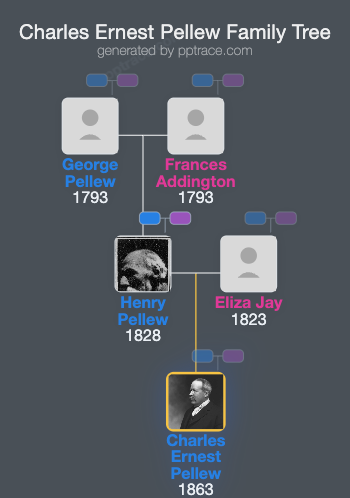
Family Tree
Tap  to expand more relatives
Introduction
Charles Ernest Pellew, 7th Viscount Exmouth (11 March 1863 – 7 June 1945), was a British peer and academic who later became a naturalised United States citizen. He inherited the title of Viscount Exmouth in 1922 upon the death of his father and held it until his own death in 1945.
Born in London, England, Pellew was the second son of Henry Pellew and Eliza Jay. His paternal grandfather was Edward Pellew, 1st Viscount Exmouth, a notable British admiral involved in actions during the American War of Independence and the Napoleonic Wars. His mother, Eliza Jay, was the daughter of a New York judge and a descendant of prominent American families including John Jay, the Van Cortlandt, Livingston, and Schuyler families. Pellew's older brother was George Pellew, a writer.
The Pellew family relocated to the United States in 1873. Henry Pellew was naturalised in 1877, and Charles Pellew, as a minor, automatically became a U.S. citizen upon reaching the age of 21. Pellew married Margaret W. Chandler, daughter of Dr. Charles T. Chandler, Dean of Columbia College, on 29 April 1886, at St Thomas's Church, New York. Margaret Chandler subsequently became Viscountess Exmouth. The couple later married in New York City on 12 May 1923, after Pellew had inherited the viscountcy.
Charles Pellew graduated from Columbia School of Mines in 1884. He served as a professor at the College of Physicians and Surgeons from 1886 to 1897. His appointment to this position was made by his father-in-law and was somewhat controversial. During this period, Pellew also became president of the Berkshire Industrial Farm in Canaan Four Corners, New York, a role he resigned from after accepting a professorship at Columbia College, where he remained until 1911. Throughout his academic career, Pellew authored at least one chemistry book and delivered lectures on topics including alcoholism, dyes, and fabric dyeing. He was involved with the New York Society of Craftsmen, the American Federation of Arts, and was a Fellow of the New York Academy of Sciences.
Following the resignation of Dr. Chandler from the Chemistry Department at Columbia College, Pellew also resigned his position, becoming a consulting chemist. Over the years, he provided expert advice on various projects, including participation in the U.S. Mint's "Annual Trial of Coins" in 1888, which involved testing coins for the federal government.
When Henry Pellew inherited the viscountcy in 1922, he sought to avoid the peerage, but the titles belonged to him regardless of his university location or whether he sat in the House of Lords. Henry Pellew died in 1923, and Charles Pellew inherited the title as the only surviving son. Subsequently, Pellew moved to the United Kingdom with his second wife, Mabel Gray, whom he married in 1923, shortly after inheriting the title. He resided in Britain and formally became a British subject in 1931, fulfilling his father's dying wish that he serve the country of his birth.
Pellew's only child, Anne Pellew, died in 1928 in Paris, France. Charles Pellew died on 7 June 1945 at Hindhead, Surrey, England, at age 82. His wife, Mabel, died in 1949. Upon his death, the viscountcy passed to his cousin, Edward Irving Pownoll Pellew.
Military service records show that Pellew served actively during the Spanish-American War era. He enlisted as a sergeant in the New York Volunteer Cavalry in 1898, was subsequently commissioned as a first lieutenant in the U.S. Army Signal Corps, and later achieved the rank of captain. He received honorable discharges from these units and also served as a member of the New York 12th Infantry in 1915–1916.
In public service, Pellew served on the Board of Managers of the Berkshire Industrial Farm and on committees related to the promotion of agriculture. He was a founding member and director of the Arts Center, Inc., and helped establish the Washington (D.C.) Handicraft Guild.
His published works include "Laboratory Schemes in Medical Chemistry," "The History of Alcohol," and "Manual of Practical Medical and Physiological Chemistry." He also held patents related to chemical processes.