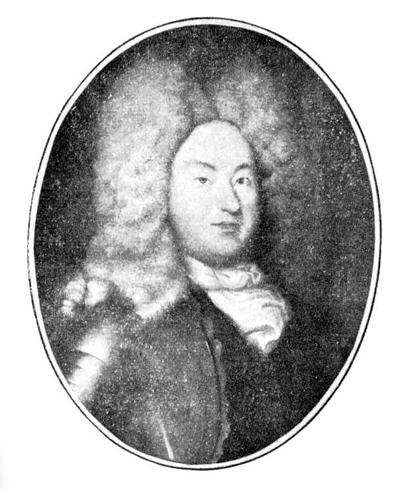
Ernest Frederick I, Duke Of Saxe-Hildburghausen
| Name | Ernest Frederick I, Duke Of Saxe-Hildburghausen |
| Title | German duke (1681–1724) |
| Gender | Male |
| Birthday | 1681-08-21 |
| nationality | Germany |
| Source | https://www.wikidata.org/wiki/Q169080 |
| pptrace | View Family Tree |
| LastUpdate | 2025-11-12T01:17:05.812Z |
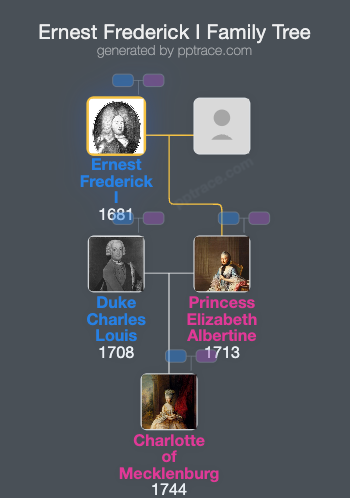
Family Tree
Tap  to expand more relatives
Introduction
Ernest Frederick I, Duke of Saxe-Hildburghausen, was born on August 21, 1681, in Gotha, and died on March 9, 1724, in Hildburghausen. He was the eldest son of Ernest, Duke of Saxe-Hildburghausen, and Countess Sophie Henriette of Waldeck.
During his youth, Ernest Frederick served in the imperial military army in the Netherlands. He participated in the Spanish Succession War, during which he was wounded at Höchstädt. In 1715, following the death of his father, he retired from military service and assumed governance of the duchy of Saxe-Hildburghausen.
He married Countess Sophia Albertine of Erbach-Erbach on February 4, 1704, in Erbach. The marriage produced fourteen children, though many died in childhood or infancy. Their offspring included Ernest Frederick II, Duke of Saxe-Hildburghausen, born in December 1707 and who died in August 1745; Louis Frederick, born in September 1710, who married Christine Luise von Holstein-Plön; and Elisabeth Albertine, born in August 1713, who married Duke Charles Louis Frederick of Mecklenburg. Several of their children were stillborn or died young.
Ernest Frederick's rule was marked by efforts to emulate the grandeur of Louis XIV's court at Versailles. These ambitions led to significant financial difficulties, causing him to levy taxes and sell off assets, including towns and lands. In 1720, he sold the County of Cuylenburg, which was part of his wife's dowry, to the Dutch Republic, not to satisfy debts but to fund the construction of a garden connected with his palace. In 1723, the county was sold again to the duchy of Saxe-Meiningen, a transaction conducted without his wife's consent, which was deemed illegal and resulted in conflict and military occupation involving both duchies. The conflict devastated the county.
Due to his financial policies, unrest arose in 1717, leading to an open revolt within the duchy. The instability stemmed from ongoing fiscal strains and the sale of territorial assets without proper authorization.
References documenting his life and rule include works such as Johann Samuel Ersch’s *Allgemeine Encyclopädie der Wissenschaften und Künste* (1842), Oliver Heyn’s studies on the military of Sachsen-Hildburghausen (2015, 2017), Rudolf Armin Human’s *Chronik der Stadt Hildburghausen* (1886), and Heinrich Ferdinand Schoeppl’s *Die Herzoge von Sachsen-Altenburg* (1917, reprinted 1992).