Margaret Thatcher
| Name | Margaret Thatcher |
| Title | British stateswoman and prime minister (1925–2013) |
| Gender | Female |
| Birthday | 1925-10-13 |
| nationality | United Kingdom |
| Source | https://www.wikidata.org/wiki/Q7416 |
| pptrace | View Family Tree |
| LastUpdate | 2025-11-26T23:33:34.843Z |
Family Tree
Tap  to expand more relatives
Introduction
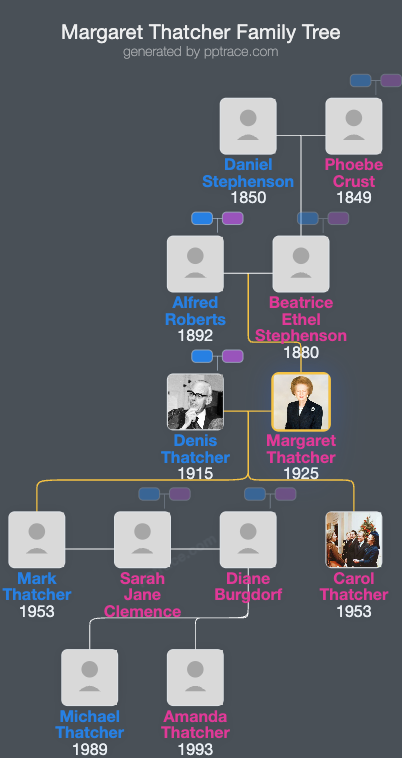
Margaret Hilda Thatcher, née Roberts, was born on October 13, 1925, in Grantham, Lincolnshire, England. Her parents were Alfred Roberts (1892–1970), a proprietor of a tobacconist and grocery store, and Beatrice Ethel Stephenson (1888–1960). Her paternal grandmother, Catherine Sullivan, was born in County Kerry, Ireland. During her childhood, her family briefly sheltered a Jewish girl fleeing Nazi Germany, with Margaret and her sister Muriel contributing to her journey’s expenses. Alfred Roberts was an alderman and Methodist preacher, bringing Margaret up in a Wesleyan Methodist household, though she expressed skepticism regarding religious beliefs.
Thatcher attended Huntingtower Road Primary School and was awarded a scholarship to Kesteven and Grantham Girls' School, a grammar school. She was highly engaged in extracurricular activities including piano, field hockey, poetry recitals, swimming, and walking, and served as head girl in 1942–43. During World War II, she volunteered as a fire watcher in the local Auxiliary Rescue Patrol (ARP). She was regarded as a “star scientist” by her peers and showed academic diligence.
In 1943, she received a scholarship to study chemistry at Somerville College, Oxford, entering in October 1943 after a brief delay caused by another candidate’s withdrawal. At Oxford, she studied under Dorothy Hodgkin, a Nobel laureate in chemistry, and undertook research on the structure of the antibiotic peptide gramicidin S. She graduated in 1947 with a second-class honours degree in chemistry and received an MA in 1950.
After graduation, Thatcher worked as a research chemist at British Xylonite (BX Plastics) in Colchester, Essex. Her role included research on attaching polyvinyl chloride to metals. In 1948, she applied to Imperial Chemical Industries (ICI), but was rejected, with their personnel describing her as “headstrong” and “self-opinionated.” She joined the local Conservative Association and participated in the party conference at Llandudno, Wales, in 1948.
Thatcher was active in Conservative grassroots organizations, including the Vermin Club. She developed an interest in politics early on, becoming President of the Oxford University Conservative Association in 1946. Her political influences included Friedrich Hayek’s "The Road to Serfdom" (1944), which critiqued government economic intervention.
In 1951, Thatcher was elected Member of Parliament for Finchley, a constituency she represented for many years. Her parliamentary career progressed when Edward Heath appointed her as Secretary of State for Education and Science in his government from 1970 to 1974. She was notably the first woman to lead a major political party in the United Kingdom, winning the leadership of the Conservative Party in 1975 after defeating Heath.
Thatcher became Prime Minister in 1979, serving until 1990. Her tenure was characterized by the implementation of economic policies emphasizing individual liberty, privatization of state-owned enterprises, and reduction of trade union power, collectively known as Thatcherism. Her government responded to economic challenges, including high inflation and unemployment, which initially diminished her popularity. Her leadership during the Falklands War in 1982 and the subsequent economic recovery bolstered her political standing, leading to a landslide victory in 1983.
In 1984, she survived an assassination attempt during the Brighton hotel bombing carried out by the Provisional Irish Republican Army. She also led the UK during the miners’ strike of 1984–85, which resulted in a significant decline in coal miners' influence. Her government deregulated financial markets in 1986, a process known as the “Big Bang,” which contributed to an economic boom.
Thatcher was re-elected in 1987 with another majority, but her support for the Community Charge, known as the “poll tax,” and her Eurosceptic views created internal divisions. In 1990, facing a leadership challenge, she resigned as Prime Minister and was succeeded by John Major. She was subsequently granted a life peerage as Baroness Thatcher of Kesteven, allowing her to sit in the House of Lords after retiring from the House of Commons in 1992.
She died of a stroke on April 8, 2013, at the Ritz Hotel in London, at the age of 87. Her political legacy remains subject to debate, although she is widely recognized as a transformative figure in British politics, marking a shift toward neoliberal economic policies and influencing the country's political landscape in the late 20th century.