Neville Chamberlain
| Name | Neville Chamberlain |
| Title | Prime Minister of the United Kingdom from 1937 to 1940 |
| Gender | Male |
| Birthday | 1869-03-18 |
| nationality | United Kingdom |
| Source | https://www.wikidata.org/wiki/Q10664 |
| pptrace | View Family Tree |
| LastUpdate | 2025-11-26T23:32:14.503Z |
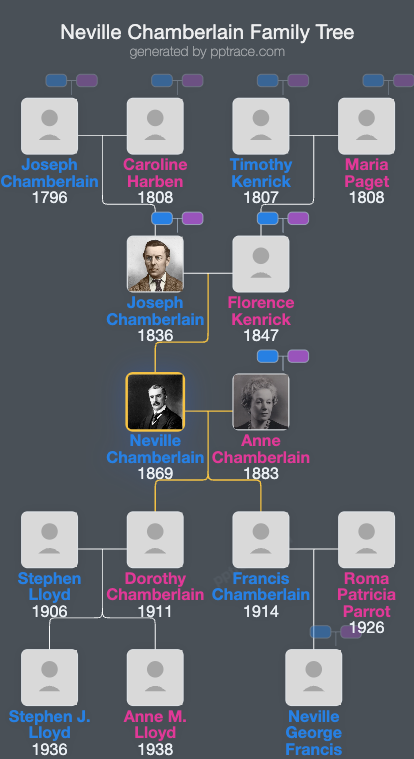
Family Tree
Tap  to expand more relatives
Introduction
Arthur Neville Chamberlain (18 March 1869 – 9 November 1940) was a British politician. He served as Prime Minister of the United Kingdom from May 1937 to May 1940 and was the Leader of the Conservative Party from May 1937 until October 1940.
Early Life and Education:
Neville Chamberlain was born at Southbourne in the Edgbaston district of Birmingham. He was the only son of Joseph Chamberlain from his second marriage to Florence Kenrick. His mother died when he was young. His family was Unitarian; however, Joseph Chamberlain lost personal religious faith by the time Neville was six years old. Neville was educated at home by his sister Beatrice Chamberlain and later attended Rugby School. He then studied at Mason College, now the University of Birmingham. Afterward, he was apprenticed to an accounting firm in 1889. Neville also spent six years on Andros Island in the Bahamas managing a sisal plantation, which was a failure.
Business Career:
Upon returning to England, Chamberlain entered the manufacturing sector, purchasing Hoskins & Company, a metal ship berth manufacturer. He served as managing director for 17 years, during which the company prospered. He was active in civic activities in Birmingham, serving as governor of Birmingham General Hospital and participating in the national United Hospitals Committee.
Family:
In 1911, Neville Chamberlain married Anne Cole, whom he met through family connections. They had a son and a daughter. Anne Cole supported his political career and was a constant companion and collaborator.
Political Career:
Chamberlain's initial involvement in politics was modest; he supported his father and half-brother, both involved in Parliament. His first electoral success was in 1911 when he was elected to Birmingham City Council for the All Saints' Ward. He served as Lord Mayor of Birmingham in 1915 during World War I. During the war, he was appointed a member of the Central Control Board on liquor traffic and later served as Director of National Service from December 1916 to August 1917, overseeing conscription and wartime industry labor forces. His relationship with Prime Minister David Lloyd George was strained during this period.
Parliament:
In the 1918 general election, Chamberlain was elected as a Member of Parliament for Birmingham Ladywood at the age of 49. He initially served as a backbencher and declined a junior ministerial role. His Parliamentary career progressed rapidly; he became Minister of Health in 1923, then Chancellor of the Exchequer, and held these posts during the 1920s. In 1931, he was appointed Chancellor of the Exchequer in the National Government.
Prime Ministership:
Neville Chamberlain became Prime Minister on 28 May 1937, succeeding Stanley Baldwin. His tenure was largely defined by foreign policy challenges related to Nazi Germany's aggressive actions. He pursued a policy of appeasement, culminating in the signing of the Munich Agreement on 30 September 1938, which ceded the Sudetenland to Germany. Initially, this move received public support. Following Germany's invasion of Poland on 1 September 1939, Chamberlain announced the UK’s declaration of war on Germany two days later.
World War II and Resignation:
Chamberlain led Britain through the early months of World War II. His management of the war faced criticism following failures such as the German invasion of Norway and the Battle of France. Amid the Norway Debate in 1940, his government’s popularity declined. Recognizing the need for a government broad coalition during wartime, Chamberlain resigned as Prime Minister on 10 May 1940. Winston Churchill succeeded him. Chamberlain remained in government as Lord President of the Council until 22 September 1940, supporting Churchill’s leadership.
Death and Legacy:
Neville Chamberlain died of cancer on 9 November 1940 at the age of 71, approximately six months after leaving office. He was a prominent figure in British politics, with his legacy subject to ongoing historical debate. Initially celebrated for his efforts, later critiques, especially those published in the book "Guilty Men" in July 1940, cast his policies and the Munich Agreement in a negative light. Subsequent historians have offered varying perspectives, some emphasizing the unpreparedness of Britain to war in 1938 and others criticizing his foreign policy decisions.
[This biography contains approximately 590 words.]