Thomas Jefferson Coolidge
| Name | Thomas Jefferson Coolidge |
| Title | American businessman and diplomat |
| Gender | Male |
| Birthday | 1831-08-26 |
| nationality | United States of America |
| Source | https://www.wikidata.org/wiki/Q23035106 |
| pptrace | View Family Tree |
| LastUpdate | 2025-11-17T06:37:34.478Z |
Family Tree
Tap  to expand more relatives
Introduction
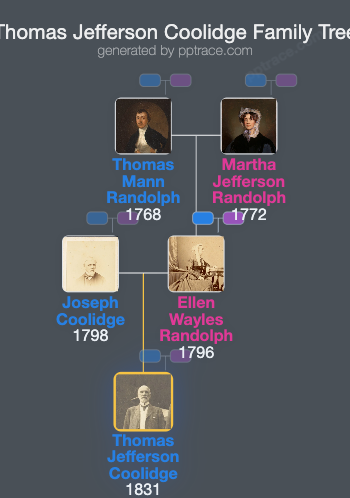
Thomas Jefferson Coolidge was born on August 26, 1831, in Boston, Massachusetts. He was the son of Joseph Coolidge (1798–1879) and Ellen Wayles (Randolph) Coolidge (1796–1876). Coolidge was part of a prominent Boston Brahmin family; his maternal great-grandfather was Thomas Jefferson, the third President of the United States, through his grandparents Thomas Mann Randolph Jr. and Martha Jefferson Randolph. His uncles included Thomas Jefferson Randolph and George Wythe Randolph. Additionally, he was a distant relative of Calvin Coolidge and was an uncle to Archibald Cary Coolidge (1866–1928) via his elder brother, Joseph Randolph Coolidge.
He received private education in Europe and graduated from Harvard University in 1850.
Professionally, Coolidge was engaged in various business ventures, particularly in textiles and banking. In 1853, he established a partnership with Joseph Peabody Gardner in the East India trade. By 1875, he became the manager of the Amoskeag Mill in Manchester, New Hampshire, which was the largest textile mill in the United States at the time. He later shifted his focus to finance and industrial investments, with interests spanning textiles, banking, railroads, publishing, and electricity sectors. In 1880, he shifted from manufacturing to railroads, serving as president of the Atchison, Topeka and Santa Fe Railway. He retired from this sector in the early 1890s and returned to the Amoskeag Company, becoming its president in 1898. Coolidge was also involved in organizing the United Fruit Company, where his son, Thomas J. Coolidge Jr., served as president.
In civic affairs, Coolidge participated in regional planning, contributing to the development of Boston’s park system.
Politically, Coolidge was aligned with the Republican Party. He was appointed as the United States Ambassador to France by President Benjamin Harrison on May 12, 1892, succeeding Whitelaw Reid. He presented his credentials on June 10, 1892, and served until his recall on May 4, 1893. He was part of the American delegation to the commission addressing the Alaska boundary dispute in 1898 and 1899. Historian Ernest May identified Coolidge as an early example of the modern foreign policy establishment.
Throughout his life, Coolidge also engaged in philanthropy. He donated the Grand Army Hall and a public library to Manchester-by-the-Sea, Massachusetts, with expenditures exceeding $40,000. He was an overseer at Harvard from 1886 to 1897, donating the Jefferson Research Laboratory and a chemical laboratory—constructed in memory of his son—with a combined value surpassing $165,000. He also contributed a $5,000 prize for college debates and, in 1898, donated a collection of Thomas Jefferson’s personal papers to the Massachusetts Historical Society. This collection included over 8,000 items, such as correspondence, Jefferson’s garden and farm books, annotated almanacs, account books, legal papers, weather notes, plans of American forts, and Jefferson’s personal library catalog.
In 1852, Coolidge married Mehitable "Hetty" Sullivan Appleton (1831–1901), daughter of William Appleton, a notable financier in the New England cotton textile industry. They owned residences in Boston and at Coolidge’s Point in Manchester-by-the-Sea. They had four children: Marian Appleton Coolidge, who married Lucius M. Sargent; Eleonora Randolph Coolidge, who married Frederick Richard Sears; Sarah Lawrence Coolidge, who married New York State Senator Thomas Newbold; and Thomas Jefferson Coolidge Jr., who graduated from Harvard in 1884 and became president of the Old Colony Trust Company until his death in 1912.
Thomas Jefferson Coolidge died at his Boston home on November 17, 1920. Among his notable contributions to art is the gifting of John Singer Sargent’s "El Jaleo" to Isabella Stewart Gardner in 1914.
His descendants include grandchildren Thomas Jefferson Coolidge III, Armory Coolidge, William A. Coolidge, and Thomas Jefferson Newbold. His granddaughter Eleonora Sears became an influential American sportswoman. The Coolidge family donated 42 acres of land to The Trustees of Reservations, now part of the Coolidge Reservation, in 1990 and 1991.