Henry Petty-Fitzmaurice, 5th Marquess Of Lansdowne
| Name | Henry Petty-Fitzmaurice, 5th Marquess Of Lansdowne |
| Title | British statesman (1845-1927) |
| Gender | Male |
| Birthday | 1845-01-14 |
| nationality | United Kingdom |
| Source | https://www.wikidata.org/wiki/Q337386 |
| pptrace | View Family Tree |
| LastUpdate | 2025-11-26T23:25:19.437Z |
Family Tree
Tap  to expand more relatives
Introduction
Henry Charles Keith Petty-Fitzmaurice, the 5th Marquess of Lansdowne, was born on 14 January 1845 and died on 3 June 1927. He was a British statesman who held several significant political and administrative positions during his career, including Governor General of Canada, Viceroy of India, Secretary of State for War, and Secretary of State for Foreign Affairs.
Early Life and Family Background:
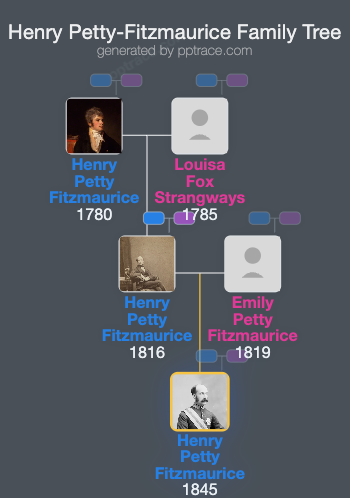
Lansdowne was born at Lansdowne House in London, the family seat. He was the eldest son of Henry Petty-Fitzmaurice, the 4th Marquess of Lansdowne, and Emily de Flahaut, 8th Lady Nairne. His maternal grandfather, Count Charles de Flahaut, was a prominent French general associated with Napoleon Bonaparte and held roles such as French ambassador and senator. Through his mother, Lansdowne was related to Emperor Napoleon III, Queen Hortense Bonaparte, and Prince Talleyrand, the foreign minister of Napoleon. His great-grandfather, George Elphinstone, 1st Viscount Keith, was a British admiral notable for his role in the aftermath of the Battle of Waterloo.
He was part of the Fitzmaurice/Petty-Fitzmaurice family, a cadet branch of the Irish House of FitzGerald. He inherited courtesy titles as Viscount Clanmaurice and later as Earl of Kerry before becoming the Marquess of Lansdowne in 1866 upon his father’s death. He also succeeded his mother as the 9th Lord Nairne in 1895.
Education:
Lansdowne was educated at Eton College and the University of Oxford.
Wealth and Estates:
He was one of the wealthiest peers in the United Kingdom at the time, estimated to be the sixteenth richest peer and the fourth largest landowner. His estates included Bowood House in Wiltshire and Derreen House in County Kerry, Ireland. He developed extensive gardens at Derreen House, starting in 1871, and spent approximately three months annually at this estate.
Political Career and Early Service:
Lansdowne entered the House of Lords in 1866 as a member of the Liberal Party. He served as a Lord of the Treasury from 1869 to 1872 and as Under-Secretary of State for War (1872–1874). In 1880, he was appointed Under-Secretary of State for India.
Governor General of Canada:
Appointed in 1883, Lansdowne served as Governor General of Canada until 1888. His tenure coincided with incidents such as the North-West Rebellion of 1885. He engaged in extensive travel across Western Canada and was known to support Indigenous Chiefs Crowfoot and Poundmaker. He bought a second residence on the Cascapédia River, Quebec, and played a role in resolving a fisheries dispute between Canada and the United States. He was well received by French-speaking Canadians due to his fluency in French. During his Canadian tenure, Lansdowne was decorated with the Order of Victoria and Albert and the Imperial Order of the Crown of India. Numerous places, including a town in India named Lansdowne and areas in Montreal, bear his name.
Viceroy of India:
Lansdowne was appointed Viceroy of India in 1888, a position he held until 1894. He was invested as GCSI and GCIE. His tenure involved reforms in the military, police, local governance, and currency. Notably, he oversaw the subjugation of Manipur following the Anglo-Manipur War in 1890, and he took a firm stance on the death penalty for the instigator of that conflict. His administration faced tensions between Hindus and Muslims.
Later Political Roles:
Returning to Britain, Lansdowne aligned with the Conservative Party as a Liberal Unionist. He was appointed Secretary of State for War in 1895 during the Second Boer War, a period marked by military criticism which he accepted responsibility for. From 1900 to 1905, he served as Secretary of State for Foreign Affairs under Prime Ministers Lord Salisbury and Arthur Balfour. During this time, he approved various treaties and agreements, including the 1901 Anglo-Ankole agreement in Uganda.
Lansdowne's career encompassed multiple facets of governance, diplomacy, and colonial administration, with his influence extending across the British Empire and its political landscape.