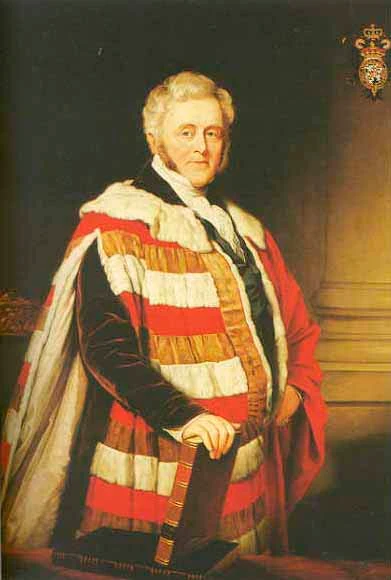
George Spencer-Churchill, 6th Duke Of Marlborough
| Name | George Spencer-Churchill, 6th Duke Of Marlborough |
| Title | British politician (1793-1857) |
| Gender | Male |
| Birthday | 1793-12-27 |
| nationality | United Kingdom of Great Britain and Ireland |
| Source | https://www.wikidata.org/wiki/Q333601 |
| pptrace | View Family Tree |
| LastUpdate | 2025-11-26T23:32:49.163Z |
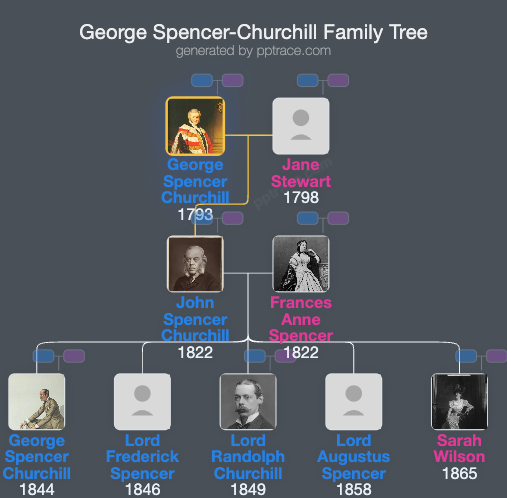
Family Tree
Tap  to expand more relatives
Introduction
George Spencer-Churchill, 6th Duke of Marlborough (born Spencer), was born on December 27, 1793, at Bill Hill, Hurst, Berkshire. He died on July 1, 1857, at Blenheim Palace. He was a British nobleman, politician, and peer, and the great-grandfather of Sir Winston Churchill.
He was the eldest son of George Spencer, Marquess of Blandford (later the 5th Duke of Marlborough), and Lady Susan Stewart, daughter of John Stewart, 7th Earl of Galloway. Originally bearing the surname Spencer, his family changed their surname to Spencer-Churchill by royal license on May 26, 1817.
His education included attendance at Eton College from 1805 to 1811, followed by studies at Christ Church, Oxford. He also received an honorary Doctorate of Civil Laws from Oxford University on June 15, 1841.
Between 1817 and 1840, he held the courtesy title Marquess of Blandford. He served as a Member of Parliament (MP) for Chippenham from 1818 to 1820, and for Woodstock during several periods: 1826-1831, 1832-1835, and 1838-1840. In 1840, he succeeded his father as the 6th Duke of Marlborough and entered the House of Lords. From 1842 until his death, he was appointed Lord-Lieutenant of Oxfordshire. Additionally, he was appointed Lieutenant-Colonel Commandant of the Queen's Own Oxfordshire Yeomanry on March 20, 1845, a position his two eldest sons also held.
Politically, Spencer-Churchill aligned as an Ultra-Tory, opposing the Liberal movement and Catholic emancipation. In response to the Roman Catholic Relief Act of 1829, he introduced a significant reform bill in February 1830, advocating for electoral reforms including the transfer of rotten borough seats to larger counties and towns, disfranchisement of non-resident voters, restrictions on Crown office holders from sitting in Parliament, payment of salaries to Members of Parliament, and a general property-based franchise.
In addition to his political pursuits, Spencer-Churchill participated in cricket, with records indicating a single first-class match in 1817, in which he scored a total of 4 runs. He was also an enthusiastic yachtsman, a member of the Royal Yacht Squadron, and participated in yachting events such as the 1851 America's Cup. In 1845, he challenged Henry Thomas Hope to a race from Yarmouth Roads around the Eddystone Lighthouse and back, a 224-mile course; the race was affected by heavy weather, causing both yachts to seek harbor.
Family-wise, he was married three times. Initially, he entered into a clandestine marriage with Susannah Law via a ceremony performed by his brother Lord Charles, with whom he had a daughter, Susanna. Afterward, he contested the legality of their cohabitation in court. His second wife was Harriet Caroline Octavia Spencer, with whom he had a daughter, Susan Harriett Elizabeth Churchill, who married her cousin Count Karl Theodor von Westerholt. His third wife was Lady Jane Stewart, his first cousin, whom he married in 1819. They had four children, including his eldest son, John Winston Spencer-Churchill, who succeeded him as the 7th Duke, and Lady Louisa Spencer-Churchill.
Following the death of his first wife in 1844, he married Charlotte Augusta Flower in 1846, with whom he had two children. After her death in 1850, he married Jane Frances Clinton Stewart in 1851, producing one more child, Lord Edward Spencer-Churchill.
He died at Blenheim Palace in 1857 and was succeeded by his eldest son. His widow, the Duchess of Marlborough, died in London in 1897 at the age of 79.