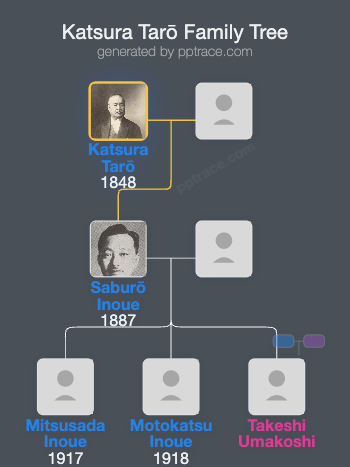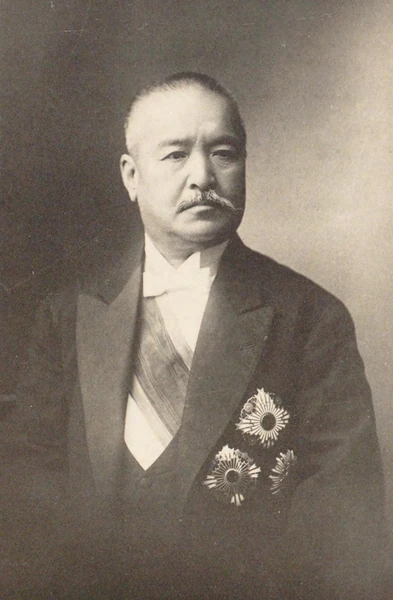
Katsura Tarō
| Name | Katsura Tarō |
| Title | Japanese general and politician (1848-1913) |
| Gender | Male |
| Birthday | 1848-01-04 |
| nationality | Japan |
| Source | https://www.wikidata.org/wiki/Q159048 |
| pptrace | View Family Tree |
| LastUpdate | 2025-11-17T10:07:48.933Z |
Family Tree
Tap  to expand more relatives
Introduction
Katsura Tarō (桂 太郎, 4 January 1848 – 10 October 1913) was a Japanese statesman and military officer. He served as the prime minister of Japan during three non-consecutive terms: from 2 June 1901 to 7 January 1906, from 14 July 1908 to 30 August 1911, and from 21 December 1912 to 20 February 1913. He was a member of the genrō, or senior statesmen, who influenced policy during the Meiji era. His total tenure as prime minister accumulated to 7 years and 330 days, making him the second-longest serving Japanese prime minister after Shinzō Abe.
Born in Hagi, Nagato Province (present-day Yamaguchi Prefecture), Katsura was the eldest son of a samurai family belonging to the Chōshū Domain. In his youth, he participated in the Boshin War, a conflict that contributed to the Meiji Restoration of 1868. After the conflict, he was recognized for his talents and was sent to Germany in 1870 to study military science. He served as a military attaché at the Japanese embassy in Germany during two periods: from 1875 to 1878 and from 1884 to 1885. He was promoted to major general upon returning to Japan and held various key positions within the Imperial Japanese Army, including Vice-Minister of War in 1886.
Katsura distinguished himself during the First Sino-Japanese War (1894–1895) while commanding the IJA 3rd Division under Yamagata Aritomo. His division notably executed a winter march to Haicheng and occupied Niuchwang, facilitating a junction with the IJA 2nd Army on the Liaodong Peninsula. Following the war, in 1896, he was appointed Governor-General of Taiwan for a brief period. From 1898 to 1901, he served as Minister of War.
Katsura's first term as prime minister began on 2 June 1901. His administration saw Japan emerge as an imperial power, marked by the signing of the Anglo-Japanese Alliance in 1902 and victory in the Russo-Japanese War (1904–1905). During this period, the Taft–Katsura agreement was reached with the United States, acknowledging Japanese influence over Korea. Katsura received multiple honors, including the Grand Cross of the Order of St Michael and St George from the United Kingdom and the title of marquess from Emperor Meiji. His domestic policy was characterized by conservative tendencies and a focus on strengthening imperial authority, often distancing himself from Party politics and the Imperial Diet.
He resigned in January 1906 over the unpopular Treaty of Portsmouth, which ended the Russo-Japanese War, though his resignation was part of a political arrangement brokered by Hara Takashi. He was awarded the Grand Cordon of the Supreme Order of the Chrysanthemum shortly thereafter.
Katsura returned to office on 14 July 1908, serving until 30 August 1911. His second term was marked by the annexation of Korea via the Japan–Korea Annexation Treaty of 1910 and the promulgation of the Factory Act in 1911, Japan’s first labor protection law. His leadership faced increasing public dissatisfaction due to perceptions of corruption and military influence.
His third and final term as prime minister was from 21 December 1912 to 20 February 1913, which initiating the Taisho Political Crisis. His appointment was seen as a political maneuver by the genrō to undermine constitutional processes. During this tenure, he founded the Rikken Dōshikai political party but was compelled to resign after the first successful vote of no confidence in Japanese history.
Katsura died of stomach cancer at the age of 65 on 10 October 1913. His funeral was held at Zōjō-ji in Tokyo, and he was buried at Shōin Jinja in Setagaya. Over his lifetime, he received numerous honors, including Japanese orders such as the Grand Cordon of the Order of the Sacred Treasure and foreign decorations from Russia, Germany, France, the United Kingdom, and other nations.