Prince Karl Of Hesse-Kassel
| Name | Prince Karl Of Hesse-Kassel |
| Title | German-Danish prince and general (1744-1836) |
| Gender | Male |
| Birthday | 1744-12-19 |
| nationality | Q529605 |
| Source | https://www.wikidata.org/wiki/Q213628 |
| pptrace | View Family Tree |
| LastUpdate | 2025-11-12T01:16:00.424Z |
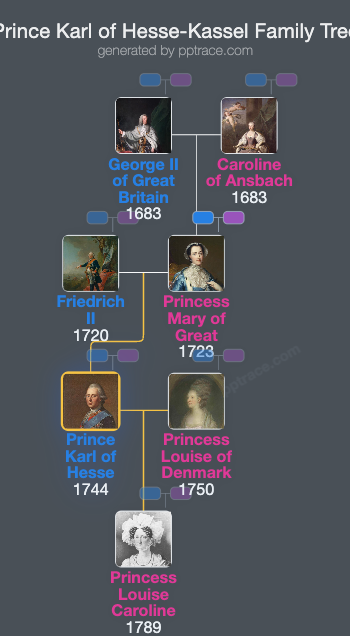
Family Tree
Tap  to expand more relatives
Introduction
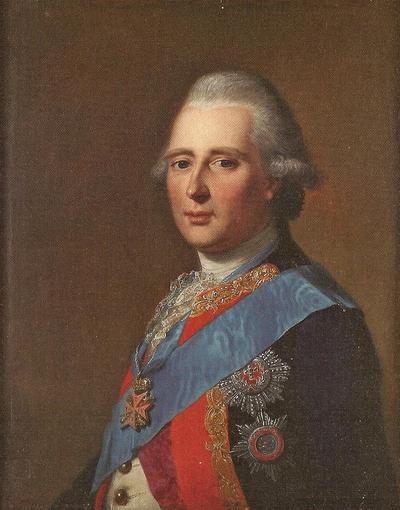
Prince Charles of Hesse-Kassel (Danish: Carl, German and Norwegian: Karl) was born on December 19, 1744, in Kassel. He was a cadet member of the House of Hesse-Kassel and held the rank of Danish general field marshal. He died on August 17, 1836, at Louisenlund Castle in Güby, Schleswig.
Family and Early Life
Charles was the second surviving son of Frederick II, Landgrave of Hesse-Kassel, and Princess Mary of Great Britain. His mother was a daughter of King George II of Great Britain and Princess Caroline of Ansbach, and sister to Queen Louise of Denmark. His father, the future Landgrave, reigned from 1760 until his death in 1785 and converted to Catholicism in 1749. His parents' marriage was formally ended in 1755, and his father's titles and revenues were granted to his mother and her sons by his grandfather, William VIII, Landgrave of Hesse.
From 1747, Charles was raised by his mother and fostered by Protestant relatives. In 1756, his mother moved to Denmark with her children to care for her sister’s children at the court of Christiansborg Palace in Copenhagen. As a result, Charles grew up largely in Denmark and became involved in Danish courts and military affairs. His elder brother William later returned to Hesse in 1785 upon becoming Landgrave.
Military Career and Service in Denmark-Norway
Charles commenced his military service in Denmark-Norway, gaining early promotions: appointed colonel in 1758 at age 14, major general in 1758, and in 1765, he was in charge of the artillery. After King Christian VII's accession in 1766, Charles was appointed lieutenant general, commander of the Royal Guard, knight of the Order of the Elephant, and a member of the Privy Council.
In 1766, he became Governor-general of Norway, succeeding Jacob Benzon; however, he never visited Norway during this appointment. In Denmark, he married Princess Louise of Denmark, his first cousin, on August 30, 1766. The marriage linked him to the Danish royal family, as Louise was the daughter of King Frederick V and Princess Louise of Great Britain. The marriage faced controversy due to accusations of debauchery but proceeded nonetheless.
In 1769, Charles was appointed royal Governor of the twin duchies of Schleswig and Holstein. Settling at Gottorp Castle, he also built the summer residence Louisenlund between 1772 and 1776, in honor of his wife.
Commander-in-Chief of the Norwegian Army
In September 1772, Charles became commander-in-chief of the Norwegian army amid tensions following the Swedish coup d'état. He and Louise moved to Christiana (now Oslo), where their daughter Juliane was born in 1773. Despite returning to Schleswig-Holstein in 1774, Charles retained his position as commander-in-chief of the Norwegian forces until 1814.
His military leadership included participation as a volunteer during the War of the Bavarian Succession in 1778–79 with Frederick the Great’s army, gaining the respect of the Prussian monarch. During the Russo-Swedish War (1788–1790), Charles commanded a Norwegian invasion of Sweden, participating in the Battle of Kvistrum Bridge and advancing toward Gothenburg before peace was signed in 1789.
In Norway, his campaign was criticized for its management, and his popularity there declined. When his daughter Marie Sophie married the future Crown Prince Frederick of Denmark in 1790, Charles attempted to influence government decisions unsuccessfully.
Freemasonry and Other Interests
Charles was a prominent supporter of Freemasonry in Denmark, founding numerous lodges. He served as Grand Master of the Rite of Strict Observance from 1796 until his death in 1836. He was involved in the founding of lodges in Frankfurt and Mainz, supporting members of Jewish communities and promoting Masonic activities. His interests also extended to alchemy and Rosicrucianism, and he was associated with the Order of the Illuminati, the Asiatic Brethren, and the Golden and Rosy Cross.
Later Life
Charles was involved in the arts, actively patronizing theater and opera, and operated his own theater in Schleswig. He commanded the Danish army during the French Revolutionary Wars, including occupying Hamburg and Lübeck in 1801. In 1805, his brother, the ruler of Hesse, granted him the title "Landgrave of Hesse."
In 1807, the estate of Gereby was renamed Carlsburg in his honor. He inherited the estate of Panker in 1808 after his cousin’s death. Following the 1814 dissolution of Denmark-Norway, he lost his military command in Norway but was appointed general field marshal of the Danish army. In 1816, he was made Grand Commander of the Order of the Dannebrog.
Marriage and Offspring
On August 30, 1766, at Christiansborg Palace in Copenhagen, Charles married Princess Louise of Denmark. Their children included:
- Marie Sophie (1767–1852), married King Frederick VI of Denmark and Norway
- Wilhelm (1769–1772)
- Prince Frederik (1771–1845), married morganatically Clarelia Dorothea von Brockdorff
- Juliane (1773–1860), Protestant Abbess of the Itzehoe Monastery
- Prince Christian (1776–1814)
- Princess Louise Caroline (1789–1867), married Friedrich Wilhelm, Duke of Schleswig-Holstein-Sonderburg-Glücksburg
Charles died in 1836 at Louisenlund Castle in Schleswig.