Alexandra Feodorovna
| Name | Alexandra Feodorovna |
| Title | Empress consort of Russia from 1894 to 1917 |
| Gender | Female |
| Birthday | 1872-06-06 |
| nationality | Russian Empire |
| Source | https://www.wikidata.org/wiki/Q152094 |
| pptrace | View Family Tree |
| LastUpdate | 2025-11-12T01:17:42.884Z |
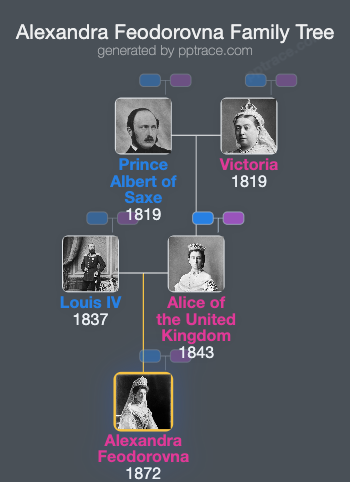
Family Tree
Tap  to expand more relatives
Introduction
Alexandra Feodorovna (Russian: Александра Фёдоровна Романова), born Princess Alix of Hesse and by Rhine on 6 June 1872, was the last Empress of Russia as the consort of Tsar Nicholas II. She was married to Nicholas II on 26 November 1894 and remained empress until his abdication on 15 March 1917. Alexandra was a granddaughter of Queen Victoria of the United Kingdom and was known for carrying hemophilia, a genetic disorder she passed to her son, Alexei Nikolaevich, Tsarevich of Russia.
Early Life:
Alix was born at the New Palace in Darmstadt, in the Grand Duchy of Hesse, part of the German Empire. She was the sixth child and fourth daughter of Louis IV, Grand Duke of Hesse, and Princess Alice of the United Kingdom, Queen Victoria's second daughter. She was baptized on 1 July 1872 in the Protestant Lutheran church, receiving the names of her mother and maternal aunts. Her nickname was "Sunny," reflecting her cheerful disposition, and her relatives in Britain called her "Alicky."
Her childhood was marked by the death of her brother Prince Friedrich of Hesse and by Rhine (Frittie), who suffered from hemophilia and died after a fall in 1873, and her mother Princess Alice, who died of diphtheria in 1878 when Alix was six. Queen Victoria took a protective interest in her, inviting her to England and sending her gifts, fostering a close relationship.
Proposed Matches and Engagements:
Queen Victoria hoped Alix would become the queen consort of the United Kingdom, but she rejected proposals from her first cousins, including Prince Albert Victor and later Prince George of Wales. She was also considered for matches with other European royals. Her future marriage to Nicholas II was facilitated by the death of Tsar Alexander III, who, in declining health, decided to allow Nicholas to marry Alix, providing stability for the Russian succession.
Marriage and Empress of Russia:
Alix converted from Lutheranism to Russian Orthodoxy upon marriage, taking the name Alexandra Feodorovna. She married Nicholas II in 1894, shortly after the death of Alexander III. Her coronation took place in 1896. Her relationship with the Russian populace was complex; she was unpopular due to her foreign origins, perceived aloofness, and her influence over her husband. Her association with the mystic Grigori Rasputin, who appeared to alleviate her son’s hemophilia, engendered scandals and rumors that further damaged her reputation.
Family and Children:
Alexandra bore four daughters—Olga, Tatiana, Maria, and Anastasia—and one son, Alexei, who suffered from hemophilia. Her intense concern for Alexei often kept her close to him, and she relied heavily on faith and Rasputin's alleged spiritual guidance to cope with his illness. Her relationship with her daughters was warm, though her bond with Olga was somewhat distant.
Health and Personality:
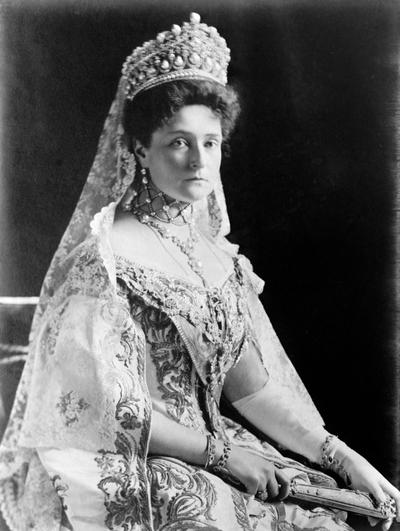
Alexandra was described as beautiful, tall, with luminous blue eyes and long red-gold hair. She was profoundly religious, devoutly Christian, and deeply serious, with a reserved and shy demeanor. Her health was fragile, affected by her frequent pregnancies and nervous exhaustion, possibly linked to Graves' disease. She spent much of her time in bed or reclined, anxious over her son’s health.
Role in Political Events:
Her involvement in court affairs and her influence over Nicholas, especially in appointing ministers under Rasputin’s sway, became sources of criticism. During World War I, her German背景 and perceived disloyalty fueled nationalist resentment. She believed deeply in the divine right of kings, opposing constitutional reforms and attempting to maintain autocratic authority.
Revolution and Execution:
Following the February Revolution in 1917, Nicholas II abdicated. Alexandra and her family were placed under house arrest, first at the Alexander Palace and later moved to Tobolsk in Siberia. In April 1918, they were transferred to Yekaterinburg, where on 17 July 1918, they were executed by Bolshevik forces. Their remains were initially disposed of in mine shafts and later recovered and identified through DNA analysis in the early 21st century. In 2000, Alexandra was canonized as a saint by the Russian Orthodox Church.
Posthumous Recognition:
Alexandra and her family were canonized as martyrs in 1981 by the Russian Orthodox Church Outside Russia and as passion bearers in 2000 by the Russian Orthodox Church. The remains of Alexandra, Nicholas, and three daughters are buried at the Peter and Paul Cathedral in Saint Petersburg.
Her life has been depicted in numerous cultural works, including films, books, and television series, often focusing on her role during Russia's last royal years and her association with Rasputin.
Her honors include various Russian and foreign decorations such as the Grand Cross of the Imperial Order of Saint Catherine, the Order of the Precious Crown from Japan, and the Order of Queen Saint Isabel from Portugal. Her correspondence and documents are preserved in archives in Yale University and in Germany.