Theodora Keogh
| Name | Theodora Keogh |
| Title | American writer (1919-2008) |
| Gender | Female |
| Birthday | 1919-06-30 |
| nationality | United States of America |
| Source | https://www.wikidata.org/wiki/Q7781650 |
| pptrace | View Family Tree |
| LastUpdate | 2025-11-17T06:42:25.769Z |
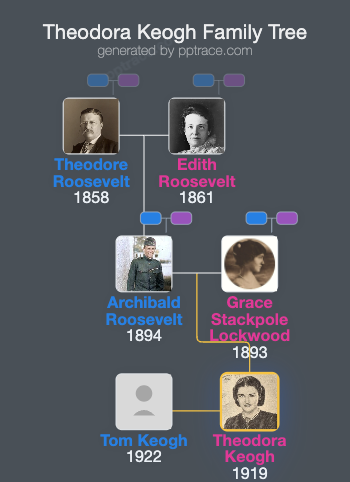
Family Tree
Tap  to expand more relatives
Introduction
Theodora Roosevelt Keogh O'Toole Rauchfuss was born on June 30, 1919, in New York City. She was a member of the Roosevelt family, being the granddaughter of President Theodore Roosevelt. Her parents were Grace Lockwood and Archibald Bulloch Roosevelt, the third son of Theodore Roosevelt. She was the eldest of three daughters.
Keogh was raised on the Upper East Side of Manhattan and in Cold Spring Harbor near Oyster Bay. Her educational background includes attendance at the Chapin School, Radcliffe College, and finishing her education at Countess Montgelas' in Munich, Germany. Following her academic pursuits, she was introduced as a debutante in New York society in 1937.
Her early career involved working as a professional dancer in Canada and South America, a profession she pursued until 1945 when she retired after marrying Tom Keogh, a costume designer and illustrator. The couple lived in Paris, where Tom Keogh contributed to theater and ballet design, worked on film costumes, and collaborated with Vogue magazine. Their social circle included writers and editors associated with the Paris Review, such as George Plimpton and Peter Matthiessen, as well as novelist Alexander Trocchi, poet Christopher Logue, and poet and screenwriter Eugene Walter.
In 1945, Keogh married Tom Keogh, and the couple moved to Paris. During her time there, she connected with various literary figures. After her marriage, Keogh shifted from her dance career to writing, producing nine novels published between 1950 and 1962. Her writing focused on characters with psychological conflicts, often featuring dark sides and exploring themes of homosexuality, making her an early contributor to lesbian pulp fiction. Her debut novel, "Meg," received praise from Patricia Highsmith, a writer known for psychological thrillers.
Keogh's novels, characterized by modernist and transitional literary styles, gained recognition for their psychological depth and exploration of taboo themes. However, her works were largely overlooked after the 1960s until they were rediscovered and reprinted by Olympia Press between 2002 and 2007.
Throughout her life, Keogh lived in multiple cities, including Paris, Rome, and New York, before settling in Caldwell County, North Carolina, in the 1970s. She divorced Tom Keogh in the 1960s after his affair with Marie-Laure de Noailles. Subsequently, she married Thomas "Tommy" O'Toole, a steward on the Circle Line, in 1979. They lived in an apartment at the Hotel Chelsea in New York, where she kept a margay, a South American wild cat. It is rumored that the margay nipped her earlobe one night while she was asleep.
In the 1970s, Keogh and O'Toole moved to North Carolina. They divorced in 1979, after which Keogh became friends with Arthur Rauchfuss's wife; Rauchfuss was a chemical plant owner. In 1979, Keogh married Arthur Rauchfuss. He died ten years later in 1989. Following his death, she resided in a house in the woods with cats and chickens until her death on January 5, 2008.
Keogh's bibliography includes the novels "Meg" (1950), "The Double Door" (1952), "Street Music" (1952), "The Tattooed Heart" (1953), "The Fascinator" (1954), "My Name Is Rose" (1956), "The Fetish" (1959), published in America as "The Mistress," "Gemini" (1961), and "The Other Girl" (1962).