Charles Ellice
| Name | Charles Ellice |
| Title | British Army general |
| Gender | Male |
| Birthday | 1823-01-01 |
| nationality | United Kingdom of Great Britain and Ireland |
| Source | https://www.wikidata.org/wiki/Q5077353 |
| pptrace | View Family Tree |
| LastUpdate | 2025-11-26T23:27:58.127Z |
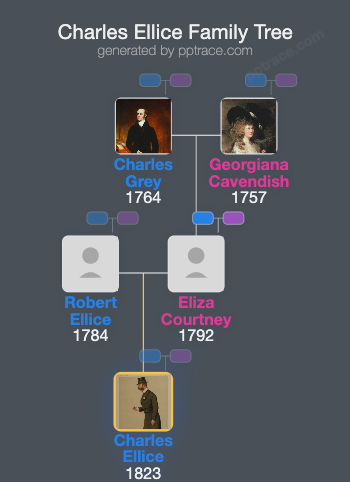
Family Tree
Tap  to expand more relatives
Introduction
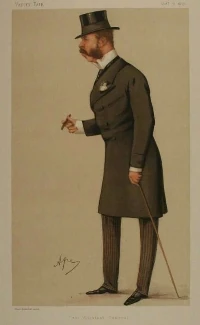
General Sir Charles Henry Ellice (10 May 1823 – 12 November 1888) was a British Army officer who held the position of Adjutant-General to the Forces.
Born in Florence, Italy, Ellice was the second son of General Robert Ellice. His family included notable relatives such as his uncle, the Right Honorable Edward Ellice, who served as secretary at war, and Eliza Courtney.
He received military training at the Royal Military College at Sandhurst, after which he was commissioned into the Coldstream Guards on 10 May 1839. Early in his career, Ellice served in Canada during the years 1840 to 1842. He was promoted to the ranks of lieutenant and captain on 8 August 1845.
On 20 March 1846, he exchanged to the 82nd Foot regiment, and shortly thereafter, on 3 April 1846, transferred to the 24th Foot, a regiment where his father held the colonelcy. Ellice accompanied this regiment to India in May of that year. Between 17 March 1848 and 3 March 1849, he served as aide-de-camp to his father, who was commanding troops in Malta. This assignment caused him to miss participation in the Second Sikh War.
He achieved the rank of major on 21 December 1849, and lieutenant-colonel on 8 August 1851. He was promoted to colonel in the army on 28 November 1854. During the Indian Mutiny, the 24th Foot was stationed at Peshawar when the rebellion broke out.
In July 1857, Ellice was dispatched to Jhelum with three companies of the 24th, along with native cavalry and artillery, with orders to disarm the 14th Bengal Native Infantry and other troops. Upon arrival, he engaged the garrison, which mutinied upon sighting his forces on 7 July 1857. Ellice led an assault that routed the mutineers in what became known as the Battle of Jhelum. During the battle, he was severely wounded in the neck, shoulder, and leg.
His conduct during the engagement earned him recognition; he was mentioned in official dispatches, received the medal for the campaign, and was made a Companion of the Order of the Bath on 1 January 1858. Subsequently, on 3 June 1858, he was appointed to command and raise the second battalion of the 24th Foot, which he led to Mauritius in March 1860. He exchanged to half-pay status on 8 July 1862.
Ellice’s later military appointments included command of a brigade in the Dublin district (25 May 1863), transfer to Dover (8 March 1864), and command of the South-Eastern District (1 September 1867 to 30 June 1868). His promotions continued with ranks of major-general (23 March 1865), lieutenant-general (28 September 1873), and full general (1 October 1877).
He served as Quartermaster-General to the Forces beginning in 1871, and in 1876, he was appointed Adjutant-General to the Forces. In this capacity, he provided the government with advice following the Battle of Isandlwana in 1879, asserting that the defeat of British forces against the Zulu was due to an underestimation of Zulu military capability.
During 1877–78, Ellice engaged in correspondence with the governors of Wellington College regarding concerns that the college was straying from its original purpose. This correspondence was published, leading to a subsequent inquiry.
He left the position of Adjutant-General in 1882 and retired from the army in 1887. He held the colonelcy of the 49th (Princess of Wales’s Own) Regiment from 1874 to 1881, and of the South Wales Borderers from 6 April 1884 until his death.
Ellice lived at 12 South Audley Street, London. He died at Brook House in Horringer, near Bury St Edmunds, on 12 November 1888.