Robert C. Buchanan
| Name | Robert C. Buchanan |
| Title | Union army general (1811-1878) |
| Gender | Male |
| Birthday | 1811-03-01 |
| nationality | United States of America |
| Source | https://www.wikidata.org/wiki/Q7342579 |
| pptrace | View Family Tree |
| LastUpdate | 2025-11-17T06:38:16.803Z |
Family Tree
Tap  to expand more relatives
Introduction
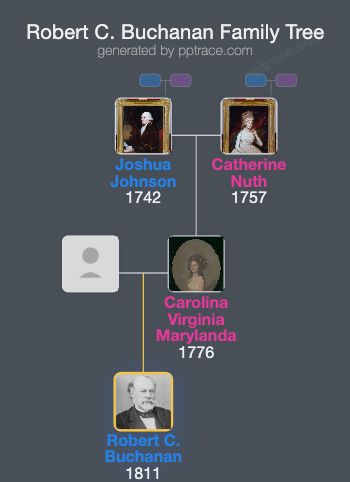
Robert Christie Buchanan was born on March 1, 1811, in Baltimore, Maryland. He was the son of Andrew Buchanan and Carolina Johnson, and was of Scottish ancestry. His grandfather, Andrew Buchanan, served as a brigadier general in the Maryland Militia during the American Revolution. Buchanan was related through family to prominent political figures; his maternal aunt was Louisa Adams, First Lady and wife of President John Quincy Adams, making him a nephew by marriage of President Adams.
He received an appointment to the United States Military Academy at West Point during the administration of John Quincy Adams and graduated in 1830. Following his graduation, Buchanan was assigned to the 4th U.S. Infantry with the rank of brevet second lieutenant. His early military service included participation in the Black Hawk War, where he commanded gunboats during the Battle of Bad Axe, and actions against the Seminoles, including the Battle of Lake Okeechobee in 1837, in which he was wounded. During his service in Florida, he attained the rank of captain.
Buchanan served in the Mexican–American War, commanding Maryland Volunteers in several major battles, including the Battle of Chapultepec, Battle of Palo Alto, Battle of Resaca de la Palma, Battle of Molino del Rey, and the capture of Mexico City. For his conduct during these battles, he received two brevets for gallantry in action. In 1847, he became a member of the Aztec Club of 1847, a military society comprising officers who served in the Mexican War.
Following the Mexican War, Buchanan held various postings and was involved in recruiting efforts. In 1853, his unit, the 4th Infantry, was assigned to northern California, where Buchanan established Fort Humboldt. This fort functioned as a buffer zone between settlers, prospectors, and Native American tribes. During his command, Captain Ulysses S. Grant served under him. It is documented that Buchanan requested Grant's resignation, allegedly due to issues related to Grant's drinking habits.
In 1855, Buchanan was promoted to major and commanded the District of Southern Oregon and Northern California, participating in the Rogue River Wars.
At the onset of the Civil War, Buchanan was stationed in San Francisco, California. He was subsequently ordered eastward, where his regiment helped defend Washington, D.C. He was promoted to lieutenant colonel on September 9, 1861, and commanded a brigade in the Army of the Potomac. Buchanan served with distinction during the Seven Days Battles in the summer of 1862, being twice brevetted for gallantry. He also participated in the Peninsula Campaign, Battle of Yorktown, and further battles during the Northern Virginia Campaign such as Second Battle of Bull Run and Antietam.
During the Maryland Campaign, Buchanan commanded the 1st Brigade, 2nd Division, V Corps. At the Battle of Antietam, he strongly opposed halting his advance on Cemetery Hill. He was appointed brigadier general of volunteers on November 29, 1862; however, this appointment expired without confirmation by the U.S. Senate on March 4, 1863. Despite this, Buchanan continued to serve, fighting in subsequent battles and performing recruiting duties.
In 1864, Buchanan was promoted to colonel of the 1st U.S. Infantry Regiment. He received brevet appointments for his performance at the Battle of Malvern Hill (1865), Battle of Second Bull Run, and Battle of Fredericksburg. These brevet ranks were confirmed by the Senate in 1866.
After the Civil War, Buchanan was tasked with enforcing Reconstruction policies in New Orleans and commanded the Department of Louisiana. He also served in the Freedmen's Bureau. A nomination for brigadier general in 1868 was tabled by the Senate, and he retired from the Army on December 31, 1870, while serving as commander of Fort Porter in New York.
Robert C. Buchanan died in Washington, D.C., on November 29, 1878. He was interred at Rock Creek Cemetery.