Maeda Toshiatsu
| Name | Maeda Toshiatsu |
| Title | Japanese daimyo and bureaucrat (1856-1921) |
| Gender | Male |
| Birthday | 1856-07-28 |
| nationality | Japan |
| Source | https://www.wikidata.org/wiki/Q11397419 |
| pptrace | View Family Tree |
| LastUpdate | 2025-11-17T10:08:56.045Z |
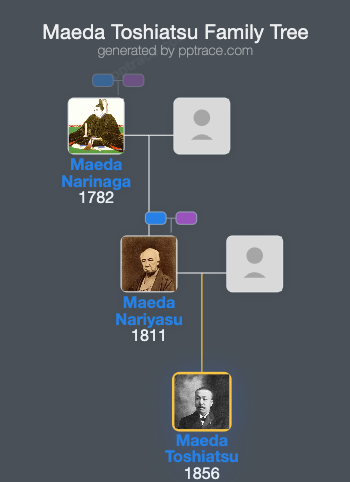
Family Tree
Tap  to expand more relatives
Introduction
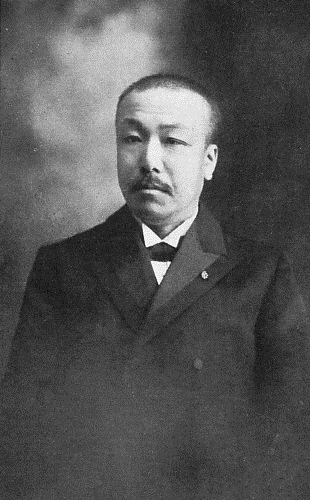
Toshihisa Maeda (June 27, 1856 – December 23, 1921) was a feudal lord (daimyo) at the end of the Edo period and a bureaucrat and aristocrat during the Meiji and Taisho periods. His court rank was Second Rank Upper (Shō-ni-i), his decorations included the Fourth Class of the Order of Merit, and his peerage was that of a count (hakushaku), bestowed in 1884 (Meiji 17). He served as the 13th lord (daimyo) of the Toyama Domain and as the chief retainer (chibunji) of the domain, later holding positions such as chamberlain, shikibu official, and advisor to the Imperial Court within the Imperial Household Ministry, as well as diplomatical posts including secretary at the consulate of the Foreign Ministry.
Regarding his birth and family background, he was born in Edo (Tokyo) on June 27, 1856, as the eleventh son of Maeda Nariyoshi, the lord of Kaga Domain. Records indicate that his mother was the daughter of the Kago family. His father, Nariyoshi, was the lord of Kaga, and on November 22, 1859 (Ansei 6), Toshihisa succeeded as the daimyo of Toyama Domain. Among his siblings, he was the foster son of Count Maeda Toshioki.
During his tenure as the head of Toyama Domain, he was still a child, so the actual authority was exercised by his father Nariyoshi. The history of his appointment includes conflicts between Toshioki and Nariyoshi, and the circumstances of his accession were supported by Nariyoshi. Following the Meiji Restoration, with the reorganization of domains into prefectures (haien hōkan) in 1869, he was appointed governor of Toyama Domain but was dismissed in 1871 (Meiji 4) following the abolition of the han system, after which he moved to Tokyo.
He also studied abroad; in October 1871 (Meiji 4), he was permitted to study in France, initially residing in Paris and subsequently in London, England. He returned to Japan in April 1882 (Meiji 15). After his studies, he worked in the Ministry of Foreign Affairs, starting as the scribe at the French legation, then as an official—御用掛 (Goyōgake)—and later served as a shikibu officer in the Imperial Household Ministry. He was granted the peerage of count in 1884.
In March 1893 (Meiji 26), he resigned from his position as the secretary at the legation of the Foreign Ministry. He died of a cerebral hemorrhage on December 23, 1921 (Taisho 10), at the age of 66. He was buried at Gokoku-ji in Bunkyō Ward.
His family: he married Mitsuko, the daughter of Matsudaira Teruoki of the Matsudaira family, as his formal wife. His children include his eldest daughter, Maeda Kanko (1893–1978), his second daughter, Maeda Beniko (1895–1965), and his third daughter, Maeda Kyōko (born 1909). He also adopted heirs, Maeda Toshiwo and Maeda Torizane.
Regarding honors, he was awarded the Junior Second Rank (Juni-ni-i) on July 10, 1908, and elevated to the Second Rank Upper (Shō-ni-i) in 1921. His medals include the Fourth Class of the Order of the Rising Sun (awarded in 1885), and in 1908, he was authorized to wear the Second Class Third Double Dragon Treasure Star of the Qing Dynasty. He was also conferred the title of count along with these honors.