George Lamb
| Name | George Lamb |
| Title | British politician and writer |
| Gender | Male |
| Birthday | 1784-07-11 |
| nationality | United Kingdom of Great Britain and Ireland |
| Source | https://www.wikidata.org/wiki/Q5541503 |
| pptrace | View Family Tree |
| LastUpdate | 2025-11-12T00:46:18.669Z |
Family Tree
Tap  to expand more relatives
Introduction
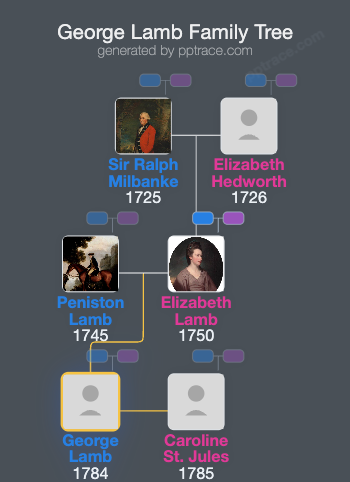
George Lamb (11 July 1784 – 2 January 1834) was a British politician and writer. He was the youngest son of Elizabeth Lamb, Viscountess Melbourne, and Peniston Lamb, 1st Viscount Melbourne. His mother's numerous romantic relationships have led to speculation regarding his paternity, with rumors suggesting that George IV, then the Prince of Wales and who acted as Lamb's godfather, may have been his biological father. George Lamb had siblings including William Lamb, 2nd Viscount Melbourne; Frederick Lamb, 3rd Viscount Melbourne; and Emily Lamb, Countess Cowper.
He received education at Eton College before attending Trinity College, Cambridge, where he attained a Master of Arts degree in 1805. On 17 May 1809, he married Caroline Rosalie Adelaide St. Jules, believed to be the illegitimate daughter of William Cavendish, 5th Duke of Devonshire, and Lady Elizabeth Foster. The marriage reportedly did not produce any children, and there has been speculation that it was never consummated. Accounts indicate that George Lamb often neglected his wife to devote time to theater and literary pursuits, leading to marital difficulties. Caroline St. Jules engaged in an affair with Henry Brougham in 1816, and she expressed feelings of confinement within the marriage. Lady Elizabeth Foster, Caroline's mother, disapproved of Lamb's treatment of her daughter and described him unfavorably. Despite these issues, the marriage eventually stabilized, with Caroline and George remaining together until his death in 1834. Caroline St. Jules died in 1862, having outlived George Lamb by nearly 28 years, and she never remarried.
Professionally, George Lamb became a barrister at Lincoln's Inn. He served as Member of Parliament for Westminster from March 1819 to March 1820, and subsequently represented Dungarvan from 1822 until his death in 1834. During his political career, he served as Under-Secretary of State for the Home Department under Earl Grey's administration from 1830 until his death.
Lamb's literary contributions include a comic opera titled "Whistle for it," produced in 1807, and adaptations such as "Timon of Athens" in 1816. His most notable work was a translation of the poems of Catullus, published in 1821.