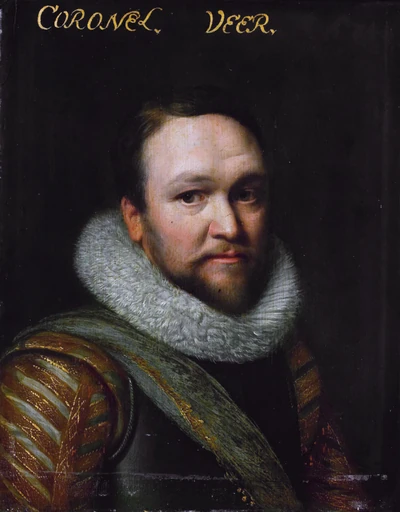
Horace Vere, 1st Baron Vere Of Tilbury
| Name | Horace Vere, 1st Baron Vere Of Tilbury |
| Title | English Baron |
| Gender | Male |
| Birthday | 1565-00-00 |
| nationality | Kingdom of England |
| Source | https://www.wikidata.org/wiki/Q2753558 |
| pptrace | View Family Tree |
| LastUpdate | 2025-11-26T23:21:51.337Z |
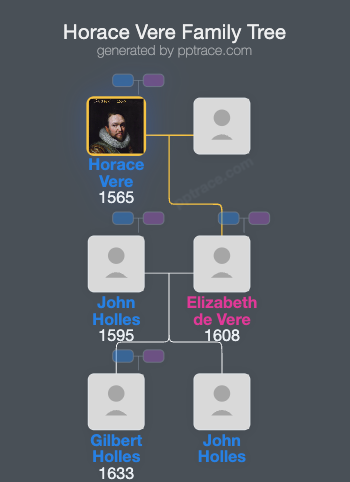
Family Tree
Tap  to expand more relatives
Introduction
Horace Vere, 1st Baron Vere of Tilbury (1565 – 2 May 1635), was an English military officer notable for his service during the Eighty Years' War and the Thirty Years' War. He was a member of the Vere family, the son of Geoffrey Vere of Crepping Hall, Essex, and Elizabeth Trussell. His paternal grandfather was John de Vere, the 15th Earl of Oxford. Horace Vere was the fourth son among his siblings, which included brothers John Vere, Sir Francis Vere, and Robert Vere, and a sister, Frances Vere.
Vere's early military career began in 1590 when he joined his brothers in the Netherlands, serving initially in the infantry under Sir Francis Vere, who was then sergeant-major-general. He participated in the assault on Steenwijk in 1592 and was wounded, and later received a knighthood for his actions at the siege of Cádiz in 1596. In 1597, he assumed command of English forces in the Netherlands temporarily during Sir Francis Vere’s absence. Vere took part in various campaigns, including the capture of Rheinberg, Meurs, and other key towns alongside Maurice of Orange. He fought in the Battle of Nieuwpoort and participated robustly in the Siege of Ostend in 1602, where he sustained a leg injury.
Following Sir Francis Vere's retirement from military service, Vere succeeded him in command in the Netherlands. He gained recognition for his role in the surrender of Sluys in 1604, and in 1605 he distinguished himself at the Battle of Mülheim by commanding infantry and managing to hold off the Spanish forces temporarily, allowing others to rally. Vere returned to England in 1607, the same year he married. In 1609, he became governor of the Brill, a key harbor, and was promised the reversion of the mastership of ordnance. By 1610, he served at the siege of Juliers, and in 1616, he surrendered the town of Brielle to the Dutch, receiving a pension for his loss of the governorship of the place. In 1618, he was appointed governor of Utrecht and actively aided the suppression of provincial levies in support of Johan van Oldenbarnevelt.
Vere's involvement in the Palatinate campaign in 1620 occurred amidst the broader context of the escalating conflicts involving Protestant and Catholic powers in Europe. He was appointed to command a force of 2,200 volunteers dispatched to aid the Protestant cause in the Electorate of the Palatinate. The regiment sailed from Gravesend in July 1620 and engaged in subsequent military operations across Germany. During the campaign, Vere's forces operated in various fortified towns, including Mannheim, Heidelberg, and Frankenthal, defending these positions against imperialist and Spanish forces. Notably, Vere's defense of Mannheim and Frankfurt came under siege, and despite his efforts, the towns were ultimately captured in 1622–1623. His courageous defense of Mannheim and Frankenthal was later acknowledged in England, and he was appointed master-general of the ordnance for life in 1623 and a member of the council of war in 1624.
Vere was elevated to the peerage of England as "Baron Vere of Tilbury" following his military service. He died on 2 May 1635, without a male heir, leading to the extinction of the barony.