Charles Lilburn Lewis
| Name | Charles Lilburn Lewis |
| Title | American pioneer |
| Gender | Male |
| Birthday | 1747-01-01 |
| nationality | — |
| Source | https://www.wikidata.org/wiki/Q5080247 |
| pptrace | View Family Tree |
| LastUpdate | 2025-11-28T20:11:00.501Z |
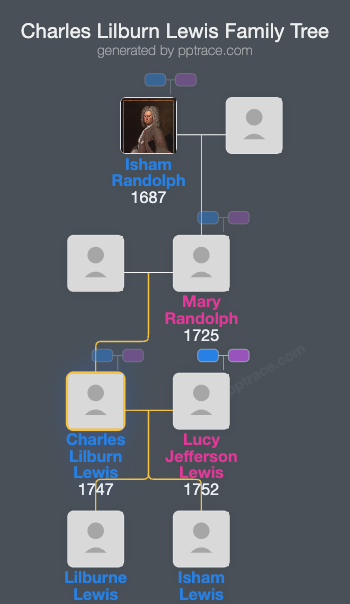
Family Tree
Tap  to expand more relatives
Introduction
Charles Lilburn Lewis (1747 – 1831 or 1837) was a Virginian planter and military officer, known for his role as a signer of the Albemarle County Declaration of Independence in 1779 and as one of the founders of Milton, Virginia. He was born in 1747 in Albemarle County, Virginia, the eldest son of Colonel Charles Lewis of Buck Island and Mary Randolph. His maternal aunt, Jane Randolph Jefferson, was the mother of President Thomas Jefferson, making Lewis a first cousin to Jefferson and other Jefferson family members. The Lewis family belonged to the wealthier class of plantation owners and slaveholders in Virginia.
Lewis received a conventional education alongside his Jefferson cousins at Buck Island, approximately eight miles from Charlottesville, Virginia. Beginning around age 16, he learned about plantation management and business affairs from his father, with occasional borrowing of books from Thomas Jefferson's library.
On September 12, 1769, Lewis married his first cousin, Lucy Jefferson, sister of Thomas Jefferson. The couple initially resided in a two-story log cabin on the Buck Island plantation, south of the Rivanna River. They had approximately eight or nine children, including a son named Charles. Their children included Randolph, who married his cousin Mary Howell Lewis in 1790 and had eight children before dying in 1809; Jane Jefferson Lewis, married to Craven Peyton with whom she had five children; Lilburne Lewis, who married Jane Woodson and later Letitia Rutter, with whom he had one child; Mary Randolph Lewis, married to Thomas Jefferson's son Thomas; Lucy B. Lewis, married to Washington A. Griffin and residing near Shelbyville, Kentucky; Martha Lewis, married to William Monroe; and Ann M. (Nancy), who died unmarried. Charles, the youngest son, was commissioned as a lieutenant in the U.S. Army by his uncle Thomas Jefferson and died in April 1806 during military service. Elizabeth Lewis also died in 1806.
Following the death of his wife Lucy in 1811, Lewis's family experienced further hardships, including the death of their eldest son Randolph, his wife Mary, and Lilburne's wife, all by early 1812. The family relocated to Kentucky around 1806–1808, settling near Smithland on the Ohio River. There, they owned large tracts of land and numerous slaves, totaling about 45 people in the family and enslaved population.
During the American Revolutionary War, Lewis participated in signing a declaration of independence for Albemarle County. He served in the Continental Army, initially joining his father and brother Isham in a militia company. Lewis attained the rank of colonel by 1782. His estate, named Monteagle or Mt. Eagle, was built on inherited land and became his family residence. However, by the early 19th century, he had lost much of his wealth, possibly due to agricultural losses and mismanagement.
In 1806, Thomas Jefferson awarded Lewis a military commission as a lieutenant in the U.S. Army, which Lewis gratefully acknowledged in his correspondence. His brother Isham received land and other possessions but also faced financial decline. Isham later sought Jefferson's assistance in establishing a surveying career.
In Kentucky, the Lewis family faced numerous challenges, including economic hardship, health issues such as recurrent malaria, and the death of family members. In December 1811, Lilburne and Isham Lewis committed the murder of an enslaved young man named George, an act that was eventually uncovered after a fallen chimney revealed remains linked to the crime. Both brothers were arrested; Lilburne committed suicide in 1812, while Isham later died following his service in the Battle of New Orleans in 1815.
Charles Lilburn Lewis's death is recorded as occurring in either 1831 or 1837. His life encompassed roles as a Revolutionary signer, military officer, plantation owner, and participant in early American state formation, with his familial connections linking him closely to notable figures in Virginia and American history.