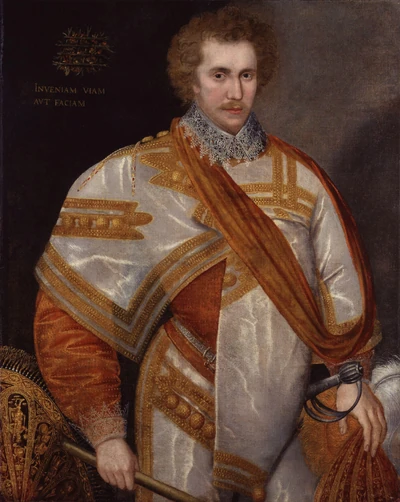
Robert Sidney, 1st Earl Of Leicester
| Name | Robert Sidney, 1st Earl Of Leicester |
| Title | English noble and diplomat (1563-1626) |
| Gender | Male |
| Birthday | 1563-11-19 |
| nationality | Kingdom of England |
| Source | https://www.wikidata.org/wiki/Q2158828 |
| pptrace | View Family Tree |
| LastUpdate | 2025-11-26T23:21:50.405Z |
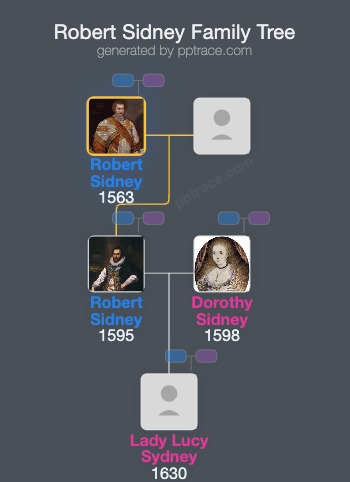
Family Tree
Tap  to expand more relatives
Introduction
Robert Sidney, 1st Earl of Leicester, was born on 19 November 1563 and died on 13 July 1626. He was an English courtier, soldier, and landowner. Sidney held the position of chamberlain to Anne of Denmark, Queen consort of King James I of England.
Family Background:
Robert Sidney was the second son of Sir Henry Sidney, a notable English statesman of the Elizabethan and Jacobean eras. His mother was Mary Sidney, née Dudley, who served as a lady-in-waiting to Queen Elizabeth I. Mary Sidney was the sister of Robert Dudley, 1st Earl of Leicester, a prominent advisor and favorite of Queen Elizabeth I.
Education and Early Career:
Sidney was educated at Shrewsbury School and Christ Church, Oxford. Following his studies, he traveled on the European continent between 1578 and 1583. In 1585, he was elected Member of Parliament for Glamorganshire. That same year, Sidney accompanied his elder brother, Sir Philip Sidney, to the Netherlands, where he participated in the war against Spain under Robert Dudley's command.
Military Service and Diplomacy:
He was present at the Battle of Zutphen, where Sir Philip Sidney was mortally wounded. Sidney remained with his brother during this period. In August 1588, Elizabeth I dispatched him on a diplomatic mission to Scotland, and in 1593, he undertook a similar diplomatic task in France. Sidney returned to the Netherlands in 1606 and served there for the next two years, notably as governor of the town of Flushing, a role he assumed in 1588.
His correspondence during this period, particularly through letters sent by his business manager Rowland Whyte, provides valuable historical insights. Whyte often complained about Sidney's handwriting, which was difficult to decipher. Sidney also sought resources and reported political developments, including the latest court gossip.
Roles under James I:
Following the accession of James I in 1603, Sidney returned to England. He purchased new clothing to meet King James I at Lord Harington’s house at Burley. He was elevated to the peerage as Baron Sidney of Penshurst and appointed as chamberlain and surveyor to Queen Anne of Denmark. His responsibilities included managing her jointure lands and revenues, as well as working on arrangements for the enlargement of the park at Nonsuch Palace for the Queen's residence.
He was recognized as an influential courtier, receiving gifts from foreign ambassadors, such as a chain of perfumed gold beads and diamonds from the Marquis de Rosny with a miniature of Henry IV of France. In 1605, he was involved in the production of the masque "The Masque of Blackness." Later that year, he was created Viscount Lisle.
In August 1605, Sidney attempted to visit Vlissingen but was forced to land at Gravelines due to a storm. Suspicion at the court led to allegations that he might have intended to betray the English-held fortress there; however, he successfully cleared himself of these accusations.
Later Life and Titles:
In September 1614, Sidney reported on Queen Anne of Denmark’s health, noting her discomfort in her legs and feet. In 1615, he traveled with the Queen to Bath, where his daughter Catherine and her husband Lewis Mansel were also present. In 1618, Sidney wrote to Sir Thomas Lake about the Queen’s declaration concerning household expenses. That same year, he was elevated to Earl of Leicester, a title previously held by his maternal uncle. His promotion was partly attributed to Queen Anne of Denmark's influence.
He was ill in September 1618 and received medical attention at Hampton Court from Henry Atkins and Théodore de Mayerne.
Marriage and Children:
Robert Sidney married twice. His first wife was Barbara Gamage, an heiress and daughter of John Gamage of Coity Castle. With Barbara Gamage, he had eleven children:
- Mary Sidney (c. 1587 – c. 1653), also known as Lady Mary Wroth, and a poet; she married Sir Robert Wroth.
- Catherine Sidney (c. 1589 – 1616), married Sir Lewis Mansel.
- Sir William Sidney (1590–1612), his eldest son, died unmarried.
- Henry Sidney (1591).
- Elizabeth Sidney (1592–1605).
- Philippa Sidney (1594–1620), performed in masques and married Sir John Hobart.
- Robert Sidney, 2nd Earl of Leicester (1595–1677), his heir.
- Bridget Sidney (1597–1599).
- Alice Sidney (1598–1599).
- Barbara Sidney (1599–1643), married Thomas Smythe and Thomas Culpeper.
- Vere Sidney (1602–1606).
His second marriage was to Sarah Blount, daughter of William Blount and widow of Sir Thomas Smythe; with her, Sidney had no children.
Cultural Contributions:
Sidney was a patron of literature and music. His courtly lifestyle at Penshurst Place was celebrated by Ben Jonson. He sponsored musicians, including Robert Jones and Robert Dowland. His personal poetry, initially not widely recognized, was later discovered through his surviving notebooks, which contain extensive self-written verse from the Elizabethan period.
Armorial Bearings:
The arms of Robert Sidney, 1st Earl of Leicester, featured sixteen quarters with various heraldic symbols representing his family lineage. The over-all shield included an inescutcheon of his wife’s paternal arms.
References:
The primary source for his poetic works is "The Poems of Robert Sidney," edited by P. J. Croft. Additionally, his biography is included in the 1911 edition of the Encyclopædia Britannica.
External links and further readings are available, including manuscripts of his poetry and scholarly analyses of his life and works.