Aubrey De Vere
| Name | Aubrey De Vere |
| Title | Irish poet |
| Gender | Male |
| Birthday | 1788-01-17 |
| nationality | — |
| Source | https://www.wikidata.org/wiki/Q18572296 |
| pptrace | View Family Tree |
| LastUpdate | 2025-11-26T12:55:39.781Z |
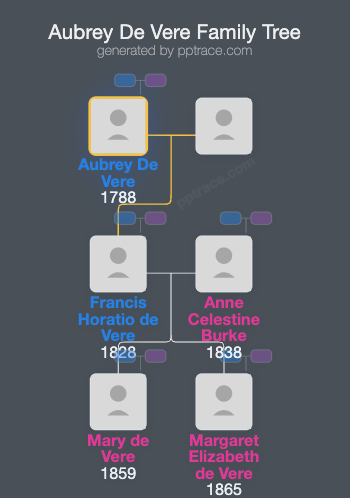
Family Tree
Tap  to expand more relatives
Introduction
Sir Aubrey (Hunt) de Vere, 2nd Baronet, was born on 28 August 1788 and died on 5 July 1846. He was an Anglo-Irish landowner and poet.
His parents were Sir Vere Hunt, 1st Baronet, and Eleanor Pery. Eleanor Pery was the daughter of William Pery, 1st Baron Glentworth, and Jane Walcott, his first wife. Sir Aubrey de Vere was educated at Harrow School, where he developed a childhood friendship with Lord Byron. He furthered his education at Trinity College, Dublin.
In 1807, he married Mary Spring Rice, the daughter of Stephen Edward Rice and Catherine Spring. Mary was also the sister of Thomas Spring Rice, 1st Baron Monteagle of Brandon. Sir Aubrey de Vere succeeded to his father's baronetcy in 1818.
He and his wife Mary had five sons and three daughters. Their children included Aubrey and Stephen de Vere, who became the third and fourth baronets respectively, as well as the poet Aubrey Thomas de Vere. Two of their daughters died in infancy.
The family estate, known as the Hunt/de Vere estate, remained in their possession for about 300 years, from 1657 to 1957. It includes what is now Curraghchase Forest Park in County Limerick. Sir Aubrey spent most of his life managing and residing on this estate.
A notable financial challenge arose due to his ownership of the island of Lundy, which his father purchased in 1802. The purchase proved financially burdensome, and Sir Aubrey was unable to find a buyer for Lundy during his lifetime. It was eventually sold by his son around 1830 or 1834.
Sir Aubrey de Vere was active in public life, serving as High Sheriff of County Limerick in 1811. He also sought political office, participating in the 1820 General Election, where he secured third place with 2,921 votes.
In 1832, he changed his surname from Hunt to de Vere, reflecting his ancestral connection to the de Vere family, originating from Aubrey de Vere I, a tenant-in-chief of William the Conqueror in 1086.
As a poet, Sir Aubrey de Vere received praise for his sonnets, with William Wordsworth describing them as some of the most perfect of the age. His literary works include the drama "Mary Tudor," published posthumously by his son Aubrey Thomas de Vere in 1875 and 1884. Other notable works by Sir Aubrey include the "Ode to the Duchess of Angouleme" (1815), "Julian the Apostate: A Dramatic Poem" (1822), "The Duke of Mercia: An Historical Drama," and "The Lamentation of Ireland, and Other Poems." His collection also features "A Song of Faith: Devout Exercises and Sonnets."