Roald Sagdeev
| Name | Roald Sagdeev |
| Title | Russian physicist (born 1932) |
| Gender | Male |
| Birthday | 1932-12-26 |
| nationality | Soviet Union |
| Source | https://www.wikidata.org/wiki/Q2038350 |
| pptrace | View Family Tree |
| LastUpdate | 2025-11-17T06:44:31.675Z |
Family Tree
Tap  to expand more relatives
Introduction
Roald Zinnurovich Sagdeev (Russian: Роальд Зиннурович Сагдеев; Tatar: Роальд Зиннур улы Сәгъдиев; born December 26, 1932) is a Russian scientist specializing in plasma physics and has held various academic and research positions. He served as the director of the Space Research Institute of the USSR Academy of Sciences and was an advisor to Soviet President Mikhail Gorbachev on scientific matters.
Sagdeev was born in Moscow and is of Tatar ethnicity. His maternal grandfather was a mathematics teacher. His family, who spoke Russian primarily at home, moved from Tatarstan to Moscow shortly after his birth. He lived near the Nikitsky Gates until the age of four before relocating to Kazan, where he completed high school. During his youth, he was recognized as an outstanding student, receiving a silver medal, and was also a champion of chess among local juniors. His brother, Renad Zinnurovich Sagdeev, was born in 1941 and later studied chemistry.
He attended Moscow State University, where he studied nuclear science and graduated in 1955 with a doctorate in physics and mathematics. During his time at university, he was one of the few students of physicist Lev Landau and resided in close proximity to future prominent figures, including Mikhail Gorbachev and Raisa Gorbacheva.
Following his graduation, Sagdeev joined the Kurchatov Institute of Atomic Energy as part of the controlled fusion team, working under Igor Kurchatov from 1956 to 1961. From 1961 to 1970, he was the head of a laboratory at the Institute of Nuclear Physics in Novosibirsk, part of the Siberian Division of the USSR Academy of Sciences. At 35 years old, he was elected a full member of the Soviet Academy of Sciences, making him one of the youngest individuals to achieve this distinction. Between 1970 and 1973, he worked at the Institute of Physics of High Temperatures, also part of the USSR Academy of Sciences. His research focused on the behavior of hot plasma and controlled thermonuclear fusion, gaining recognition internationally.
In 1973, Sagdeev was appointed director of the Space Research Institute of the USSR Academy of Sciences, a position he held until 1988. During his tenure, he oversaw numerous space projects, including the Kosmos, Forecast, Interkosmos, Meteor, and Astron programs. He contributed to or managed space missions such as the Soviet Venera probes to Venus, the joint Soviet-U.S. Soyuz-Apollo Test Project, and the Venus-Halley (Vega) and Phobos missions. He authored studies on plasma physics and magnetofluid dynamics. In 1984, he received the Lenin Prize for his work on the neoclassical theory of transport processes in toroidal plasma.
Sagdeev participated in political and scientific advisory roles during the later years of the Soviet Union. He engaged with work commissioned during Yuri Andropov’s leadership to provide scientific justifications for nuclear disarmament. Under Gorbachev, he advised on issues related to civil and military space activities. In 1986, he was awarded the Hero of Socialist Labour for his involvement in the international research program related to Halley’s Comet. He was elected to the Supreme Soviet of the USSR in 1987 and advised Gorbachev and Eduard Shevardnadze at summits in Geneva (1985), Washington D.C. (1987), and Moscow (1988). Following some disagreements and a public critique of the Soviet supercomputer program, he was removed from a state visit to Poland in 1988.
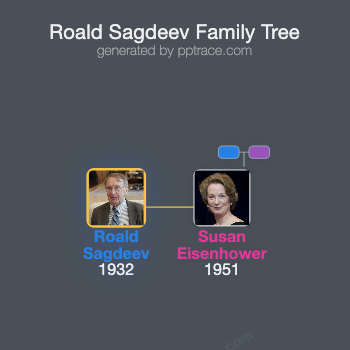
In his personal life, Sagdeev married Susan Eisenhower in 1990, after meeting her at a U.S.-Soviet forum in 1987. Eisenhower is the granddaughter of U.S. President Dwight D. Eisenhower. They later divorced; as of 2008, Sagdeev was no longer married to her.
Since the end of the Cold War, Sagdeev has been a Distinguished Professor of Physics at the University of Maryland, College Park. He is a member of the U.S. National Academy of Sciences and the Royal Swedish Academy of Sciences. He also serves on the Supervisory Council of the International Luxembourg Forum on Preventing Nuclear Catastrophe. Additionally, he is a senior advisor at the Albright Stonebridge Group, a global strategy firm, where he provides expertise on issues involving Russia and the former Soviet Union.