Arabella Denny
| Name | Arabella Denny |
| Title | Irish philanthropist, founder of the Magdalen Asylum |
| Gender | Female |
| Birthday | 1707-01-01 |
| nationality | — |
| Source | https://www.wikidata.org/wiki/Q4783326 |
| pptrace | View Family Tree |
| LastUpdate | 2025-11-26T12:29:39.303Z |
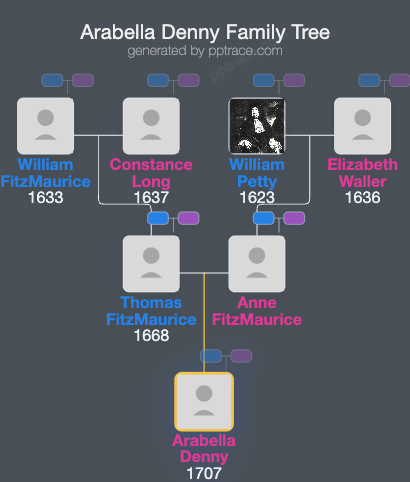
Family Tree
Tap  to expand more relatives
Introduction
Lady Arabella Fitzmaurice Denny (1707–1792) was an Irish philanthropist known for her charitable endeavors in 18th-century Ireland. She was born in County Kerry, the second daughter of Thomas FitzMaurice, 1st Earl of Kerry, and Anne Petty, daughter of Sir William Petty. As a teenager, she managed a basic medical dispensary for tenants on her father's estate. On 26 August 1727, she married Colonel Arthur Denny, a Member of Parliament for Kerry. Following his death, she was widowed at age thirty-five.
Her familial connections included William Petty, 2nd Earl of Shelburne, a nephew of her. She resided at Peafield Cliff House, located in Blackrock, Dublin, known today as Lios an Uisce or Lisnaskea House. Notably, the Methodist founder John Wesley visited her there in 1783.
In her philanthropic work, Lady Arabella supported the Dublin Foundling Hospital, an institution established to care for children abandoned due to poverty or illegitimacy. In 1760, she presented a clock to the hospital, which was installed in the nursery to regulate infant feeding. She contributed to reform efforts for the hospital and received acknowledgment from the Irish House of Commons in 1764 for her charitable work. She collaborated with the Dublin Society, promoting lace-making among workhouse children. Her efforts in aid of the poor earned her the Freedom of the City of Dublin in 1765, and she was made an honorary member of the Dublin Society in 1766.
Her association with the Foundling Hospital exposed her to the plight of young women who faced despair and hardship, often leading to giving up their children, homes, or families. In June 1767, she established the Magdalen Asylum for Protestant Girls in Leeson Street, Dublin. This institution aimed to rehabilitate women considered "fallen" or involved in prostitution. Inmates worked in exchange for shelter, clothing, food, and religious instruction, typically remaining between 18 months and two years. They could only leave if they secured a new position or were permitted to return home. It was the first such institution in Ireland and served as a model for similar facilities nationwide.
The asylum aimed to save women from shame, reproach, disease, want, and societal rejection. Over time, these institutions have been criticized for their harsh conditions and strict rules, with some likening them to industrial laundries where unpaid labor generated profit, leading to the term "Magdalene Laundries." An estimated 30,000 women were housed over their century-and-a-half existence, with the last Magdalene House closing in 1996. Investigations, including the 2013 report led by Irish Senator Martin McAleese, concluded that the Irish government and police were responsible for involuntary placements, with ongoing issues regarding workers' rights and institutional treatment.
In 1773, she founded the Magdalene Chapel, an episcopal chapel frequented by Dublin high society, with chaplains including Rev. Dr. Joseph Henderson Singer, assistant Rev. J. Lowe, and Rev. Caesar Otway. The Archbishop of Dublin served as president, with Rev. James Dunn as chaplain, and the Duchess of Gloucester among its patrons. The governance of the Magdalen Asylum was transferred to the Leeson Street Trust, later named the Lady Arabella Denny Trust, a registered charity. The Protestant Adoption Society, which later became PACT, named its office Arabella House in her honor. Additionally, Lady Denny established an almshouse in Tralee.
She retired in 1790 and died in Dublin on 18 March 1792. She had a fear of being buried alive and specified that her body should not be disturbed for at least seventy-two hours after death.