Duncan Sandys
| Name | Duncan Sandys |
| Title | British politician (1908-1987) |
| Gender | Male |
| Birthday | 1908-01-24 |
| nationality | United Kingdom |
| Source | https://www.wikidata.org/wiki/Q203129 |
| pptrace | View Family Tree |
| LastUpdate | 2025-11-26T23:32:42.086Z |
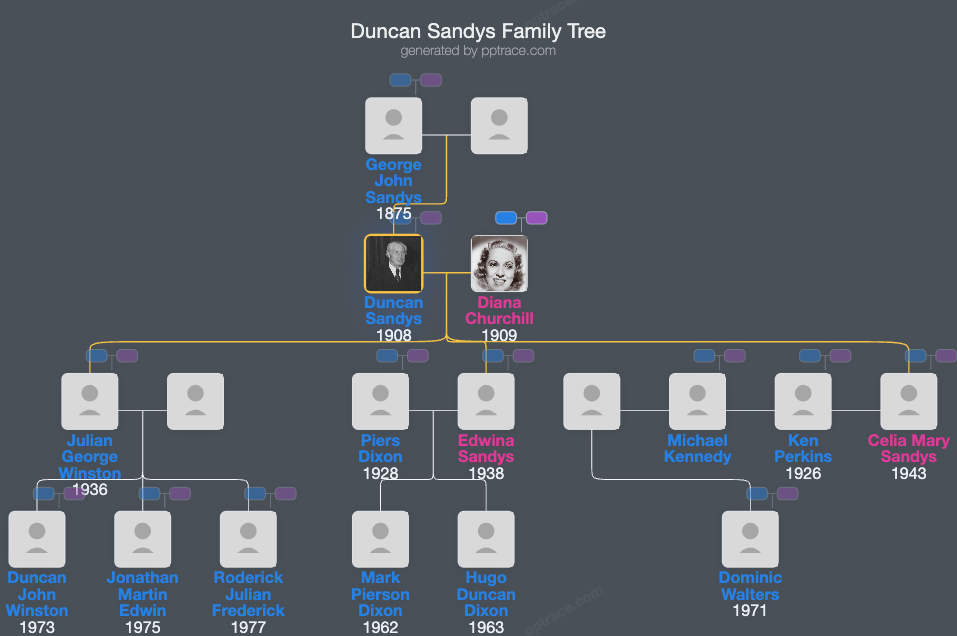
Family Tree
Tap  to expand more relatives
Introduction
Duncan Edwin Duncan-Sandys, Baron Duncan-Sandys (24 January 1908 – 26 November 1987), was a British politician and government minister associated with the Conservative Party. He was born at the Manor House in Sandford Orcas, Dorset, the son of George John Sandys, a Conservative Member of Parliament from 1910 to 1918, and Mildred Helen Cameron. His parents divorced in January 1921, and his mother subsequently married Frederick Hamilton Lister, adopting the surname Lister.
Sandys received education at Eton College and later attended Magdalen College, Oxford. He entered the diplomatic service in 1930, serving at the Foreign Office in London and at the British embassy in Berlin. In March 1935, he was elected as the Member of Parliament for Norwood in a by-election. During this period, he expressed views suggesting that Germany should have a dominant position in central Europe to allow Britain to pursue colonial interests without opposition. Sandys was associated with the Anglo-German Fellowship prior to World War II.
In 1937, Sandys was commissioned into the Territorial Army, serving in the 51st (London) Anti-Aircraft Brigade, Royal Artillery. He conducted inquiries related to national security questions in the House of Commons in 1938 and was approached by unidentified individuals who threatened him under the Official Secrets Act. He reported these incidents, which contributed to the passage of the Official Secrets Act 1939.
During World War II, Sandys served with the 51st (London) Heavy Anti-Aircraft Regiment in the Norwegian campaign. He sustained injuries in a motoring accident in April 1941, resulting in a permanent limp. His wartime governmental roles included serving as Financial Secretary to the War Office (1941–1944), Parliamentary Secretary to the Minister of Supply, and Minister of Works (1944–1945). He was a member of the War Cabinet Committee for defense against German flying bombs and rockets. Sandys lost his parliamentary seat in the 1945 general election and resigned his commission as a lieutenant-colonel the following year.
In 1947, Sandys co-founded the European Movement, which was influenced by Winston Churchill's Zurich speech calling for European unity. He established the United Europe Movement in Britain following this speech. Sandys collaborated with Joseph Retinger, and together they organized a conference in Paris in July 1947 involving multiple organizations advocating European integration. The committee formed from this conference eventually organized the Congress of Europe in The Hague in May 1948, with 750 delegates. The European Movement was subsequently established as the successor organization.
Sandys was re-elected to Parliament in 1950 representing Streatham. Under the Conservative government formed in 1951, he was appointed Minister of Supply. From 1954, he served as Minister of Housing, introducing legislative measures such as the Clean Air Act and the establishment of green belts. He became Minister of Defence in 1957, where he proposed significant reforms to the Royal Air Force, including shifting focus from fighter aircraft to missile technology—a policy that was later reversed.
Throughout his political career, Sandys was involved in decolonization efforts, overseeing independence for several colonies and managing British responses to conflicts in East Africa. He remained a member of the Conservative shadow cabinet until 1966, when he was dismissed for his support of Ian Smith in the Rhodesian UDI dispute. He served as the UK delegate to the Council of Europe and Western European Union until 1972. In 1974, he was granted a life peerage, taking the title Baron Duncan-Sandys, of the City of Westminster, incorporating his first name in the title due to another family peerage with the surname Sandys.
Sandys married Diana Churchill, daughter of Winston Churchill, in 1935; the couple divorced in 1960. In 1962, he married Marie-Claire Schmitt, with whom he remained until his death. His children include Julian Sandys, Edwina Sandys, Celia Sandys, and Laura Sandys.
He held interests in historic architecture, founding the Civic Trust in 1957 and serving as its president. He was also an honorary Fellow of the Royal Institute of British Architects and an honorary member of the Royal Town Planning Institute. Additionally, he was involved in business as a director of Ashanti Goldfields Corporation and was later associated with Lonrho. His later years included advocacy for European cultural heritage and participation in various organizations related to architecture and preservation.