Francis W. Eppes
| Name | Francis W. Eppes |
| Title | American politician (1801-1881) |
| Gender | Male |
| Birthday | 1801-09-20 |
| nationality | United States of America |
| Source | https://www.wikidata.org/wiki/Q1441763 |
| pptrace | View Family Tree |
| LastUpdate | 2025-11-17T06:37:36.741Z |
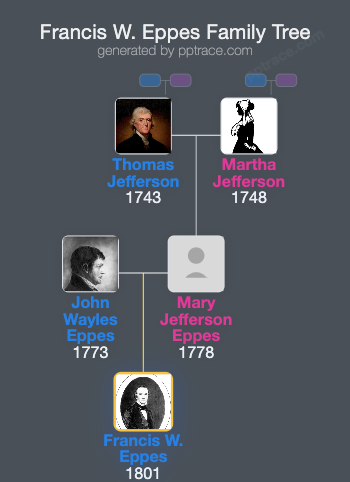
Family Tree
Tap  to expand more relatives
Introduction
Francis Wayles Eppes was born on September 20, 1801, at Monticello in Albemarle County, Virginia. He was the second child of Maria (née Jefferson) and John Wayles Eppes. His mother was the daughter of Thomas Jefferson, the third President of the United States, and the grandson of Martha Wayles Skelton Jefferson. His father, John Wayles Eppes, served in the Virginia House of Delegates and both houses of the United States Congress.
Eppes' mother died in 1804 when he was three years old, shortly after the birth of her third child. Following her death, his father relocated the family from Mont Blanco plantation in Chesterfield County to Millbrook in Buckingham County, Virginia, closer to Monticello. Eppes spent considerable time at Monticello with his maternal aunt Martha Randolph and his grandfather, Thomas Jefferson. At his father's Millbrook plantation, he was cared for by Betsy Hemmings, a slave whom Jefferson had given to Eppes' parents at their wedding. Betsy Hemmings was the daughter of Mary Hemings and granddaughter of Betty Hemings, both of whom were associated with Monticello.
Eppes studied law but did not complete his legal education. He inherited the Poplar Forest plantation from his grandfather Thomas Jefferson, which was established in Bedford County, Virginia. Jefferson had originally intended to leave this property to his daughter Maria, Eppes' mother, but it ultimately passed to Eppes after Jefferson’s death in 1826, becoming the only Jefferson property to be inherited by his designated heir.
In 1822, at the age of 21, Eppes married Mary Elizabeth Cleland Randolph, a distant cousin. They lived initially at Poplar Forest in Virginia. The couple had six children, three of whom died early in childhood. Mary Elizabeth Randolph Eppes died in 1835 from complications following childbirth. In 1837, Eppes married Susan Margaret Ware Crouch, the widowed daughter of U.S. Senator Nicholas Ware of Georgia. Together, they had seven children, making a total of thirteen children from both marriages, with at least three having died in childhood.
In 1829, Eppes moved his family to Tallahassee, in the Territory of Florida, where he established the Francis Eppes Plantation. This move separated families among planters and enslaved people. Eppes raised cotton using slave labor, and he owned numerous slaves, including descendants of Betsy Hemmings.
Eppes became an active civic leader in Tallahassee. He served as one of fourteen justices of the peace for Leon County in 1833 and was elected as the city’s intendant (mayor) from 1841 to 1844 and again from 1856 to 1857. During this period, he helped establish the Tallahassee Police Department and was involved in efforts to improve civic order.
Eppes was interested in education and religious affairs. He was a founding member of the Episcopal Church in Tallahassee, participating in the 1838 General Convention. In 1851, legislation authorized two higher education seminaries in Florida; Eppes was instrumental in securing funding and establishing the seminary in Tallahassee, which later developed into Florida State University. He served on the board of trustees for over a decade, including eight years as its president.
Eppes died in Orlando, Florida, on May 30, 1881, and was interred at Greenwood Cemetery in Tallahassee. His remains and those of several family members are buried at the Jefferson family cemetery at Monticello. His legacy includes a statue installed at Florida State University, which was removed from public display in 2018 amid reevaluation of historical associations with slavery. In 2021, the university officially removed Eppes' name from a building housing the College of Criminology and Criminal Justice.