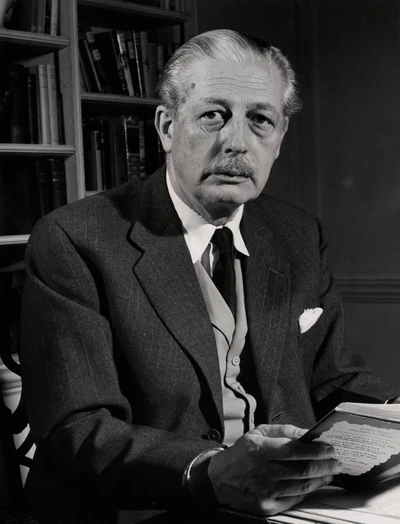
Harold Macmillan
| Name | Harold Macmillan |
| Title | Prime Minister of the United Kingdom from 1957 to 1963 |
| Gender | Male |
| Birthday | 1894-02-10 |
| nationality | United Kingdom |
| Source | https://www.wikidata.org/wiki/Q128985 |
| pptrace | View Family Tree |
| LastUpdate | 2025-11-26T23:33:11.743Z |
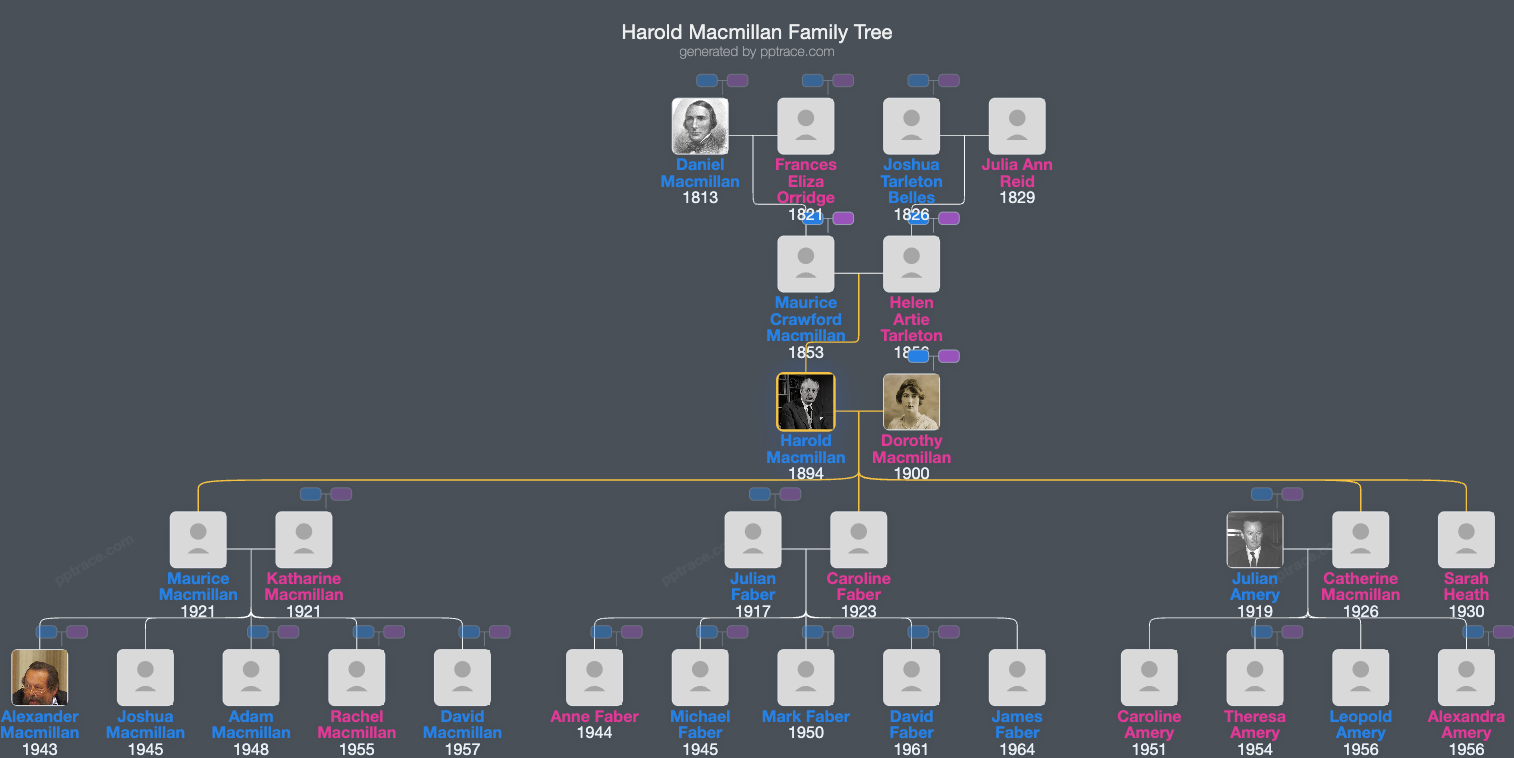
Family Tree
Tap  to expand more relatives
Introduction
Maurice Harold Macmillan, 1st Earl of Stockton, was born on 10 February 1894 in Belgravia, London. His father, Maurice Crawford Macmillan, was a publisher, and his mother, Helen (Nellie) Artie Tarleton Belles, was an artist and socialite from Spencer, Indiana. Macmillan had two older brothers, Daniel and Arthur. His paternal grandfather, Daniel MacMillan, was the founder of Macmillan Publishers and originated from the Isle of Arran in Scotland. Macmillan identified as Scottish by heritage.
His early education was closely supervised by his American mother, who ensured he learned French daily and engaged in physical activities. At the age of six or seven, he began studying classical Latin and Greek at a school near Sloane Square. He attended Summer Fields School in Oxford between 1903 and 1906. From 1906 to 1910, he was a student at Eton College, where he was a Third Scholar. His time there was interrupted by recurrent illness, including a near-fatal pneumonia attack. After leaving Eton, he was tutored privately, notably by Ronald Knox, who influenced his Anglican beliefs.
In 1911, Macmillan received a scholarship to Balliol College, Oxford. His political views during his university years encompassed a mixture of moderate conservatism, liberalism, and Fabian socialism. He admired various political figures, including Liberal Prime Ministers Henry Campbell-Bannerman and H. H. Asquith, and regarded David Lloyd George as a man of action. He was active in political societies at Oxford, serving as secretary and junior treasurer of the Oxford Union Society. Macmillan graduated in 1914 with a First in Honour Moderations, focusing on Latin and Greek, the first part of the Classics course.
With the outbreak of World War I, Macmillan volunteered for military service and was commissioned as a second lieutenant in the King's Royal Rifle Corps on 19 November 1914. He was later transferred to the Grenadier Guards. During the war, he served on the front lines in France, where he sustained multiple injuries, including a gunshot wound to the right hand and a head wound at the Battle of Loos in September 1915. He was hospitalized and later rejoined the front lines, participating in the Battle of Flers–Courcelette in September 1916, where he was severely wounded. His fellow officer, Raymond Asquith, was killed during this time. Macmillan spent the last two years of the war in hospitals undergoing multiple operations; he was still on crutches at the armistice in November 1918. His hip injury resulted in a limp and affected his handwriting.
In late 1918, Macmillan declined to return to Oxford, citing that the university would never be the same after the war. Instead, he joined the Guards Reserve Battalion at Chelsea Barracks for light duties, including a notable incident where he commanded troops in a park amid a brief refusal to disembark in France. In 1919, he served in Ottawa as aide-de-camp to Victor Cavendish, 9th Duke of Devonshire, then Governor-General of Canada. Macmillan’s engagement to the Duke’s daughter, Lady Dorothy Cavendish, was announced on 7 January 1920. He resigned his military commission on 1 April 1920.
Following the war, Macmillan joined his family's book-publishing business before entering politics. He was elected as Member of Parliament for Stockton-on-Tees in the 1924 general election. He lost his seat in 1929 but regained it in 1931. During the 1930s, he vocalized opposition to the policy of appeasement towards Germany practiced by the Conservative government.
Macmillan rose to prominent political roles during World War II, notably serving as a protégé of Winston Churchill. In the 1950s, he served as Foreign Secretary and Chancellor of the Exchequer under Prime Minister Anthony Eden. Following Eden’s resignation in 1957 amidst the Suez Crisis, Macmillan succeeded him as Prime Minister and as Leader of the Conservative Party. He held the office of Prime Minister from 1957 to 1963.
As Prime Minister, Macmillan was identified with the "One Nation" conservative tradition and supported the post-war consensus, including the welfare state and a mixed economy. He promoted Keynesian fiscal policies, aimed at maintaining demand and encouraging domestic growth. His government oversaw an era of economic prosperity, characterized by low unemployment and high growth, and he publicly declared in 1957 that the country had "never had it so good," while also recognizing the risks of inflation.
In international affairs, Macmillan worked to restore the "Special Relationship" with the United States after the Suez Crisis and oversaw decolonization in Africa. He restructured national defense policy to cope with nuclear realities, ending National Service, augmenting nuclear forces through the acquisition of Polaris submarines, and participating in the Nuclear Test Ban treaties. His efforts to promote British involvement in Europe faced obstacles, including the veto of UK accession to the European Economic Community and France’s independent acquisition of nuclear weapons in 1960.
Toward the end of his tenure, his government was affected by scandals, notably the Vassall Tribunal and the Profumo affair, which were perceived as symbols of moral decline within the British establishment. After resigning as Prime Minister in 1963, Macmillan retired from active politics but remained a member of the House of Lords. He died on 29 December 1986 at the age of 92.