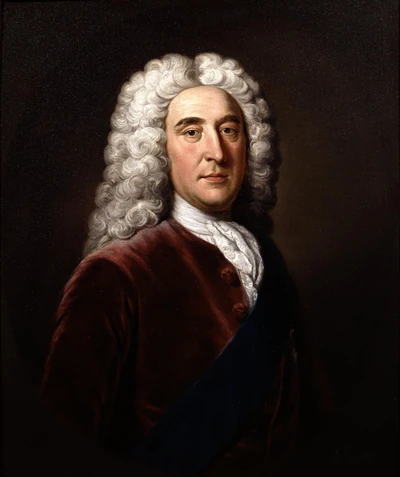
Thomas Pelham-Holles, 1st Duke Of Newcastle-upon-Tyne
| Name | Thomas Pelham-Holles, 1st Duke Of Newcastle-upon-Tyne |
| Title | Prime Minister of Great Britain (1693-1768) |
| Gender | Male |
| Birthday | 1693-07-21 |
| nationality | Great Britain |
| Source | https://www.wikidata.org/wiki/Q273809 |
| pptrace | View Family Tree |
| LastUpdate | 2025-11-26T23:21:20.500Z |
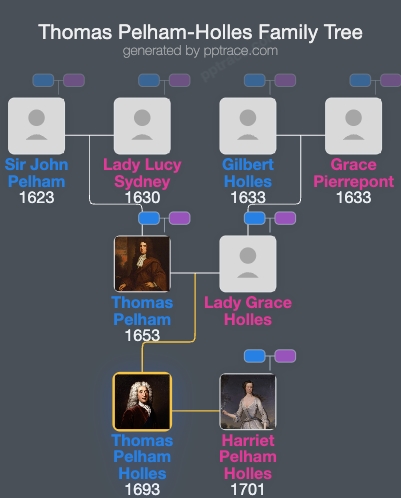
Family Tree
Tap  to expand more relatives
Introduction
Thomas Pelham-Holles, 1st Duke of Newcastle upon Tyne and 1st Duke of Newcastle-under-Lyne, was born on 21 July 1693 in London. He was the eldest son of Thomas Pelham, 1st Baron Pelham, and Lady Grace Holles, the younger sister of John Holles, 1st Duke of Newcastle-upon-Tyne. His early education included attendance at Westminster School and admission as a fellow commoner at Clare College, Cambridge, in 1710. In 1711, his uncle died, and in 1712, his father passed away, leaving him significant estates and influence, particularly in Sussex. Upon reaching adulthood in 1714, he inherited substantial landholdings and patronage power, and he subsequently adopted the surname Pelham-Holles, pursuant to his uncle's will.
Politically, Pelham-Holles aligned with the Whigs, supporting the Hanoverian succession following Queen Anne’s death. His political activity included involvement with the Hannover Club and the Kit Kat Club, both prominent Whig organizations. He became known as a supporter of the Whig cause during a highly divided period in British politics, with tensions between Whigs and Tories centered around the Jacobite question.
In 1714, Pelham-Holles was granted the titles of Earl of Clare, Marquess of Clare, and Duke of Newcastle-upon-Tyne, reflecting his rising prominence and favor from the new Hanoverian regime. He also received positions such as Lord-Lieutenant of Middlesex and Nottingham and was made a Knight of the Garter. His early role involved efforts to suppress Jacobitism, including arresting numerous suspected Jacobites and organizing defenses in Middlesex. His active support contributed to the suppression of the Jacobite uprising of 1715, culminating in the victory at the Battle of Preston.
Pelham-Holles formed an alliance with Sir Robert Walpole, a leading Whig statesman, in the years following the Hanoverian succession. Walpole, who became Britain’s first de facto prime minister in 1721, valued Newcastle’s influence and political connections. The duke married Lady Henrietta Godolphin in 1717, further strengthening ties within the Whig political network. His political career advanced quickly, and by 1717, he was appointed Lord Chamberlain of the Household, a position in which he oversaw theatrical censorship and played a role in the regulation of political expression through the arts.
He served as Lord Chamberlain until 1724, during which time he also participated financially in the arts, notably investing in George Frideric Handel's Royal Academy of Music. His influence extended through control of parliamentary elections, particularly in counties such as Sussex, Nottinghamshire, Yorkshire, and Lincolnshire, where he was recognized as a key party manager.
In 1724, Newcastle was appointed Secretary of State for the Southern Department, serving largely as a deputy to Sir Robert Walpole, who prioritized foreign policy through his control of the government. During this period, Newcastle’s involvement in foreign affairs increased as he educated himself on diplomatic matters, although he initially deferred to others in this domain.
Pelham-Holles held the office of Secretary of State for over three decades. He served as Prime Minister twice, from 1754 to 1756 and again from 1757 to 1762. His first term as prime minister was characterized by limited achievements; however, he played a significant role in the events leading up to the Seven Years' War. His diplomatic shortcomings and the costs associated with the war contributed to the end of his premiership. After his second term, he briefly served in Lord Rockingham’s ministry before retiring from active government service.
Throughout his career, Pelham-Holles was recognized for his skill and industriousness in maintaining political patronage. Despite this, his reputation in history has been mixed, with some historians highlighting his reliance on patronage and describing his leadership as characterized by weaknesses in diplomacy and decision-making. He died on 17 November 1768.