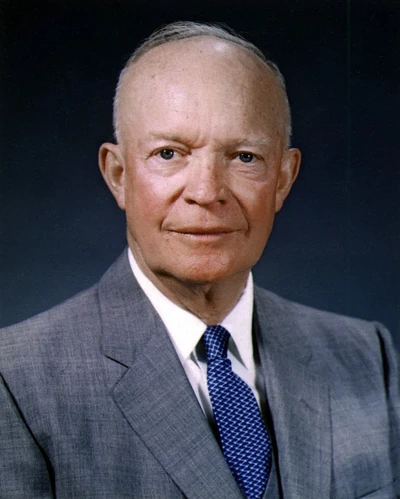
Dwight D. Eisenhower
| Name | Dwight D. Eisenhower |
| Title | president of the United States from 1953 to 1961 |
| Gender | Male |
| Birthday | 1890-10-14 |
| nationality | United States of America |
| Source | https://www.wikidata.org/wiki/Q9916 |
| pptrace | View Family Tree |
| LastUpdate | 2025-11-17T06:44:22.061Z |
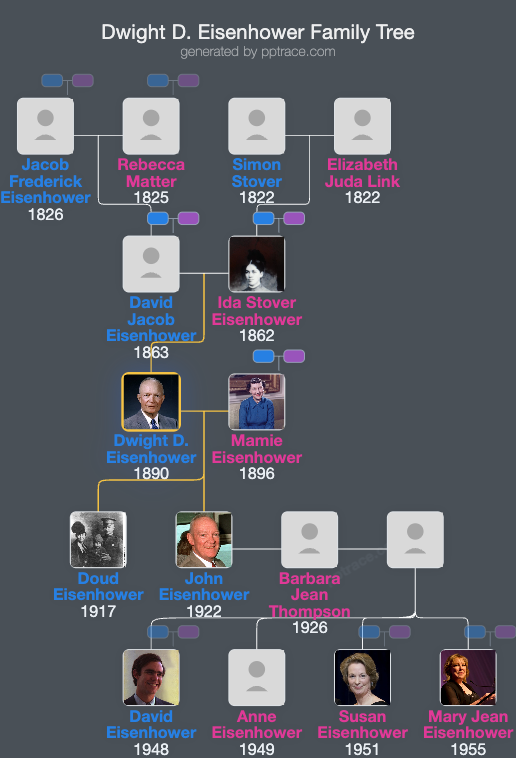
Family Tree
Tap  to expand more relatives
Introduction
Dwight David "Ike" Eisenhower, originally named David Dwight Eisenhower, was born on October 14, 1890, in Denison, Texas. He was the third of seven sons in his family. His father was David Jacob Eisenhower, a college-educated engineer, and his mother was Ida Elizabeth (Stover) Eisenhower, of predominantly German Protestant descent. The family relocated to Abilene, Kansas, in 1892, where Eisenhower was primarily raised and considered his hometown.
Eisenhower's early years included involvement in outdoor activities such as hunting, fishing, and camping. He developed an interest in military history, which was sparked by his mother's collection of history books. His family observed daily Bible readings, reflecting their religious background; his mother was associated with the River Brethren sect of the Mennonites before joining the International Bible Students Association, later known as Jehovah's Witnesses. Eisenhower himself did not join any organized church until 1952, although he was baptized in the Presbyterian Church in 1953.
He attended Abilene High School, graduating in 1909. During his adolescence, he suffered a severe leg injury that nearly required amputation but ultimately healed, allowing him to continue his education. Eisenhower and his brother Edgar made a pact to alternate paid college years to fund their education. He worked as a night supervisor at the Belle Springs Creamery to support himself and his family.
Eisenhower was accepted to West Point Military Academy in 1911, after an initial application attempt to the U.S. Naval Academy was unsuccessful due to his age. At West Point, he developed an appreciation for military traditions and sports, though he was less enthusiastic about hazing. He was considered an average student academically, excelling mainly in English and enjoying engineering disciplines. His discipline rating was modest, and he was known to have occasionally violated regulations.
Graduating from West Point in 1915, Eisenhower was commissioned as a second lieutenant. He married Mamie Doud, with whom he had two sons. During World War I, he was assigned to train tank crews rather than serve in Europe, as he had requested.
Between the wars, Eisenhower served in various staff and command positions in the United States and the Philippines. He achieved the rank of brigadier general shortly before the United States entered World War II in 1941. During the war, Eisenhower advanced to the rank of five-star General of the Army and served as Supreme Commander of the Allied Expeditionary Force in Europe. He supervised two major military campaigns: Operation Torch in North Africa (1942–1943) and the invasion of Normandy (1944). Post-war, he served as military governor of the American zone in Germany in 1945, then as Army Chief of Staff from 1945 to 1948.
He was president of Columbia University from 1948 to 1953 before becoming the first Supreme Commander of NATO in 1951, a position held until 1952. In the U.S. presidential election of 1952, Eisenhower ran as a Republican, defeating Democratic candidate Adlai Stevenson II in both 1952 and 1956. His presidency lasted from 1953 to 1961, during which he aimed to contain communism and reduce federal deficits.
Eisenhower's administration adopted the "New Look" policy, emphasizing nuclear deterrence and reducing traditional army expenditures while supporting the recognition of Taiwan as the legitimate government of China. He provided aid in the First Indochina War, supported South Vietnam, and authorized CIA-led regime changes in Iran and Guatemala. During the Suez Crisis of 1956, he condemned the invasion of Egypt by Israel, Britain, and France, forcing their withdrawal. He also opposed the Soviet invasion of Hungary but took no military action.
Regarding domestic policies, Eisenhower continued New Deal programs, expanded Social Security, and responded to the Soviet launch of Sputnik in 1957 by establishing NASA and enacting the National Defense Education Act. His administration oversaw the construction of the Interstate Highway System, the largest in U.S. history.
Eisenhower's presidency concluded with his famous farewell address, in which he warned of the potential dangers posed by the military-industrial complex. He died on March 28, 1969, at the age of 78.