Robert A. Taft
| Name | Robert A. Taft |
| Title | American politician, son of 27th U.S. President William Howard Taft (1889–1953) |
| Gender | Male |
| Birthday | 1889-09-08 |
| nationality | United States of America |
| Source | https://www.wikidata.org/wiki/Q519730 |
| pptrace | View Family Tree |
| LastUpdate | 2025-11-17T06:42:39.055Z |
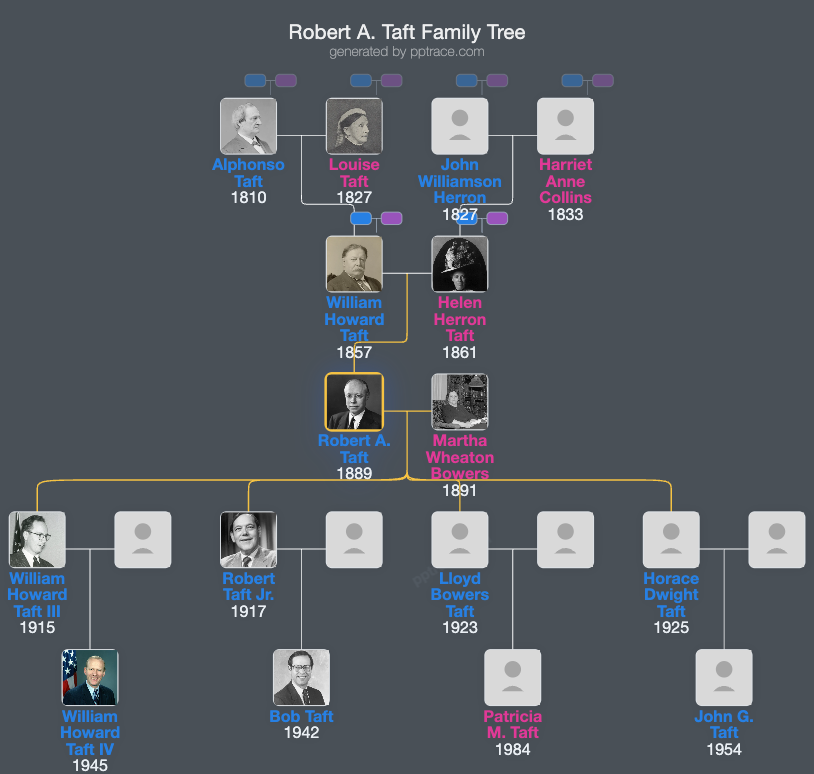
Family Tree
Tap  to expand more relatives
Introduction
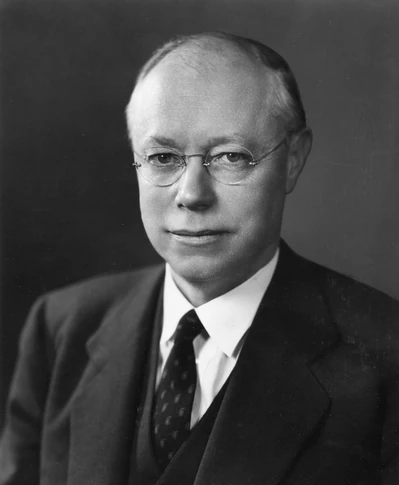
Robert Alphonso Taft Sr. (September 8, 1889 – July 31, 1953) was an American politician and lawyer associated with the Republican Party. He was a member of the Taft family, being the elder son of William Howard Taft, the 27th President of the United States and the 10th Chief Justice of the United States. Taft was born in Cincinnati, Ohio, and pursued a legal career following his graduation from Harvard Law School in 1913.
Family Background and Education:
Taft was born on September 8, 1889, in Cincinnati, Ohio. His grandfather was Alphonso Taft, who served as Attorney General and Secretary of War. His mother was Helen Louise "Nellie" Herron, and his father, William Howard Taft, held significant political offices. As a child, he spent four years in the Philippines during his father's tenure as Governor-General. He attended the Taft School, Yale College (graduating in 1910), and Harvard Law School, where he edited the Harvard Law Review and graduated in 1913, having scored the highest on the Ohio bar exam.
Legal and Early Political Career:
After completing law school, Taft practiced law in Cincinnati, founding the partnership Taft Stettinius & Hollister with his brother Charles Phelps Taft II in 1924. He briefly worked for the Food and Drug Administration in Washington, D.C., and served as legal adviser for the American Relief Administration during World War I. Returning to Cincinnati, he entered politics in Ohio, serving in the Ohio House of Representatives from 1921 to 1931, and as Speaker of the House from 1926 to 1927. He subsequently served in the Ohio Senate from 1931 to 1933.
Political Positions and U.S. Senate Service:
Taft was a prominent conservative voice within the Republican Party. He was elected to the United States Senate in 1938, representing Ohio, defeating incumbent Democrat Robert J. Bulkley. During his Senate tenure, he became known as "Mr. Republican" and was a leader in the conservative coalition that opposed the expansion of New Deal policies. He co-sponsored the Taft–Hartley Act of 1947, which limited labor organization practices, including banning closed shops and establishing the right-to-work concept. Taft was also an advocate of non-interventionism before the United States entered World War II, criticizing U.S. involvement prior to the 1941 attack on Pearl Harbor.
Presidential Campaigns and Later Political Activities:
Taft sought the Republican presidential nomination multiple times. He campaigned for the nomination in 1940 but lost to Wendell Willkie. He ran again in 1948, but was defeated by Thomas E. Dewey at the Republican National Convention. His third attempt was in 1952, where he was considered a front-runner until Dwight D. Eisenhower entered the race; Eisenhower narrowly won the nomination and subsequently the election.
Leadership and Death:
In 1953, Taft was elected Senate majority leader. Later that year, he died from a cerebral hemorrhage while being treated for pancreatic cancer. In 1957, the Senate committee named him as one of America's five greatest senators, alongside Henry Clay, Daniel Webster, John C. Calhoun, and Robert M. La Follette Sr.
Family and Personal Life:
Taft married Martha Wheaton Bowers on October 17, 1914. They had four sons: William Howard Taft III, Robert Alphonso Taft Jr., Lloyd Bowers Taft, and Horace Dwight Taft. His older son, William Howard Taft III, served as ambassador to Ireland. His son Robert Jr. was also elected to the U.S. Senate. He purchased a farm called Sky Farm in Indian Hill, Ohio, which became his primary residence.
Religious and Personal Traits:
Although nominally an Episcopalian, Taft's religious involvement was limited, with some noting his inclinations were weak. His wife Martha was considered a confidante and supportive partner, especially after suffering a severe stroke in 1950. Despite his public image as reserved and intellectual, reports indicate he was attentive and caring toward his wife.
Legacy:
Taft's political career was marked by his advocacy for conservative policies, his opposition to certain international organizations like NATO, and his influence within the Republican Party. His legislative contributions, notably the Taft–Hartley Act, reflect his ideological stances and impact on labor law in the United States.