Daniel Stover
| Name | Daniel Stover |
| Title | (1826-1864) |
| Gender | Male |
| Birthday | 1826-11-14 |
| nationality | — |
| Source | https://www.wikidata.org/wiki/Q75766075 |
| pptrace | View Family Tree |
| LastUpdate | 2025-11-16T10:14:00.203Z |
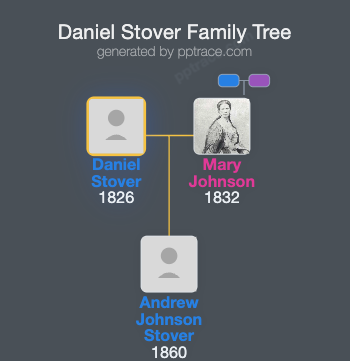
Family Tree
Tap  to expand more relatives
Introduction
Daniel Stover (November 26, 1826 – December 18, 1864) was an American farmer and Union guerrilla participant in Tennessee during the Civil War. He was born in Carter County, Tennessee. In 1852, he married Mary Johnson, the younger daughter of Andrew Johnson, who later became the 17th President of the United States in 1865.
Stover owned a plantation in the Watauga Valley, with a farm valued at approximately US$18,000 in 1860, and a personal estate valued at around US$12,000. At that time, the family resided together in Carter County, and he had three children named Lillie, Sarah, and Andrew Johnson Stover.
During the initial year of the Civil War, Stover participated in the East Tennessee bridge burnings, a guerrilla operation aimed at facilitating the Union occupation of East Tennessee, a region that generally opposed secession. On November 8, 1861, he led the successful destruction of the Holston River Bridge at Union Depot, also known as Zollicoffer or Bluff City, Tennessee. Prior to the operation, he selected approximately thirty reliable men from the vicinity of Elizabethton, Tennessee, and swore them into service at Reuben Miller's barn near Indian Creek. The operation involved overwhelming Confederate guards and igniting the bridge with turpentine and pine knots, as well as cutting telegraph lines.
The Union leadership, including Abraham Lincoln and Andrew Johnson, approved the plan, which was intended to prevent Confederate troop movements and allow a potential Union advance. However, Federal forces did not arrive as expected, and Confederate Secretary of War Judah Benjamin ordered the execution of captured bridge burners. Consequently, Stover and his men retreated into the hills of eastern Carter County, living in hiding throughout the winter of 1861-62. Due to intercessions by Confederate-aligned acquaintances, Stover was eventually permitted to return home "on parole."
In October 1862, the Stover family was forced from their Carter County residence and moved to Murfreesboro, Tennessee. Their home and farm were subsequently looted. During early 1863, the family traveled to Indiana and Louisville, Kentucky. In spring 1863, Stover organized the Fourth Regiment of Tennessee Volunteer Infantry in Louisville. The family arrived in Nashville on May 30, 1863, and they were received by a large crowd.
Health issues stemming from his time in hiding led Stover to resign from the Union Army on August 10, 1864. He died in Nashville on December 18, 1864, shortly before Christmas, of illness. Records from a 1903 regimental history note that although Stover was a slave owner before the war, he was willing to relinquish his slaves for the sake of his country. Census records from 1860 indicate that Daniel Stover and his paternal grandfather, Daniel Stover I, collectively owned nine slaves in Carter County, Tennessee.
Stover’s activities during the Civil War and his family ties link him to significant historical figures and events in Tennessee history during the Civil War era.