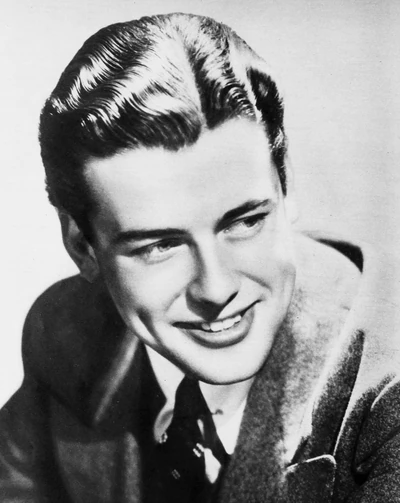
Richard Greene
| Name | Richard Greene |
| Title | British film and television actor (1918-1985) |
| Gender | Male |
| Birthday | 1918-08-25 |
| nationality | United Kingdom |
| Source | https://www.wikidata.org/wiki/Q1309447 |
| pptrace | View Family Tree |
| LastUpdate | 2025-11-29T01:01:14.089Z |
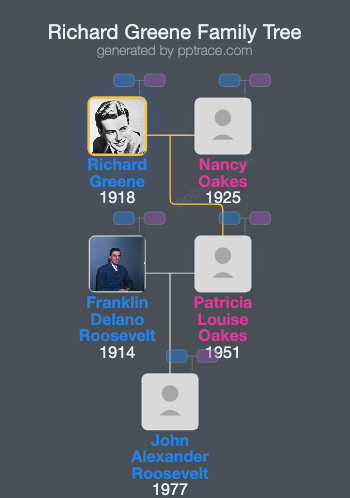
Family Tree
Tap  to expand more relatives
Introduction
Richard Marius Joseph Greene was born on 25 August 1918 in Plymouth, Devon, England. His parents, Kathleen Gerrard and Richard Abraham Greene, were both actors associated with the Plymouth Repertory Theatre. Greene was raised Roman Catholic and attended Cardinal Vaughan Memorial School in Kensington, London, leaving at the age of 18. His aunt was actress Evie Greene. Greene was descended from four generations of actors; however, claims that he was the grandson of William Friese-Greene, the inventor associated with early cinematography, were later disproven through genealogical research conducted by the British Film Institute and others.
Greene began his stage career in 1933 as a spear carrier in William Shakespeare’s Julius Caesar at the Old Vic. In his early years, he supplemented his income through modeling shirts and hats. His stage appearances included a production of Journey's End, and he had a small role in Sing As We Go (1934). In 1936, he joined the Jevan Brandon Repertory Company, performing in Antony and Cleopatra, and gained praise for his role in Terence Rattigan’s French Without Tears, which garnered the attention of Hollywood studios.
In January 1938, Greene signed a contract with 20th Century Fox at the age of 20. His first film for Fox was John Ford’s Four Men and a Prayer (1938), and he quickly became popular with audiences, especially women, owing to his good looks. Notable early films include My Lucky Star (1938) with Sonia Henie, Submarine Patrol (1939), Kentucky (1938), The Little Princess (1939), and Sherlock Holmes and the Hound of the Baskervilles (1939), where he played Sir Henry Baskerville and was the top-billed actor. Greene also appeared in Stanley and Livingstone (1939), Little Old New York (1940), and I Was an Adventuress (1940).
During World War II, Greene attempted to enlist in the Seaforth Highlanders in Vancouver but was unable to obtain a commission. He traveled to England and enlisted in the 27th Lancers, where he distinguished himself. After three months, he attended the Royal Military College, Sandhurst, and was commissioned as an officer with the service number 184251. He was promoted to captain in May 1944. Greene appeared in British propaganda films such as Flying Fortress (1942), Unpublished Story (1942), and Yellow Canary (1943), and toured with productions like Shaw’s Arms and the Man to entertain troops. He was discharged in December 1944.
Following his military service, Greene starred in the British musical Gaiety George (1946), which was unsuccessful at the box office. Returning to Hollywood, he appeared in Forever Amber (1947) in a supporting role, and subsequently played a villain in The Fighting O’Flynn (1948). He also starred in The Fan (1949), based on Lady Windermere’s Fan, and continued to act in films across Britain, Italy, and Mexico, including The Desert Hawk (1950), The Rival of the Empress (1951), Lorna Doone (1951), and Captain Scarlett (1953).
Greene was cast in the television series The Adventures of Robin Hood (1955–1959), where he portrayed Robin Hood. This role marked a significant milestone in his career, providing financial stability and international recognition. During the series’ run, Greene engaged in a romantic relationship with Nancy Oakes, with whom he had a daughter, Patricia Luisa Oakes, born in 1951.
In the subsequent years, Greene appeared in various television programs such as A Man For Loving, The Doctors, The Morecambe and Wise Show, Dixon of Dock Green, and Tales of the Unexpected. He played Sir Denis Nayland Smith in two of the Fu Manchu films directed by Jess Franco, The Blood of Fu Manchu (1968) and The Castle of Fu Manchu (1969), both shot in Spain.
In 1972, Greene was involved in the Lewis v Averay court case after a fraudster impersonated him to purchase a vehicle. He passed away from cardiac arrest at his home in Kelling Hall, Norfolk, England, on 1 June 1985, at the age of 66. His daughter reported that he had not fully recovered from an injury sustained in a fall three years earlier, but he still received fan mail and signed photographs during his later years.