Martha Parke Custis
| Name | Martha Parke Custis |
| Title | daughter of Martha Washington (1755-1773) |
| Gender | Female |
| Birthday | 1755-01-01 |
| nationality | Q179997 |
| Source | https://www.wikidata.org/wiki/Q21004273 |
| pptrace | View Family Tree |
| LastUpdate | 2025-11-29T00:59:45.880Z |
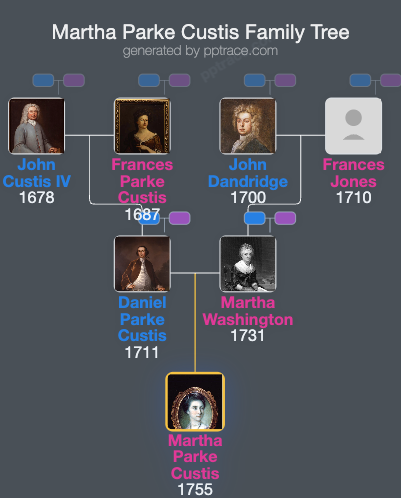
Family Tree
Tap  to expand more relatives
Introduction
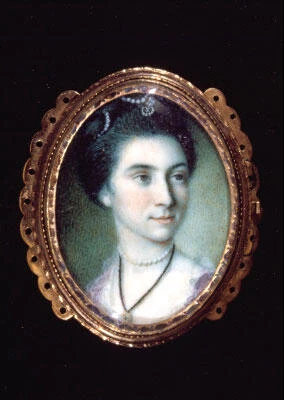
Martha Parke Custis (1756 – June 19, 1773) was the stepdaughter of George Washington. She was born in 1756 at White House Plantation in Virginia, the youngest child of Martha Custis (later Martha Washington) and Colonel Daniel Parke Custis. Her father died on July 8, 1757, possibly from a virulent throat infection, one year after her birth. Her mother remarried George Washington on January 6, 1759, when Martha was two years old, making her a stepdaughter to Washington and her brother John "Jacky" Custis his stepson.
Her siblings included Daniel Jr., who died at age three, and Frances, who died at age four. Both had died of unknown causes prior to her birth. Martha Custis was a wealthy heiress, with her share of her father's estate managed by Washington in a guardian account. Historical records note that Washington frequently purchased personal items for her, including jewelry, clothing, a pet parrot, and music lessons.
Her epilepsy began around the age of five or six. In a letter dated September 26, 1760, Martha Washington mentioned that Patsy was recovering from fits and fevers. Records from 1761 indicate she was treated with mercury, among other remedies. Her seizures reoccurred with increased frequency and severity starting in 1768, requiring her mother to care for her full time. She was open about her condition, which was unusual for the period, and her family sought various treatments from at least seven physicians, including Dr. William Rumney, Dr. John Johnson, Hugh Mercer, George Steptoe, John de Sequeyra, William Pasteur, and Arthur Lee.
Treatments administered included herbal remedies, antispasmodic medications such as valerian and musk, ether, purging pills, mercury, and bleeding. The Washingtons also attempted folk remedies, including fitting her with an "iron ring," based on the belief that a "cramp ring" could alleviate seizures. They traveled to Berkeley Springs for therapeutic waters in 1769, although this did not improve her condition.
Washington documented her seizure episodes extensively from 1770 to 1772. Despite the increase in seizure frequency, the family encouraged her participation in normal activities, such as music and social visits. By 1772, Dr. John Johnson suggested that her condition might improve with moderate exercise, temperate living, and cooling diets.
On June 19, 1773, Patsy Custis died at approximately five o'clock in the afternoon, aged 17, following a seizure during a family gathering at Mount Vernon. Witnessed by Eleanor Calvert, her brother's fiancée, she was found in seizure and was declared dead within minutes, without apparent distress. Her death was described in George Washington's correspondence as sudden and unexpected, and she was buried the following day in an old brick vault near the river at Mount Vernon.
Modern medical historians have analyzed Washington's contemporaneous diary entries, suggesting that her death was likely caused by sudden unexpected death in epilepsy (SUDEP). An article in 1999 noted that her seizure history and the rapidity of her death align with the characteristics of SUDEP, making her one of the earliest well-documented cases of the condition.