Ali Kemal
| Name | Ali Kemal |
| Title | Ottoman liberal journalist, politician and poet (1867-1922) |
| Gender | Male |
| Birthday | 1867-01-01 |
| nationality | Ottoman Empire |
| Source | https://www.wikidata.org/wiki/Q349199 |
| pptrace | View Family Tree |
| LastUpdate | 2025-11-26T23:34:14.332Z |
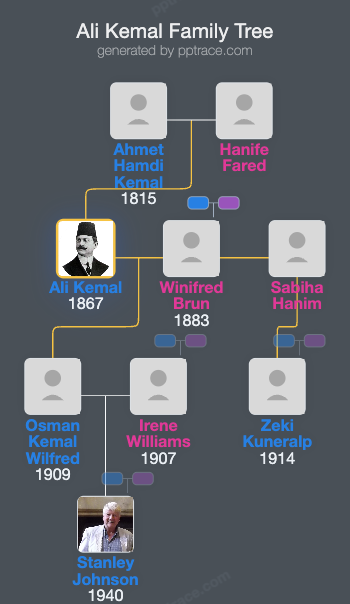
Family Tree
Tap  to expand more relatives
Introduction
Ali Kemal (7 September 1869 – 6 November 1922) was a Turkish journalist, politician, and writer. He served as the Minister of the Interior of the Ottoman Empire in 1919 during the government of Grand Vizier Damat Ferid Pasha.
Born in 1867 in the Süleymaniye district of Istanbul, Ali Kemal's original name was Ali Rıza. He changed his second name to Kemal in admiration of Namık Kemal. His father, Hacı Ahmet Hamdi Rıza Effendi, was a Turkish merchant born in 1815 in Kalfat, Çankırı. His mother, Hanife Fered, was of Circassian descent and reportedly of slave origin.
Kemal attended the Mekteb-i Mülkiye, the Civil Service School in Istanbul, and left in his final year to travel to Europe. In 1886, he moved to Paris to improve his French skills, and in 1887 to Geneva. He returned to Istanbul in 1888 to complete his education. His exposure to European liberal ideas during his visits likely influenced his political convictions.
In 1889, he was imprisoned for nine months after attempting to establish student associations that were dissolved by Ottoman authorities. He was subsequently exiled to Aleppo, where he taught Turkish language and literature at a high school. He returned to Istanbul in 1895 but soon fled to Paris again due to ongoing exile orders.
While in Paris, Kemal maintained a mediating stance between the Young Turks and the palace. He defected from the Committee of Union and Progress (CUP) along with Mizancı Murad Bey and was appointed as deputy secretary of the Ottoman Embassy in Brussels. After obtaining a diploma in Political Sciences in 1899, he lived in Egypt until the Young Turk Revolution, managing a farm and establishing the weekly magazine Türk between 1903 and 1907.
During his time in Europe, Kemal worked as a journalist for the İkdam newspaper in Istanbul. His articles expressed admiration for Western culture, though Hüseyin Cahit Yalçın later accused him of plagiarizing translations from French sources.
In 1903, Kemal married Winifred Brun Hanım, an Anglo-Swiss woman born in Warwick in 1883. They married in London in September 1903. They had a son, Osman Wilfred Ali Kemal, born in Bournemouth in September 1909, shortly before Winifred died of puerperal fever. They also had a son named Lancelot Beodar, who died in childhood, and a daughter named Celma.
Kemal returned to Istanbul after the 1908 Young Turk Revolution and became a prominent journalist and political figure opposing the CUP. He joined the Liberty Party, edited the liberal İkdam newspaper, and taught political history at the Darülfünun. He unsuccessfully contested the 1909 Istanbul by-election as the Liberty Party candidate.
Following the 31 March Incident in 1909, Kemal fled to Paris again, where his wife gave birth to their son Osman Wilfred. After the deposition of Sultan Abdul Hamid II and the declaration of Sultan Mehmed V, Kemal returned to the Ottoman Empire in 1912. He participated in political debates, including supporting war against the Balkan League, which began with Montenegro's declaration of war and resulted in significant territorial losses for the Ottoman Empire.
During World War I, Kemal maintained a low profile, working as a teacher and merchant. He became the general secretary of the reestablished Freedom and Accord Party in January 1919. In March 1919, he was appointed as Minister of Education, then Minister of Interior in May of the same year, during which he issued orders against Mustafa Kemal Pasha's National Forces. He resigned from this position in June 1919.
Ali Kemal's opposition to the Turkish National Movement and his liberal political stance led to his eventual lynching in 1922 by paramilitary officers loyal to Nureddin Pasha, following Turkey’s victory in the Greco-Turkish War.
He was the father of Zeki Kuneralp, a diplomat who served as Turkey's ambassador to Switzerland, the United Kingdom, and Spain. Ali Kemal was also the paternal grandfather of both Turkish diplomat Selim Kuneralp and British politician Stanley Johnson. Through Johnson, he was the great-grandfather of Boris Johnson, a former Prime Minister of the United Kingdom.