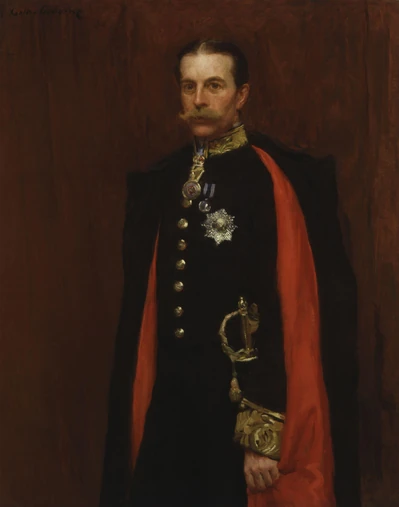
Robert Crewe-Milnes, 1st Marquess Of Crewe
| Name | Robert Crewe-Milnes, 1st Marquess Of Crewe |
| Title | British diplomat (1858-1945) |
| Gender | Male |
| Birthday | 1858-01-12 |
| nationality | United Kingdom |
| Source | https://www.wikidata.org/wiki/Q336421 |
| pptrace | View Family Tree |
| LastUpdate | 2025-11-26T23:30:50.490Z |
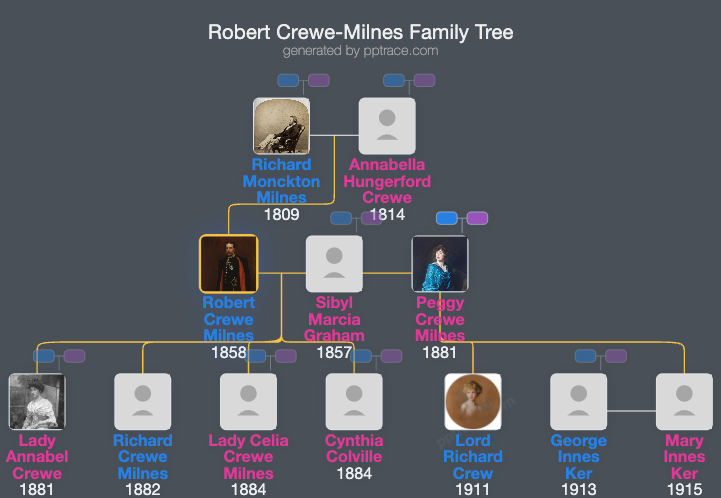
Family Tree
Tap  to expand more relatives
Introduction
Robert Offley Ashburton Crewe-Milnes, 1st Marquess of Crewe (born 12 January 1858, died 20 June 1945), was a British politician who held various offices in the Liberal Party during the late 19th and early 20th centuries. He was originally known as The Honourable Robert Milnes from 1863 until 1885, then as The Lord Houghton from 1885 to 1895, and subsequently as The Earl of Crewe from 1895 to 1911.
Early Life and Education
Crewe-Milnes was born at 16 Upper Brook Street, Mayfair, London. He was the only son of Richard Monckton Milnes, 1st Baron Houghton, and his wife, the Hon. Annabella Crewe, daughter of John Crewe, 2nd Baron Crewe. For his education, he attended Winton House near Winchester, Harrow School, and later studied at Trinity College, Cambridge, graduating in 1880.
Political Career
Crewe-Milnes was affiliated with the Liberal Party. His political career began with his appointment as Assistant Private Secretary to Lord Granville in April 1883, when Granville was Foreign Secretary. In 1884, he was selected as the prospective Liberal candidate for Barnsley but did not contest the seat due to succeeding to his father's peerage in August 1885, which granted him a seat in the House of Lords. He became the Liberal whip in 1885 and was appointed a Lord-in-waiting to Queen Victoria in January 1886 during William Ewart Gladstone's third ministry.
Following personal tragedies—his wife Sybil Marcia Graham, whom he married on 3 June 1880, died in September 1887 at age thirty, and his eight-year-old son Richard died in 1890—Crewe-Milnes focused on areas such as agriculture, though illness prevented further studies at the Royal Agricultural College. He traveled to Egypt, writing "the Stray Verses," and remained in mourning during that period.
In 1892, he returned to England and served as Lord Lieutenant of Ireland under Prime Minister William Ewart Gladstone’s government. Upon the death of his uncle, Hungerford Crewe, 3rd Baron Crewe, in 1894, he inherited extensive estates totaling nearly 50,000 acres across four counties, and he adopted the additional surname Crewe by royal license on 8 June 1894. He was created Earl of Crewe in 1895.
Marriage and Later Political Engagements
In 1899, Crewe-Milnes married Lady Margaret Etrenne Hannah Primrose, the daughter of Prime Minister Lord Rosebery. During the Second Boer War, he advocated for negotiated settlement efforts and subsequently aligned with the Radicals and the Liberal leadership. He was appointed Lord President of the Council from 1905 to 1908, during which he supported legislation such as the Parliament Act 1911, which limited the veto powers of the House of Lords.
He served as Secretary of State for the Colonies from 1908 to 1910, during which he oversaw significant colonial policies, including the organization of the Delhi Durbar, the relocation of the Indian capital to Delhi, and the commissioning of Sir Edwin Lutyens for the design of New Delhi. In 1911, he was further elevated in peerage as Marquess of Crewe.
He continued to serve in government roles during World War I, including Lord President of the Council in 1915 and briefly as President of the Board of Education in 1916. Following the split of the Liberal government, he led the independent Liberal opposition in the House of Lords.
Later Life
Crewe-Milnes served as Ambassador to France between 1922 and 1928, where he promoted educational and cultural initiatives, including the creation of the British Institute in Paris, which evolved into the University of London Institute in Paris (ULIP). He briefly held the office of Secretary of State for War in August 1931 within Ramsay MacDonald's National Coalition government but did not serve after the ensuing general election. Throughout the 1930s and during World War II, he was leader of the Independent Liberals in the House of Lords and served as Lord High Constable at the coronation of King George VI.
Public Speaking
Known for his reserved and formal style, Crewe-Milnes was not comfortable with public speaking, often hesitating with long pauses during speeches. His manner was influenced by a traditional, royalist approach typical of earlier periods.