Princess Elisabeth Of Hesse And By Rhine
| Name | Princess Elisabeth Of Hesse And By Rhine |
| Title | Member of House of Hesse-Darmstadt and Grand Duchess of Russia |
| Gender | Female |
| Birthday | 1864-11-01 |
| nationality | Russian Empire |
| Source | https://www.wikidata.org/wiki/Q58063 |
| pptrace | View Family Tree |
| LastUpdate | 2025-11-12T01:17:45.305Z |
Family Tree
Tap  to expand more relatives
Introduction
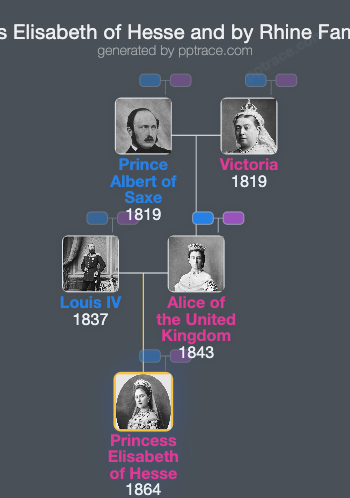
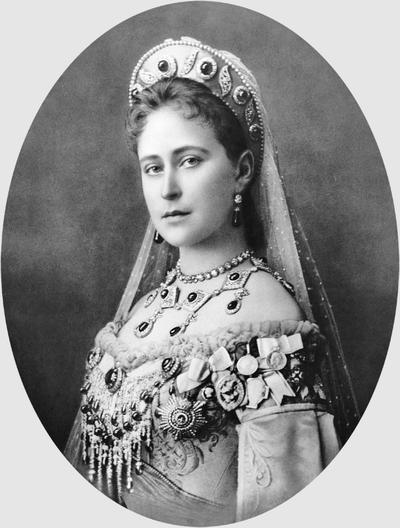
Princess Elisabeth of Hesse and by Rhine (1 November 1864 – 18 July 1918), later known as Grand Duchess Elizabeth Feodorovna of Russia, was a German princess belonging to the House of Hesse-Darmstadt. She was born in 1864 in Darmstadt, the second child of Ludwig IV, Grand Duke of Hesse and by Rhine, and Princess Alice of the United Kingdom, a daughter of Queen Victoria. She was the granddaughter of Queen Victoria and an older sister of Alexandra, the last Russian Empress.
Her full name at birth was Elisabeth Alexandra Luise Alix. She was christened on 28 November 1864, with her godparents including her grandmother, Princess Charles of Leiningen; her great-uncle, Emperor Alexander II of Russia; her maternal aunts, Princess Alix of Hesse and Princess Helena of the UK; and her uncles, Prince Alfred and Crown Prince Friedrich of Prussia. She was informally known among her family as Ella.
The upbringing of Elisabeth was simple, emphasizing modesty and charity, with her mother Princess Alice instilling in her and her siblings the importance of caring for the poor and participating in charitable activities. In 1873, her family experienced tragedy when her hemophiliac younger brother Friedrich died after falling from a window. Subsequently, in 1878, her family was devastated by the deaths of her sister Marie and her mother Alice due to illness.
Elisabeth was recognized for her striking beauty and became admired in European society. She attracted interest from several suitors, including Prince Wilhelm of Prussia, who expressed affection for her in 1875, and the future Frederick II, Grand Duke of Baden, who proposed marriage. Despite early resistance, she ultimately accepted the proposal of Grand Duke Sergei Alexandrovich of Russia, her first cousin once removed, in early 1884. They married on 15 June 1884 at the Winter Palace in Saint Petersburg, and Elisabeth converted from Lutheranism to Russian Orthodoxy, adopting the name Elizaveta Feodorovna.
As Grand Duchess of Russia, she settled in Saint Petersburg and later in Moscow, where her husband served as Governor-General of Moscow starting in 1892. Sergei's tenure was marked by strict nationalist policies, including the expulsion of Jews from Moscow. The couple was childless but fostered children, including Grand Duke Dmitry Pavlovich and Grand Duchess Maria Pavlovna.
The assassination of Sergei in 1905 by a Socialist Revolutionary bomb marked a turning point in her life. She publicly forgave her husband's assassin, Ivan Kalyayev, and campaigned unsuccessfully for his pardon. Following this event, Elisabeth withdrew from the imperial court and became a nun, founding the Marfo-Mariinsky Convent in Moscow, dedicating herself to charitable work among the poor. She sold her jewels and possessions, establishing hospitals and orphanages as part of her religious mission.
During the turbulent years of the February Revolution of 1917, Elisabeth maintained concern for her relatives, including her sister Alexandra, who was in exile with her family. She corresponded with her sister from Tobolsk amid political upheaval. After the Bolsheviks seized power and during the subsequent Russian Civil War, Elisabeth was arrested in 1918. She was executed by the Cheka on 18 July 1918 in Alapayevsk, being killed along with other prisoners in a mine shaft.
Canonized as a saint by the Russian Orthodox Church outside Russia in 1981 and by the Moscow Patriarchate in 1992, she is commemorated as a holy martyr. Her relics are enshrined at the Marfo-Mariinsky Convent and the Church of Mary Magdalene in Jerusalem. Her legacy endures through her religious veneration, the sites associated with her life, and her recognition as a saint in the Russian Orthodox tradition.