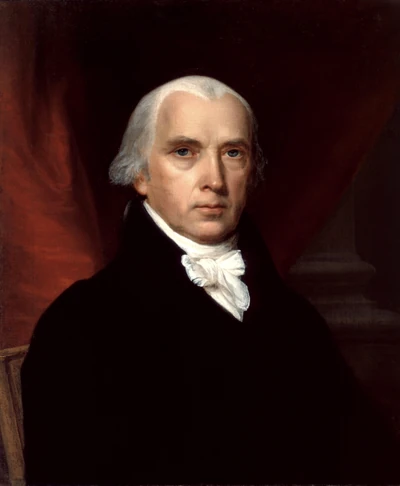
James Madison
| Name | James Madison |
| Title | President of the United States from 1809 to 1817 |
| Gender | Male |
| Birthday | 1751-03-16 |
| nationality | United States of America |
| Source | https://www.wikidata.org/wiki/Q11813 |
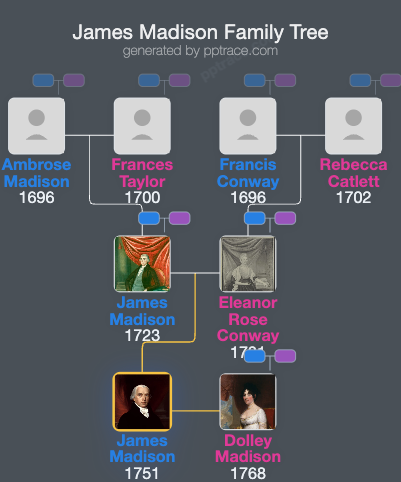
| pptrace | View Family Tree |
| LastUpdate | 2025-11-17T06:37:43.482Z |
Family Tree
Tap  to expand more relatives
Introduction
James Madison was born on March 16, 1751 (Old Style: March 5, 1750), at the Belle Grove plantation near Port Conway in the Colony of Virginia. His parents were James Madison Sr. and Eleanor Madison. His maternal grandfather, Francis Conway, was a prominent planter and tobacco merchant. Madison's family was among the largest landowners in Virginia's Piedmont, with an estimated 100 slaves and a 5,000-acre plantation called Mount Pleasant. The family moved to a newly constructed residence, Montpelier, in the early 1760s.
Madison was the oldest of twelve children, with only six surviving to adulthood: brothers Francis, Ambrose, and William, and sisters Nelly, Sarah, and Frances. Ambrose Madison assisted in managing Montpelier until his death in 1793. From ages 11 to 16, Madison studied under Donald Robertson, focusing on mathematics, geography, and languages, especially Latin. At age 16, he continued his education under Reverend Thomas Martin at Montpelier, preparing for college.
In 1769, Madison enrolled at the College of New Jersey (later Princeton University), where he studied Latin, Greek, theology, and Enlightenment philosophy. He was a prominent member of the American Whig–Cliosophic Society and graduated in 1771 after completing a three-year Bachelor of Arts in two years. He considered entering clergy or practicing law but pursued further studies in Hebrew and political philosophy at Princeton under college president John Witherspoon. Madison returned to Montpelier in early 1772.
During his youth, Madison was influenced by Enlightenment ideas and became engaged in discussions about civil and political liberty. He began reading law books in 1773 but never formally apprenticed as a lawyer. His intellectual development shaped his later contributions to American constitutional development.
Madison's early life coincided with the rising tensions between American colonists and British authorities, particularly following the 1765 Stamp Act. He aligned with Patriot sentiments and took a seat on the local Committee of Safety after returning to Montpelier in 1774. In October 1775, he was commissioned as a colonel of the Orange County militia, serving as second-in-command to his father until his election as a delegate to the Virginia Convention.
Madison participated in Virginia's efforts to establish a new state government amid the Revolutionary War. He was influential in modifying the Virginia Declaration of Rights during the constitutional convention, advocating for "equal entitlement" in religious exercise, which modified the original draft. He also contributed to drafting Virginia's first constitution and was elected to the Virginia House of Delegates.
Throughout the Revolution and the subsequent years, Madison emerged as a significant political figure. He opposed British taxation policies, supported colonial independence, and was involved in Virginia politics. His early career laid the groundwork for his later work in shaping the Federal Constitution and his role as a key architect of the United States government.
Madison married Dolley Payne Todd in 1794. They had one son, Payne Todd. Madison's health experienced episodes of mental exhaustion and nervousness, possibly related to epilepsy, but he remained active in public service. He served as a member of the Continental Congress, helped draft the U.S. Constitution, and became known as the "Father of the Constitution."
Madison was the fourth President of the United States, serving from 1809 to 1817. His presidency included the War of 1812, a conflict with Britain that resulted in an inconclusive end but increased national unity and strength. During his leadership, the United States expanded its territory by acquiring land through treaties and warfare, notably the Louisiana Purchase and land gained from Native American tribes. Madison retired from public office at the end of his second term and returned to his Montpelier estate, where he died on June 28, 1836.
He was a slave owner, freeing one slave in 1783 but did not free any through his will. Madison is recognized as a significant Founding Father, with numerous landmarks named in his honor, including Madison Square Garden, James Madison University, and the James Madison Memorial Building.