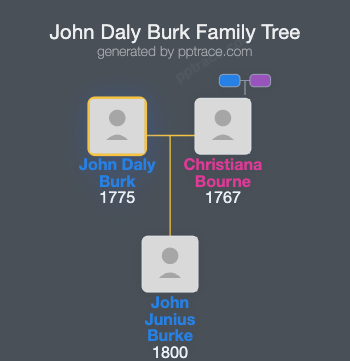
John Daly Burk
| Name | John Daly Burk |
| Title | Irish historian and writer |
| Gender | Male |
| Birthday | 1775-01-01 |
| nationality | United States of America |
| Source | https://www.wikidata.org/wiki/Q6228483 |
| pptrace | View Family Tree |
| LastUpdate | 2025-11-16T10:09:01.546Z |
Family Tree
Tap  to expand more relatives
Introduction
John Daly Burk (circa 1772 – 1808) was an Irish-born writer and historian who became active in the early United States. His birthplace is likely Cork, Ireland, where he was raised Protestant. Burk attended Trinity College in Dublin.
According to accounts, Burk attempted to aid a rebel scheduled for execution outside Trinity College Dublin. During this incident, he was pursued by police and managed to escape through a bookstore. Using garments obtained from Ms. Daly, a resident of the bookstore, he adopted the surname "Daly" and subsequently left Ireland aboard a ship bound for America.
In the United States, Burk engaged in journalism and theatrical endeavors. Around 1796, he served as editor of the "Polar Star," a newspaper based in Boston, Massachusetts. Later, he published "The Time-Piece" in New York. In 1798, he settled in Virginia, where he continued his literary work.
Burk's theatrical play "Bunker-Hill" premiered at the Haymarket Theatre in Boston in 1797. The play was about the Battle of Bunker Hill and was reportedly well received by audiences sympathetic to the American patriotic cause. However, critics like J.T. Buckingham described the play as lacking substantial merit, criticizing its simplicity and lack of poetic quality. President John Adams viewed the play in New York, and upon being asked his opinion by actor Giles Leonard Barrett, who portrayed General Warren, Adams remarked that Warren was a scholar and gentleman, but Burk's portrayal turned him into a "bully and a blackguard."
Among Burk's literary works are "History of the Late War in Ireland" (1799), "History of Virginia" (1804), and various plays including "Bethlem Gabor, Lord of Transylvania," "Female Patriotism, or The Death of Joan d'Arc," and "Bunker Hill." He also corresponded with Thomas Jefferson in 1801.
Burk died in 1808, reportedly in a duel in Virginia. His life and works have been documented in various biographical and literary sources, including the "William and Mary Quarterly" and the "Virginia Magazine of History and Biography."
His contributions to American historical and theatrical literature remain part of the early cultural history of the United States.